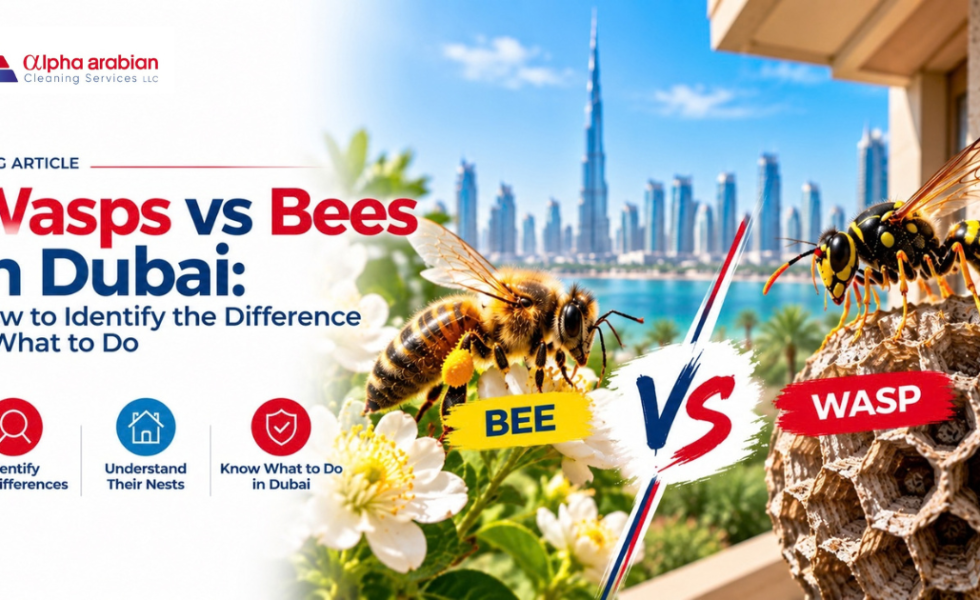
Wasps vs Bees in Dubai: How to Identify the Difference & What to Do
Wasps vs Bees in Dubai: How to Identify the Difference & What to Do
Wasps and bees are not the same, and identifying them correctly matters before attempting any type of removal. Bees generally have hairier, more robust bodies and play an important role as pollinators, while many wasps have smoother bodies, narrower waists and different nesting behaviour.
If you find a flying insect nest around your villa, balcony, garden or commercial property in Dubai, avoid disturbing it until you know whether you’re dealing with bees or wasps.
The appropriate response can be very different. A suspected wasp nest may require professional wasp control in Dubai, while a honey-bee colony may require assessment for bee hive removal in Dubai and, where appropriate and feasible, possible relocation.
This guide explains the differences between wasps and bees, how their nests differ, why they may appear around Dubai properties, what to do when you find them and when professional assistance may be appropriate.
What Is the Main Difference Between Wasps and Bees?
The easiest visible difference between many bees and wasps is their body structure.
Bees generally appear hairier and more robust, while many wasps have smoother bodies with a more noticeable narrow waist.
However, appearance varies between species, so colour alone should not be used for identification.
Some wasps and bees can look similar, particularly when they are flying. If there is an active nest, you should not move closer simply to identify the insect.
Wasps vs Bees: Quick Comparison
| Feature | Bees | Wasps |
|---|---|---|
| Body | Often hairier and more robust | Often smoother with a narrower waist |
| Role | Important pollinators | Many species are predators of other insects and may also visit food sources |
| Nest | Honey bees construct wax comb | Many social wasps construct paper-like nests |
| Food attraction | Often associated with flowers, nectar and pollen | Some species may be attracted to sweet foods, waste or other insects |
| Behaviour around nest | May defend an established colony if threatened | Some social wasps may strongly defend their nest when disturbed |
| Recommended response | Identify and assess before removal; relocation may sometimes be considered | Avoid disturbing an active nest and arrange appropriate assessment/control where necessary |
How Can You Identify a Bee?
Many bees have relatively rounded bodies covered with visible hairs. These hairs help collect pollen while bees move between flowers.
Depending on the species, bees may appear yellow, brown, black, golden or a combination of these colours.
You may notice bees:
- Visiting flowering plants
- Moving between garden areas
- Collecting pollen
- Gathering temporarily in a large cluster
- Repeatedly entering and leaving a particular structural opening
A few bees visiting flowers usually does not mean you have a bee hive on your property.
However, repeated activity concentrated around one opening, roof space, wall cavity or other sheltered location can indicate that a colony may be present.
How Can You Identify a Wasp?
Many wasps have a smoother and more slender appearance than bees.
A narrow waist between the thorax and abdomen is another common characteristic of many wasp species.
Depending on the species, wasps may be seen around:
- Building eaves
- Balconies
- Gardens
- Outdoor dining areas
- Waste areas
- Roof structures
- Wall openings
- Sheltered external structures
Some wasps also hunt other insects, while others may investigate sweet food, drinks or waste.
If wasps repeatedly travel to and from one particular location, there may be a nest nearby.
What Does a Bee Hive Look Like?
Honey bees construct wax comb made up of hexagonal cells.
An exposed colony may make this structure relatively easy to recognise, but colonies can also establish themselves inside protected cavities where the comb cannot be seen from outside.
In those situations, you may only notice bees repeatedly entering and leaving through a small opening.
Potential nesting locations around a property can include:
- Wall cavities
- Roof spaces
- Building gaps
- Balcony structures
- Trees
- Garden structures
- Other protected cavities
If you’ve discovered a suspected colony, see our guide to bee hive removal in Dubai for more information about identifying swarms and established hives.
What Does a Wasp Nest Look Like?
Many social wasps build nests using material created from chewed plant or wood fibres.
This can give the nest a grey, brown or paper-like appearance.
The exact structure varies considerably between species.
Wasps may establish nests in protected areas such as:
- Under roof edges
- Around eaves
- Balconies
- Sheds
- Garden structures
- Wall cavities
- External building gaps
If you’ve found a suspected nest, avoid touching, knocking or spraying it without first understanding what you’re dealing with.
Our guide to wasp control in Dubai explains how to recognise common warning signs and what to do when a nest is discovered.
Bee Hive vs Wasp Nest: How Can You Tell the Difference?
The material used to construct the nest is one of the clearest differences.
Honey bees produce wax comb with recognisable hexagonal cells. Many social wasps, by comparison, construct nests from a paper-like material.
However, you may not always be able to see the nest.
If insects are disappearing through a small opening in a wall, roof or other structure, identification may require observing their appearance and behaviour from a safe distance.
Do not put yourself at risk by approaching an active nest simply to determine which insect is present.
Why Are Bees Coming to My Dubai Property?
Seeing bees around your property does not necessarily indicate a pest problem.
Bees may simply be visiting flowering plants for nectar and pollen.
However, larger numbers may sometimes appear when bees are swarming or searching for a suitable nesting location.
A temporary swarm can form when a group of honey bees leaves an established colony and searches for a new home.
During this process, bees may temporarily gather on:
- Trees
- Walls
- Balcony structures
- Fences
- Other sheltered surfaces
A swarm should not automatically be treated as an established hive.
Why Are Wasps Coming to My Dubai Property?
Wasps may visit a property for several reasons.
Depending on the species, they may be searching for food, water, other insects or a protected nesting location.
Outdoor areas containing food and waste can sometimes attract wasps.
Suitable sheltered building features can also provide potential nesting locations.
Repeated wasp activity concentrated around one particular area is more significant than an occasional wasp flying through a garden.
Are Wasps More Dangerous Than Bees?
It isn’t useful to assume that every wasp is dangerous or every bee is harmless.
Both bees and wasps can sting when threatened, particularly when an established colony or nest is disturbed.
The level of risk depends on the species, circumstances, nest location and proximity to people.
A nest beside a frequently used doorway, balcony, children’s play area or outdoor seating area can create a greater chance of accidental disturbance.
People with known severe insect-sting allergies should be particularly cautious around active bee or wasp colonies.
If someone develops symptoms of a severe allergic reaction after a sting—such as difficulty breathing, swelling of the face or throat, dizziness or collapse—seek emergency medical assistance immediately.
Do Bees and Wasps Sting Differently?
Stinging behaviour varies by species.
A commonly discussed difference is that a worker honey bee may leave its barbed stinger behind after stinging a person, whereas many wasps can sting more than once.
However, you should not rely on this distinction when deciding whether it is safe to approach a nest.
The safest approach is to avoid disturbing either insect when significant nest activity is present.
What Should You Do If You Find a Bee or Wasp Nest?
If you discover an active nest, the first priority is simple:
Keep a safe distance and don’t disturb it.
You should also:
- Keep children away from the area
- Keep pets away from the nest
- Avoid hitting or shaking it
- Avoid blocking an active entrance
- Don’t attempt to knock the nest down
- Avoid uncontrolled DIY spraying
- Observe activity only from a safe distance
If possible, safely note where the insects are entering and leaving.
A photograph taken from an appropriate distance may also help with initial identification.
Should You Spray a Bee Hive or Wasp Nest?
Do not automatically spray a nest simply because flying insects are present.
There are two important reasons.
First, disturbing an active colony can provoke defensive behaviour and increase the risk of stings.
Second, you may not have correctly identified the insect.
Bees and wasps should not automatically receive identical treatment.
Correct identification should come before deciding on an appropriate removal or control method.
Can You Remove a Bee or Wasp Nest Yourself?
DIY removal can be risky, particularly when the nest is active, elevated, concealed or located close to frequently occupied areas.
Professional assessment becomes more appropriate when:
- The nest is above head height
- A ladder would be required
- The colony is inside a wall or roof
- Large numbers of insects are present
- The nest is beside an entrance
- Children or pets regularly use the area
- The insect cannot be confidently identified
- Someone nearby has a known severe sting allergy
The objective should not simply be to remove something that looks like a nest. The insect, colony location and surrounding conditions should first be understood.
What Is the Difference Between Bee Removal and Wasp Control?
The appropriate management approach can differ considerably.
Bees are important pollinators, and where circumstances, species, accessibility and practical conditions allow, removal or relocation may sometimes be considered.
Not every bee colony can necessarily be relocated, particularly when it is deeply established inside an inaccessible structural cavity.
Wasp management generally focuses on assessing the nest, the species involved, its location and the risk it presents before selecting an appropriate control approach.
This is why professional identification should happen before treatment rather than after it.
Wasps and Bees Around Dubai Villas
Villas can provide numerous locations where bees or wasps may temporarily gather or establish nests.
These can include:
- Gardens
- Trees
- Roof edges
- Balconies
- External storage areas
- Wall openings
- Garden structures
- Utility areas
Regularly checking less-used external areas can help identify developing activity before a nest becomes difficult to access.
If insects repeatedly travel to the same location, avoid sealing the opening until the activity has been properly assessed.
Wasps and Bees Around Apartments
Apartment residents may notice bee or wasp activity around balconies, windows, external AC areas or building openings.
An occasional flying insect does not necessarily indicate a nearby nest.
Repeated traffic to the same structural location is more important.
Because some nesting areas may be outside an individual apartment or within shared building structures, building management may also need to be involved depending on the location.
Wasps and Bees Around Restaurants and Commercial Properties
Restaurants, cafés, hotels and other commercial premises can experience flying-insect activity around outdoor areas, landscaping, waste zones and food-service locations.
The first step should still be correct identification.
A bee swarm resting temporarily outside a property should not automatically be treated as though it were an established wasp nest.
Where activity creates a potential risk for customers, employees or visitors, professional assessment can help determine the appropriate response.
How Can You Reduce the Risk of Wasps Nesting Around Your Property?
It isn’t possible to prevent every flying insect from entering an outdoor space, but maintaining the property can reduce some nesting opportunities.
Consider:
- Inspecting roof edges and external structures
- Maintaining balconies and storage areas
- Managing waste properly
- Cleaning food residue from outdoor dining areas
- Checking rarely used exterior spaces
- Repairing suitable structural gaps after confirming they are inactive
Never seal an opening that is actively being used by bees or wasps without first determining what is inside.
When Should You Call a Pest Control Professional?
Professional assistance should be considered when there is an established or suspected nest, large numbers of insects, recurring activity, a concealed colony or uncertainty about whether the insects are bees or wasps.
This is particularly important when the activity occurs close to people.
If you’re experiencing other pest problems around the property as well, professional pest control services in Dubai can help identify the pest and determine an appropriate management approach.
Professional Wasp and Bee Assessment in Dubai
The most important step when you discover a bee hive or wasp nest is correct identification.
A temporary bee swarm, established honey-bee colony and active wasp nest are different situations and should not automatically receive the same treatment.
Alpha Arabian Cleaning Services LLC provides professional pest-management services across Dubai for villas, apartments and commercial properties.
If you’ve discovered an active nest or recurring bee or wasp activity, professional assessment can help identify the insect, locate the nesting area and determine an appropriate course of action.
Not sure whether you have bees or wasps? Contact Alpha Arabian for professional identification and pest-management assistance in Dubai.
Frequently Asked Questions About Wasps vs Bees in Dubai
How can I quickly tell a bee from a wasp?
Many bees have hairier, more robust bodies, while many wasps appear smoother and have a narrower waist. However, appearance varies between species, so professional identification may be necessary when a nest is present.
How can I tell a bee hive from a wasp nest?
Honey bees construct wax comb with hexagonal cells. Many social wasps construct nests from a grey or brown paper-like material. Concealed nests may be difficult to identify without observing insect activity.
Why are bees suddenly gathering outside my house?
A large temporary cluster may be a bee swarm searching for a new nesting location. It does not necessarily mean an established hive is already present.
Why do wasps keep returning to the same area?
Repeated activity may indicate access to food, water, prey or a nearby nesting site. Wasps repeatedly entering the same structural opening can indicate a nest nearby.
Should I spray a bee or wasp nest?
Do not automatically spray an active nest. Disturbance can increase the risk of stings, and the insect should be correctly identified before deciding on an appropriate management approach.
Can bees and wasps build nests inside walls?
Depending on the species, both may use protected structural cavities. Repeated insects entering and leaving the same opening can be an important sign of nesting activity.
Should I block the hole they’re entering?
Not while the opening is actively being used. Blocking an entrance without addressing the colony can create additional problems and may cause insects to seek another route.
Are all bees and wasps aggressive?
No. Behaviour varies by species and situation. However, both bees and wasps may defend an established colony or nest when they perceive a threat.
Can a bee hive be relocated?
Relocation may be possible in some circumstances depending on the species, colony location, accessibility and practical conditions. It is not feasible for every colony.
Who should I call if I don’t know whether I have bees or wasps?
Contact an appropriately qualified pest-management or bee-removal professional who can identify the insect and assess the nesting location before recommending a response.