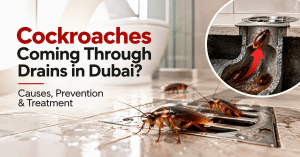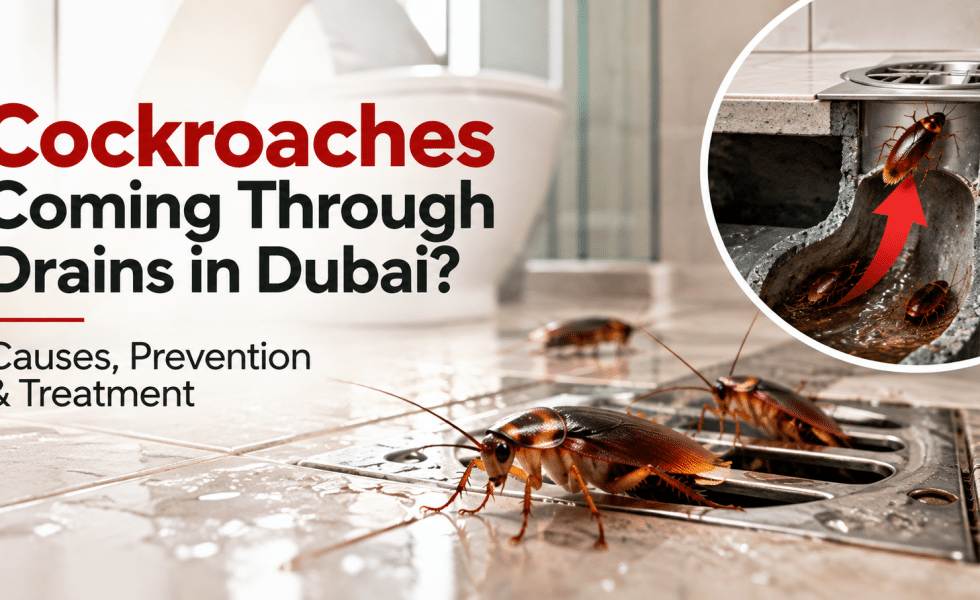
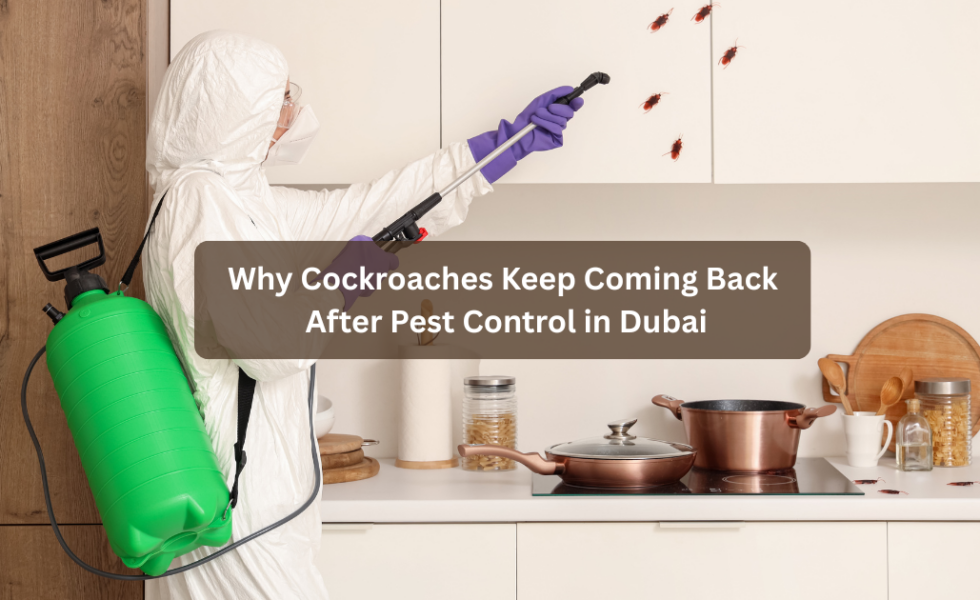

Cockroaches Coming Through Drains in Dubai? Causes, Prevention & Treatment.
Cockroaches Coming Through Drains in Dubai? Causes, Prevention & Treatment
You walk into the bathroom or kitchen at night and suddenly notice a large cockroach near the floor drain. You remove it, clean the area and assume the problem is solved—only to find another one a few days later.
If this keeps happening, you may naturally wonder: are cockroaches coming through the drains?
In some Dubai properties, drainage systems, manholes, pipe openings and other damp environments can be associated with cockroach activity. However, seeing a cockroach beside a drain does not automatically prove that it came directly through the drain opening.
The key is identifying where the cockroaches are actually coming from before deciding how to treat the problem.
Can Cockroaches Really Come Through Drains?
Yes, cockroaches can sometimes move through drainage-related environments and enter properties through accessible openings or gaps around plumbing systems.
Certain cockroaches are well adapted to dark, humid environments where water and organic material may be available. Drainage areas, sewer systems, manholes and utility spaces can therefore provide suitable conditions for cockroach activity.
But the drain itself is only one possibility.
A cockroach found near a bathroom drain may also have entered through a gap around a pipe, an opening beneath a door, a service shaft, a wall cavity or another structural route.
This is why repeated activity requires investigation rather than assuming every cockroach near a drain has travelled directly through the pipe.
Why Are Cockroaches Attracted to Drainage Areas?
Cockroaches generally look for three basic things: food, water and shelter.
Drainage environments can sometimes provide several of these conditions at once.
Potential attractions include:
- Moisture and standing water
- Organic residue
- Dark and protected spaces
- Cracks and gaps around plumbing
- Connections to external drainage environments
- Nearby waste or food residue
In Dubai’s warm climate, suitable protected environments can support pest activity throughout much of the year.
What Type of Cockroach Is Commonly Found Around Drains?
Large cockroaches found around drains, bathrooms, utility areas and manholes may sometimes be American cockroaches.
American cockroaches are much larger than German cockroaches and are generally reddish-brown in appearance.
They may be associated with:
- Drainage systems
- Manholes
- Sewer environments
- Utility rooms
- Basements
- Garbage and waste areas
- Damp external spaces
By comparison, the small cockroaches commonly found inside kitchen cabinets and around appliances are often German cockroaches.
Correct identification matters because a kitchen infestation involving German cockroaches may require a different treatment strategy from large cockroaches associated with drainage or external environments.
Why Do Cockroaches Come Through Bathroom Drains?
Bathrooms contain several features that can attract or provide access for cockroaches.
There is regular moisture, multiple plumbing connections and often several concealed structural openings.
If you repeatedly notice cockroaches around a bathroom, check areas such as:
- Floor drains
- Sink plumbing
- Pipe penetrations
- Gaps around sanitary fittings
- Utility openings
- Areas beneath cabinets
- Door gaps
Remember that finding a cockroach beside a floor drain doesn’t necessarily identify the drain as the exact entry point.
Why Are Cockroaches Appearing From Kitchen Drains?
Kitchens provide even more potential attractions because food and water are often available in the same area.
Food residue around sinks, moisture beneath cabinets, leaking plumbing, waste bins and grease or organic material can all contribute to pest activity.
If cockroaches repeatedly appear around the kitchen sink or drainage area, the problem may involve both an accessible entry route and favourable conditions inside the kitchen.
Cleaning the drain while ignoring food residue, plumbing gaps or nearby harbourage may therefore fail to solve the underlying problem.
Does Seeing One Cockroach Near a Drain Mean You Have an Infestation?
Not necessarily.
An occasional large cockroach may enter a property from an external environment without establishing an indoor infestation.
However, repeated sightings deserve attention.
Possible warning signs include:
- Large cockroaches appearing regularly at night
- Repeated sightings in the same bathroom or kitchen
- Cockroaches appearing around several drains
- Activity around manholes or external drainage areas
- Cockroaches emerging from plumbing or structural gaps
- Multiple cockroaches appearing over a short period
If the problem continues despite cleaning and basic prevention, professional inspection can help identify the source.
How Do You Stop Cockroaches Coming Through Drains?
There is no single solution that works for every drainage-related cockroach problem because the actual entry route can vary.
A more effective approach is to combine inspection, sanitation, entry-point management and appropriate pest-control treatment.
1. Keep Drain Areas Clean
Regular cleaning can reduce organic residue that may attract pests.
Kitchen sinks and surrounding surfaces should be kept free from food debris, grease and standing water wherever practical.
2. Check for Water Leaks
Inspect areas under sinks, around plumbing and inside cabinets for leaks or persistent moisture.
Even small water sources can create favourable conditions for cockroaches.
3. Inspect Gaps Around Pipes
Plumbing penetrations can leave small openings between pipes, cabinets, walls and floors.
These gaps may provide pest entry routes even when the actual drain opening is not responsible.
Once active pest issues have been assessed, suitable gaps can be sealed where appropriate.
4. Check External Drainage Areas
For villas and ground-floor properties, external drainage areas and manholes may also need attention.
If large numbers of cockroaches are active outside the property, repeatedly treating only the bathroom or kitchen may provide limited results.
5. Use Appropriate Drain Covers Where Suitable
Properly fitting drain covers can help reduce access through certain openings when appropriate for the drainage system.
However, covers alone will not solve activity originating from pipe gaps, structural openings or other parts of the property.
Should You Pour Insecticide Down the Drain?
Pouring household insecticide or other chemicals into a drain is not a good general solution.
The product may not reach the actual cockroach harbourage, and using chemicals in ways that are inconsistent with their instructions can create unnecessary risks.
Drainage-related infestations should instead be assessed so that treatment can be directed toward the actual areas of activity using products and methods appropriate for the situation.
Why Does Spraying the Bathroom Not Stop the Cockroaches?
If the cockroaches originate from a drainage system, external environment, manhole or concealed entry point, spraying visible bathroom surfaces may kill individual cockroaches without addressing the source.
This can create a cycle:
Cockroach appears → spray is applied → cockroach disappears → another cockroach appears later.
The problem continues because only the visible insect is being treated.
Professional cockroach control in Dubai should therefore investigate where the activity originates and which conditions are allowing cockroaches to enter the property.
Cockroaches Coming Through Drains in Dubai Apartments
Apartments can present additional challenges because plumbing, service ducts and other building systems may connect multiple areas of the property.
A cockroach problem may not always originate entirely within one apartment.
Potential pathways can include:
- Shared plumbing routes
- Service shafts
- Structural gaps
- Common drainage systems
- Utility areas
- Neighbouring units or shared spaces
If drainage-related cockroach activity repeatedly returns despite treatment inside the apartment, the broader building environment may need to be considered.
Cockroaches Coming Through Drains in Dubai Villas
Villas can have a different set of risk factors.
External drainage points, gardens, waste areas, utility spaces and manholes around the property can contribute to cockroach activity.
Large cockroaches found inside a villa may sometimes originate outdoors and enter through gaps, doors, drainage-related areas or other openings.
Inspection should therefore consider both the interior and relevant external areas rather than focusing exclusively on the room where the cockroach was found.
What About Restaurants and Commercial Kitchens?
Drainage-related cockroach activity can be particularly concerning in restaurants, cafés, food-preparation facilities and commercial kitchens.
These environments can provide food, moisture, warmth and multiple potential harbourage areas.
Effective control may require attention to:
- Floor drains
- Sink and plumbing areas
- Grease and food residue
- Waste-storage areas
- Equipment and appliances
- Structural gaps
- External drainage and service areas
Good sanitation and professional pest management should work together rather than being treated as separate issues.
How Does Professional Drain Cockroach Treatment Work?
The first step should be inspection.
A pest-control professional can assess where cockroaches are being seen, identify likely cockroach species and investigate potential harbourage and entry routes.
Depending on the findings, treatment may involve targeted pest-control measures around relevant areas, together with recommendations for sanitation, moisture management and entry-point reduction.
The exact treatment should depend on the property and infestation rather than applying the same method to every drain.
How Can You Reduce Drain-Related Cockroach Problems?
Prevention should focus on making the property less accessible and less attractive to cockroaches.
- Keep kitchens and bathrooms clean and dry where practical
- Remove food residue promptly
- Clean waste bins regularly
- Repair plumbing leaks
- Inspect gaps around pipes and fixtures
- Use suitable drain covers where appropriate
- Monitor external drainage and manhole areas
- Address recurring activity rather than repeatedly killing individual cockroaches
These measures can reduce risk, but established or recurring activity may still require professional treatment.
When Should You Call a Cockroach Control Professional?
Consider arranging professional inspection when:
- Cockroaches repeatedly appear from or around drains
- You see large cockroaches several times per week
- Several bathrooms or drainage areas are affected
- DIY sprays provide only temporary results
- Activity appears to originate from manholes or external drains
- Cockroaches are affecting a restaurant or commercial property
- You cannot identify where the cockroaches are entering
Finding the source can be more important than simply treating the location where the cockroach was last seen.
Professional Cockroach Control in Dubai
If cockroaches keep appearing around your drains, bathroom or kitchen, don’t assume that repeatedly spraying the visible insects will solve the problem.
The source may involve drainage areas, plumbing gaps, structural openings, external environments or other hidden harbourage.
Alpha Arabian Cleaning Services LLC provides professional cockroach control in Dubai for apartments, villas, restaurants and commercial properties.
Our approach focuses on inspecting the property, identifying likely cockroach activity and applying an appropriate treatment strategy based on the conditions found.
Contact Alpha Arabian today to arrange professional cockroach inspection and treatment in Dubai.
Frequently Asked Questions
Can cockroaches come up through bathroom drains?
Cockroaches can sometimes move through drainage-related environments and accessible openings. However, a cockroach found near a bathroom drain may also have entered through plumbing gaps, service areas or other structural openings.
Why do I see cockroaches in my bathroom at night?
Cockroaches are generally more active at night. Bathrooms can provide moisture, shelter and potential access through plumbing or structural openings, making them common areas for sightings.
What type of cockroach comes from drains?
Large cockroaches associated with drainage environments may sometimes be American cockroaches. Proper identification is recommended because different cockroach species can require different treatment approaches.
Will covering my drain stop cockroaches?
A suitable drain cover may reduce access through a particular opening, but it will not prevent cockroaches entering through gaps around pipes, doors, service shafts or other structural routes.
Does bleach kill cockroaches in drains?
Household drain-cleaning products should be used only for their intended purpose and according to their instructions. They should not be relied upon as a complete cockroach-control strategy because they may not address the actual harbourage or entry route.
Why do cockroaches keep returning after I spray them?
Spraying may kill the cockroaches you can see without treating insects or harbourage in drainage systems, structural gaps or other concealed locations. Identifying the source is important when activity repeatedly returns.
Do I need pest control if I only see one cockroach?
One occasional cockroach does not necessarily indicate an established indoor infestation. However, repeated sightings, multiple cockroaches or recurring activity around the same drain or room should be investigated.
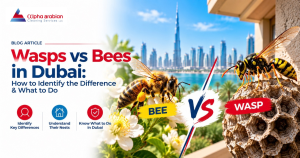
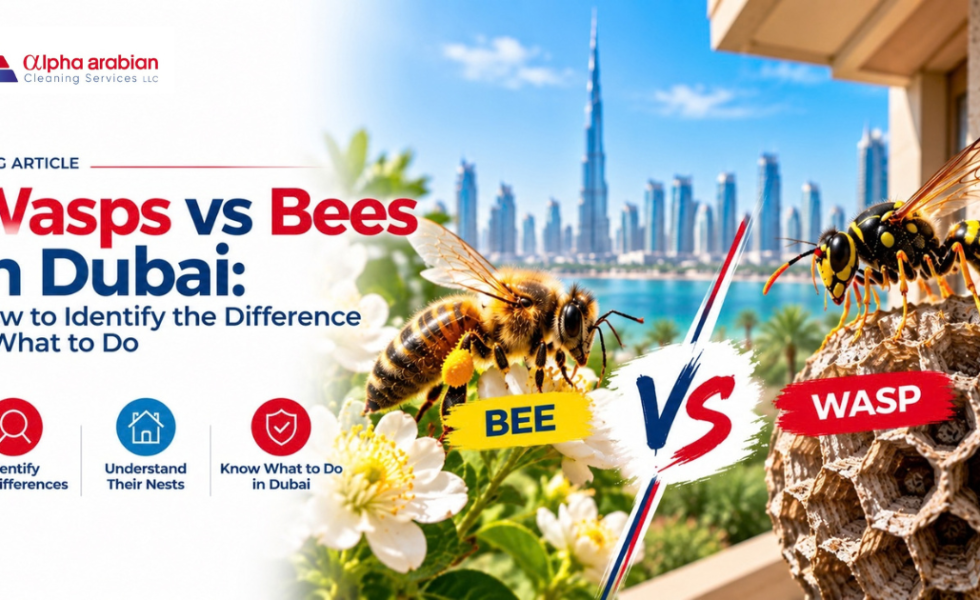
Wasps vs Bees in Dubai: How to Identify the Difference & What to Do
Wasps and bees are not the same, and identifying them correctly matters before attempting any type of removal. Bees generally have hairier, more robust bodies and play an important role as pollinators, while many wasps have smoother bodies, narrower waists and different nesting behaviour.
If you find a flying insect nest around your villa, balcony, garden or commercial property in Dubai, avoid disturbing it until you know whether you’re dealing with bees or wasps.
The appropriate response can be very different. A suspected wasp nest may require professional wasp control in Dubai, while a honey-bee colony may require assessment for bee hive removal in Dubai and, where appropriate and feasible, possible relocation.
This guide explains the differences between wasps and bees, how their nests differ, why they may appear around Dubai properties, what to do when you find them and when professional assistance may be appropriate.
What Is the Main Difference Between Wasps and Bees?
The easiest visible difference between many bees and wasps is their body structure.
Bees generally appear hairier and more robust, while many wasps have smoother bodies with a more noticeable narrow waist.
However, appearance varies between species, so colour alone should not be used for identification.
Some wasps and bees can look similar, particularly when they are flying. If there is an active nest, you should not move closer simply to identify the insect.
Wasps vs Bees: Quick Comparison
| Feature | Bees | Wasps |
|---|---|---|
| Body | Often hairier and more robust | Often smoother with a narrower waist |
| Role | Important pollinators | Many species are predators of other insects and may also visit food sources |
| Nest | Honey bees construct wax comb | Many social wasps construct paper-like nests |
| Food attraction | Often associated with flowers, nectar and pollen | Some species may be attracted to sweet foods, waste or other insects |
| Behaviour around nest | May defend an established colony if threatened | Some social wasps may strongly defend their nest when disturbed |
| Recommended response | Identify and assess before removal; relocation may sometimes be considered | Avoid disturbing an active nest and arrange appropriate assessment/control where necessary |
How Can You Identify a Bee?
Many bees have relatively rounded bodies covered with visible hairs. These hairs help collect pollen while bees move between flowers.
Depending on the species, bees may appear yellow, brown, black, golden or a combination of these colours.
You may notice bees:
- Visiting flowering plants
- Moving between garden areas
- Collecting pollen
- Gathering temporarily in a large cluster
- Repeatedly entering and leaving a particular structural opening
A few bees visiting flowers usually does not mean you have a bee hive on your property.
However, repeated activity concentrated around one opening, roof space, wall cavity or other sheltered location can indicate that a colony may be present.
How Can You Identify a Wasp?
Many wasps have a smoother and more slender appearance than bees.
A narrow waist between the thorax and abdomen is another common characteristic of many wasp species.
Depending on the species, wasps may be seen around:
- Building eaves
- Balconies
- Gardens
- Outdoor dining areas
- Waste areas
- Roof structures
- Wall openings
- Sheltered external structures
Some wasps also hunt other insects, while others may investigate sweet food, drinks or waste.
If wasps repeatedly travel to and from one particular location, there may be a nest nearby.
What Does a Bee Hive Look Like?
Honey bees construct wax comb made up of hexagonal cells.
An exposed colony may make this structure relatively easy to recognise, but colonies can also establish themselves inside protected cavities where the comb cannot be seen from outside.
In those situations, you may only notice bees repeatedly entering and leaving through a small opening.
Potential nesting locations around a property can include:
- Wall cavities
- Roof spaces
- Building gaps
- Balcony structures
- Trees
- Garden structures
- Other protected cavities
If you’ve discovered a suspected colony, see our guide to bee hive removal in Dubai for more information about identifying swarms and established hives.
What Does a Wasp Nest Look Like?
Many social wasps build nests using material created from chewed plant or wood fibres.
This can give the nest a grey, brown or paper-like appearance.
The exact structure varies considerably between species.
Wasps may establish nests in protected areas such as:
- Under roof edges
- Around eaves
- Balconies
- Sheds
- Garden structures
- Wall cavities
- External building gaps
If you’ve found a suspected nest, avoid touching, knocking or spraying it without first understanding what you’re dealing with.
Our guide to wasp control in Dubai explains how to recognise common warning signs and what to do when a nest is discovered.
Bee Hive vs Wasp Nest: How Can You Tell the Difference?
The material used to construct the nest is one of the clearest differences.
Honey bees produce wax comb with recognisable hexagonal cells. Many social wasps, by comparison, construct nests from a paper-like material.
However, you may not always be able to see the nest.
If insects are disappearing through a small opening in a wall, roof or other structure, identification may require observing their appearance and behaviour from a safe distance.
Do not put yourself at risk by approaching an active nest simply to determine which insect is present.
Why Are Bees Coming to My Dubai Property?
Seeing bees around your property does not necessarily indicate a pest problem.
Bees may simply be visiting flowering plants for nectar and pollen.
However, larger numbers may sometimes appear when bees are swarming or searching for a suitable nesting location.
A temporary swarm can form when a group of honey bees leaves an established colony and searches for a new home.
During this process, bees may temporarily gather on:
- Trees
- Walls
- Balcony structures
- Fences
- Other sheltered surfaces
A swarm should not automatically be treated as an established hive.
Why Are Wasps Coming to My Dubai Property?
Wasps may visit a property for several reasons.
Depending on the species, they may be searching for food, water, other insects or a protected nesting location.
Outdoor areas containing food and waste can sometimes attract wasps.
Suitable sheltered building features can also provide potential nesting locations.
Repeated wasp activity concentrated around one particular area is more significant than an occasional wasp flying through a garden.
Are Wasps More Dangerous Than Bees?
It isn’t useful to assume that every wasp is dangerous or every bee is harmless.
Both bees and wasps can sting when threatened, particularly when an established colony or nest is disturbed.
The level of risk depends on the species, circumstances, nest location and proximity to people.
A nest beside a frequently used doorway, balcony, children’s play area or outdoor seating area can create a greater chance of accidental disturbance.
People with known severe insect-sting allergies should be particularly cautious around active bee or wasp colonies.
If someone develops symptoms of a severe allergic reaction after a sting—such as difficulty breathing, swelling of the face or throat, dizziness or collapse—seek emergency medical assistance immediately.
Do Bees and Wasps Sting Differently?
Stinging behaviour varies by species.
A commonly discussed difference is that a worker honey bee may leave its barbed stinger behind after stinging a person, whereas many wasps can sting more than once.
However, you should not rely on this distinction when deciding whether it is safe to approach a nest.
The safest approach is to avoid disturbing either insect when significant nest activity is present.
What Should You Do If You Find a Bee or Wasp Nest?
If you discover an active nest, the first priority is simple:
Keep a safe distance and don’t disturb it.
You should also:
- Keep children away from the area
- Keep pets away from the nest
- Avoid hitting or shaking it
- Avoid blocking an active entrance
- Don’t attempt to knock the nest down
- Avoid uncontrolled DIY spraying
- Observe activity only from a safe distance
If possible, safely note where the insects are entering and leaving.
A photograph taken from an appropriate distance may also help with initial identification.
Should You Spray a Bee Hive or Wasp Nest?
Do not automatically spray a nest simply because flying insects are present.
There are two important reasons.
First, disturbing an active colony can provoke defensive behaviour and increase the risk of stings.
Second, you may not have correctly identified the insect.
Bees and wasps should not automatically receive identical treatment.
Correct identification should come before deciding on an appropriate removal or control method.
Can You Remove a Bee or Wasp Nest Yourself?
DIY removal can be risky, particularly when the nest is active, elevated, concealed or located close to frequently occupied areas.
Professional assessment becomes more appropriate when:
- The nest is above head height
- A ladder would be required
- The colony is inside a wall or roof
- Large numbers of insects are present
- The nest is beside an entrance
- Children or pets regularly use the area
- The insect cannot be confidently identified
- Someone nearby has a known severe sting allergy
The objective should not simply be to remove something that looks like a nest. The insect, colony location and surrounding conditions should first be understood.
What Is the Difference Between Bee Removal and Wasp Control?
The appropriate management approach can differ considerably.
Bees are important pollinators, and where circumstances, species, accessibility and practical conditions allow, removal or relocation may sometimes be considered.
Not every bee colony can necessarily be relocated, particularly when it is deeply established inside an inaccessible structural cavity.
Wasp management generally focuses on assessing the nest, the species involved, its location and the risk it presents before selecting an appropriate control approach.
This is why professional identification should happen before treatment rather than after it.
Wasps and Bees Around Dubai Villas
Villas can provide numerous locations where bees or wasps may temporarily gather or establish nests.
These can include:
- Gardens
- Trees
- Roof edges
- Balconies
- External storage areas
- Wall openings
- Garden structures
- Utility areas
Regularly checking less-used external areas can help identify developing activity before a nest becomes difficult to access.
If insects repeatedly travel to the same location, avoid sealing the opening until the activity has been properly assessed.
Wasps and Bees Around Apartments
Apartment residents may notice bee or wasp activity around balconies, windows, external AC areas or building openings.
An occasional flying insect does not necessarily indicate a nearby nest.
Repeated traffic to the same structural location is more important.
Because some nesting areas may be outside an individual apartment or within shared building structures, building management may also need to be involved depending on the location.
Wasps and Bees Around Restaurants and Commercial Properties
Restaurants, cafés, hotels and other commercial premises can experience flying-insect activity around outdoor areas, landscaping, waste zones and food-service locations.
The first step should still be correct identification.
A bee swarm resting temporarily outside a property should not automatically be treated as though it were an established wasp nest.
Where activity creates a potential risk for customers, employees or visitors, professional assessment can help determine the appropriate response.
How Can You Reduce the Risk of Wasps Nesting Around Your Property?
It isn’t possible to prevent every flying insect from entering an outdoor space, but maintaining the property can reduce some nesting opportunities.
Consider:
- Inspecting roof edges and external structures
- Maintaining balconies and storage areas
- Managing waste properly
- Cleaning food residue from outdoor dining areas
- Checking rarely used exterior spaces
- Repairing suitable structural gaps after confirming they are inactive
Never seal an opening that is actively being used by bees or wasps without first determining what is inside.
When Should You Call a Pest Control Professional?
Professional assistance should be considered when there is an established or suspected nest, large numbers of insects, recurring activity, a concealed colony or uncertainty about whether the insects are bees or wasps.
This is particularly important when the activity occurs close to people.
If you’re experiencing other pest problems around the property as well, professional pest control services in Dubai can help identify the pest and determine an appropriate management approach.
Professional Wasp and Bee Assessment in Dubai
The most important step when you discover a bee hive or wasp nest is correct identification.
A temporary bee swarm, established honey-bee colony and active wasp nest are different situations and should not automatically receive the same treatment.
Alpha Arabian Cleaning Services LLC provides professional pest-management services across Dubai for villas, apartments and commercial properties.
If you’ve discovered an active nest or recurring bee or wasp activity, professional assessment can help identify the insect, locate the nesting area and determine an appropriate course of action.
Not sure whether you have bees or wasps? Contact Alpha Arabian for professional identification and pest-management assistance in Dubai.
Frequently Asked Questions About Wasps vs Bees in Dubai
How can I quickly tell a bee from a wasp?
Many bees have hairier, more robust bodies, while many wasps appear smoother and have a narrower waist. However, appearance varies between species, so professional identification may be necessary when a nest is present.
How can I tell a bee hive from a wasp nest?
Honey bees construct wax comb with hexagonal cells. Many social wasps construct nests from a grey or brown paper-like material. Concealed nests may be difficult to identify without observing insect activity.
Why are bees suddenly gathering outside my house?
A large temporary cluster may be a bee swarm searching for a new nesting location. It does not necessarily mean an established hive is already present.
Why do wasps keep returning to the same area?
Repeated activity may indicate access to food, water, prey or a nearby nesting site. Wasps repeatedly entering the same structural opening can indicate a nest nearby.
Should I spray a bee or wasp nest?
Do not automatically spray an active nest. Disturbance can increase the risk of stings, and the insect should be correctly identified before deciding on an appropriate management approach.
Can bees and wasps build nests inside walls?
Depending on the species, both may use protected structural cavities. Repeated insects entering and leaving the same opening can be an important sign of nesting activity.
Should I block the hole they’re entering?
Not while the opening is actively being used. Blocking an entrance without addressing the colony can create additional problems and may cause insects to seek another route.
Are all bees and wasps aggressive?
No. Behaviour varies by species and situation. However, both bees and wasps may defend an established colony or nest when they perceive a threat.
Can a bee hive be relocated?
Relocation may be possible in some circumstances depending on the species, colony location, accessibility and practical conditions. It is not feasible for every colony.
Who should I call if I don’t know whether I have bees or wasps?
Contact an appropriately qualified pest-management or bee-removal professional who can identify the insect and assess the nesting location before recommending a response.
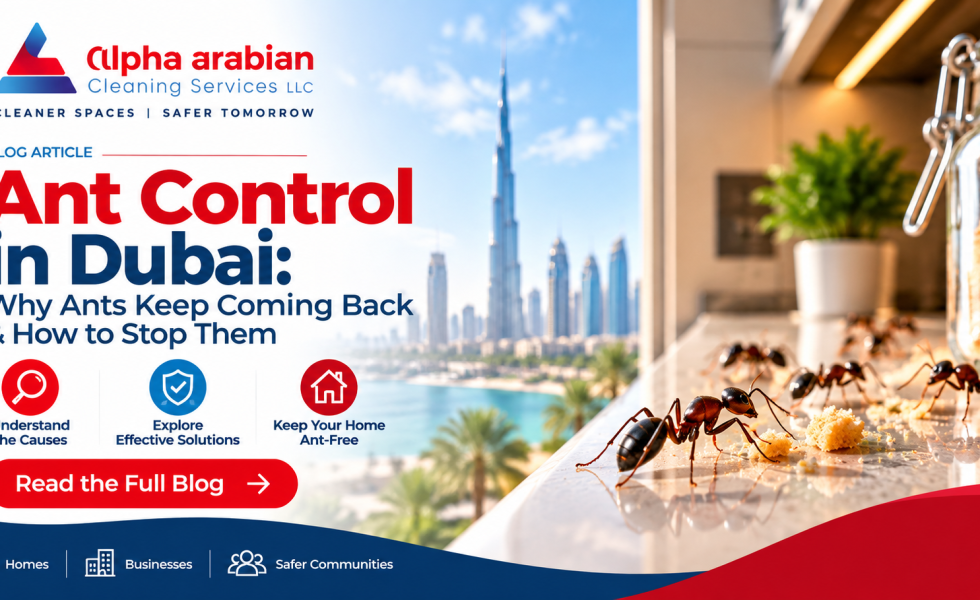
Ant Control in Dubai: Why Ants Keep Coming Back & How to Stop Them
Seeing a few ants in your kitchen may not seem like a serious problem. But when the same ant trails return day after day—even after cleaning or spraying—the visible ants may only be a small part of a larger colony.
Effective ant control in Dubai is not simply about killing the ants you can see. Ants may be nesting in wall gaps, around kitchens, beneath flooring, outdoors, or in other protected areas and travelling between their nest and available food or water sources.
Ants are one of the common pest problems affecting residential and commercial properties in Dubai. If you’re dealing with multiple pest issues, professional pest control services in Dubai can help identify the source and determine an appropriate treatment.
This guide explains why ants keep coming back, what attracts them to Dubai properties, common methods for ant control, why some DIY treatments provide only temporary results, and practical ways to help prevent another infestation.
Why Do Ants Keep Coming Back?
One of the most common frustrations with an ant problem is that it appears to disappear after cleaning or spraying, only to return a few days later.
The reason can be relatively simple: you may have removed the visible ants without addressing the colony or the conditions attracting them.
Worker ants leave their nesting area to search for food and water. Once they locate a suitable source, they can establish trails that other workers follow.
Removing those workers may temporarily reduce visible activity, but if the colony remains active, more ants can appear.
Recurring ant activity can therefore be associated with:
- Accessible food
- Crumbs and food residue
- Moisture or water sources
- Unsealed food containers
- Waste bins
- Pet food
- Structural gaps
- Suitable nesting locations
- Established colonies nearby
This is why professional ant control in Dubai should focus on understanding where the ants are coming from rather than treating only the ants that happen to be visible.
Why Are Ants Common in Dubai Homes?
Ants are highly adaptable insects and can exploit very small opportunities to enter residential properties.
In Dubai, they may be found around villas, apartments, kitchens, balconies, gardens, bathrooms, utility areas and commercial premises.
Air-conditioned indoor environments don’t necessarily prevent ants from entering. If food, water and suitable access points are available, ants can establish trails into occupied spaces.
Properties with gardens and landscaped outdoor areas may also experience activity originating outside the building.
The important question isn’t simply “Where are the ants?” It’s “Where are they coming from, and what is attracting them?”
That distinction can make a significant difference to the effectiveness of an ant-control strategy.
What Attracts Ants Into Your Home?
Ants usually enter properties while searching for food, water or suitable nesting conditions. Several everyday conditions can make a property more attractive to foraging ants.
1. Food Residue
Even very small amounts of food can attract ants.
Common sources include:
- Crumbs
- Sugar and sweets
- Fruit
- Cooking residue
- Grease
- Open food packaging
- Pet food
Kitchen counters, cabinets, dining areas and spaces underneath appliances can therefore become frequent ant-activity zones.
2. Water and Moisture
Ants also require water. Activity may occur around sinks, bathrooms, leaking plumbing, damp areas, plant pots and other moisture sources.
3. Waste Bins
Food residue inside or around waste bins can provide a consistent food source. Regular cleaning and properly closed bins can help reduce this attraction.
4. Small Entry Points
Ants can enter through very small openings around:
- Doors
- Windows
- Wall cracks
- Pipes
- Utility penetrations
- Balcony areas
- Skirting
- Cabinet gaps
Finding these routes can be more useful than simply spraying the visible trail.
5. Outdoor Landscaping
Gardens, plants, soil and landscaped areas naturally support insect activity.
Ants nesting outdoors may eventually begin foraging around the building, particularly when food or water is easily available.
Why Are Ants Appearing in My Kitchen?
The kitchen is one of the most common places to notice ants because it provides several potential food and water sources in a relatively small area.
You might clean the visible countertop and still continue seeing ants because food residue can accumulate in less obvious places.
Check areas such as:
- Behind appliances
- Under cabinets
- Around waste bins
- Beneath dining furniture
- Inside cupboards
- Around sinks
- Along wall edges
If you notice ants travelling in a relatively consistent line, observe the trail and determine where they appear to be entering the room.
Don’t assume that the point where you see the largest number of ants is necessarily where the colony is located.
Kitchens can attract more than ants. Food residue, moisture and hidden spaces can also contribute to cockroach activity. If you’re experiencing recurring cockroach problems as well, read our guide on why cockroaches keep coming back after treatment.
Does Killing the Ants You See Solve the Problem?
Not necessarily.
The ants travelling across your countertop or floor are typically worker ants. The colony itself may contain many more ants in a protected nesting area.
This is one reason indiscriminately spraying visible ants can sometimes produce disappointing long-term results.
You may kill the workers you can see while leaving the underlying colony unaffected.
A more complete ant pest control strategy considers:
Species → Trail → Food/Water Source → Entry Point → Nesting Area → Appropriate Control Method
This approach addresses the cause of recurring activity rather than focusing exclusively on the symptom.
What Are the Most Effective Methods for Ant Control?
There isn’t one universal treatment for every ant problem.
The appropriate method depends on factors such as the type of ant, colony location, level of activity and property conditions.
Professional ant control may therefore involve a combination of approaches.
Inspection
An inspection helps determine where ants are active, their likely entry routes, potential food and water sources, and possible nesting locations.
This should come before simply applying products throughout the property.
Ant Baiting
Baiting may be appropriate for certain ant infestations.
Worker ants encounter the bait and can carry it back towards the colony. The type and placement of bait matter, which is why random application may not produce the expected result.
Targeted Treatment
Depending on the infestation and species involved, targeted treatment may be applied to specific ant-active locations.
The objective should be to address identified activity rather than unnecessarily treating every surface.
Entry-Point Management
Structural gaps and openings can allow ants to continue entering the property.
Once active nesting areas have been appropriately addressed, suitable entry points may be sealed as part of longer-term prevention.
Sanitation and Environmental Management
Pest treatment alone cannot compensate indefinitely for readily available food and water.
Cleaning food residue, controlling waste and addressing moisture can therefore form an important part of an integrated approach.
Why Doesn’t Ant Spray Always Work?
Household sprays can kill ants they directly contact.
The problem is that the ants you see may represent only a portion of the colony.
Repeated spraying without understanding the infestation can therefore become a cycle:
Ants appear → Spray → Visible ants disappear → New workers arrive → Spray again.
It can look like the treatment worked initially when the underlying source was never addressed.
Different ant species can also respond differently to control methods. That’s another reason identification and targeted ant control in Dubai can be more effective than relying entirely on general-purpose spraying.
Can Ants Nest Inside Walls?
Yes. Depending on the species and property conditions, ants can sometimes establish nests in protected areas within or around structures.
Possible locations can include:
- Wall voids
- Gaps around cabinets
- Flooring edges
- Utility areas
- Roof or ceiling spaces
- External cracks
- Garden areas
- Spaces around pipes
If ants repeatedly emerge from the same crack or opening, simply sealing it immediately may not address the colony.
The activity should first be assessed.
How Can You Prevent Ant Infestations in Your Dubai Home?
Preventing every ant from entering an outdoor or residential environment isn’t realistic. However, you can make your property considerably less attractive to them.
Keep Food Properly Stored
Store sugar, sweets, cereals, snacks and other foods in properly closed containers. Clean spills promptly, particularly sugary liquids.
Clean Kitchen Surfaces Regularly
Wipe counters and dining surfaces and pay attention to less-visible areas around appliances and cabinets.
Don’t Leave Pet Food Out Unnecessarily
Pet bowls can provide ants with a readily accessible food source. Clean the surrounding area regularly.
Manage Waste Properly
Use bins with suitable lids and clean food residue from the surrounding area.
Address Moisture
Check for dripping taps, plumbing leaks and persistent damp areas.
Inspect Entry Points
Look around doors, windows, pipe penetrations and structural gaps for possible ant access.
Maintain Outdoor Areas
For villas in particular, gardens and external areas should be maintained and monitored for recurring ant activity near the structure.
Prevention works best when combined with appropriate treatment of an existing colony rather than being used as a substitute for addressing an established infestation.
Ant Control for Villas in Dubai
Villas can present different ant-control challenges from apartments.
Gardens, external walls, patios, landscaping, service areas and multiple access points can create a larger interface between the building and outdoor insect activity.
If ants repeatedly enter a villa, inspection should therefore consider both the interior and exterior environment.
Treating only the kitchen may not solve an infestation originating from an outdoor colony.
Professional ant control in Dubai villas can include inspection of trails, likely nesting areas, external activity and entry points before determining the appropriate control strategy.
Ant Control for Apartments in Dubai
Ants can also become a recurring problem in apartments.
They may enter through small structural gaps, balconies, utility penetrations or other access points.
In multi-unit buildings, the source of activity may not always be limited to the exact location where ants are first noticed.
Recurring activity should therefore be assessed rather than repeatedly treated with household spray alone.
Ant Control for Restaurants and Commercial Properties
For restaurants, cafés, food businesses, offices, warehouses and other commercial properties, ant activity can become more than a simple nuisance.
Food-handling environments in particular require strong sanitation, monitoring and pest-management procedures.
Potential problem areas include:
- Kitchens
- Food preparation areas
- Storage rooms
- Waste areas
- Staff pantries
- Outdoor dining areas
- Loading and delivery zones
A professional pest-management programme can combine inspection, targeted treatment, monitoring and preventive recommendations appropriate to the premises.
DIY Ant Control vs Professional Ant Control
For occasional ants, basic sanitation and removing an obvious food source may be enough to stop the activity.
Recurring infestations are different.
If ants continue returning despite cleaning and basic preventive measures, there may be a colony or ongoing entry route that hasn’t been addressed.
Professional ant control becomes particularly useful when:
- Ants return repeatedly
- Several rooms are affected
- Large numbers appear
- The trail cannot be traced
- Ants emerge from walls or structural gaps
- Kitchen activity continues despite cleaning
- DIY treatments provide only temporary results
- A restaurant or commercial property is affected
The goal isn’t simply to use a stronger chemical. The goal is to understand why the infestation is occurring and select an appropriate method accordingly.
Different pests also require different approaches. For example, attempting DIY treatment around an active wasp nest can present different risks from dealing with an ant trail. Read our guide to wasp control in Dubai if you’ve discovered a suspected wasp nest around your property.
How Long Does Ant Control Take?
There is no single timeframe that applies to every infestation.
The result depends on factors such as:
- Ant species
- Colony size
- Nest location
- Property conditions
- Treatment method
- Access to food and water
- Whether multiple colonies are involved
Some treatments are intentionally designed to work through ant activity rather than producing an immediate disappearance of every visible worker.
For that reason, the appropriate treatment should be judged according to the method being used and the infestation being treated.
Avoid expecting every ant problem to disappear instantly after one application.
When Should You Call a Professional for Ant Control?
A few occasional ants don’t always indicate a major infestation.
However, professional assessment is worth considering if you notice persistent trails, repeated kitchen activity, ants emerging from structural gaps, activity in multiple rooms, or ants returning shortly after DIY treatment.
The sooner the source is identified, the easier it may be to prevent the activity from becoming an ongoing problem.
Not every insect problem around a property should be treated in the same way. If you’ve noticed bees gathering around your balcony, roof or garden, read our guide to bee hive removal in Dubai before attempting to disturb them.
Professional Ant Control in Dubai
Recurring ants are often a sign that simply killing the visible insects isn’t addressing the full problem.
Effective ant control in Dubai starts with identifying where the ants are active, what is attracting them, where they may be entering and which treatment approach is appropriate for the situation.
Alpha Arabian Cleaning Services LLC provides professional pest control services in Dubai for villas, apartments and commercial properties, including solutions for ants and other common pest problems.
Whether you’re dealing with ants in the kitchen, recurring trails around your villa or persistent activity at a commercial property, a professional inspection can help determine the source and appropriate treatment.
Need help with recurring ants? Contact Alpha Arabian for professional ant control services in Dubai.
Frequently Asked Questions About Ant Control in Dubai
Why do ants keep coming back after I spray them?
Spraying may kill visible worker ants without addressing the colony. If the nest, food source or entry route remains active, additional ants can continue appearing.
What is the best way to get rid of ants in a Dubai home?
The appropriate method depends on the ant species and source of the infestation. Cleaning food sources, managing moisture and identifying entry points can help, while recurring infestations may require targeted professional treatment.
Why are there suddenly ants in my kitchen?
Ants may have discovered food, water or another attractive resource. Once workers establish a route to that source, additional ants may follow the trail.
Can ants live inside walls?
Some ants can establish nests in protected structural areas or use wall gaps as travel routes. Repeated activity from the same opening should be investigated.
Should I seal a hole where ants are coming from?
If an active infestation is present, identify and address the source first. Simply sealing one visible opening may cause ants to use another route.
Are ant baits better than sprays?
They work differently. Contact sprays primarily affect ants they reach directly, while appropriately selected baits may be carried by foraging ants. The appropriate approach depends on the species and infestation.
How can I prevent ants from coming back?
Reduce accessible food and water, clean spills and crumbs, manage waste, address moisture and inspect suitable entry points. For recurring infestations, the colony itself may also need to be addressed.
Do I need professional pest control for a few ants?
Not necessarily. Occasional activity may be resolved by removing the food or water source. Repeated trails, large numbers or persistent activity are stronger reasons to arrange an inspection.
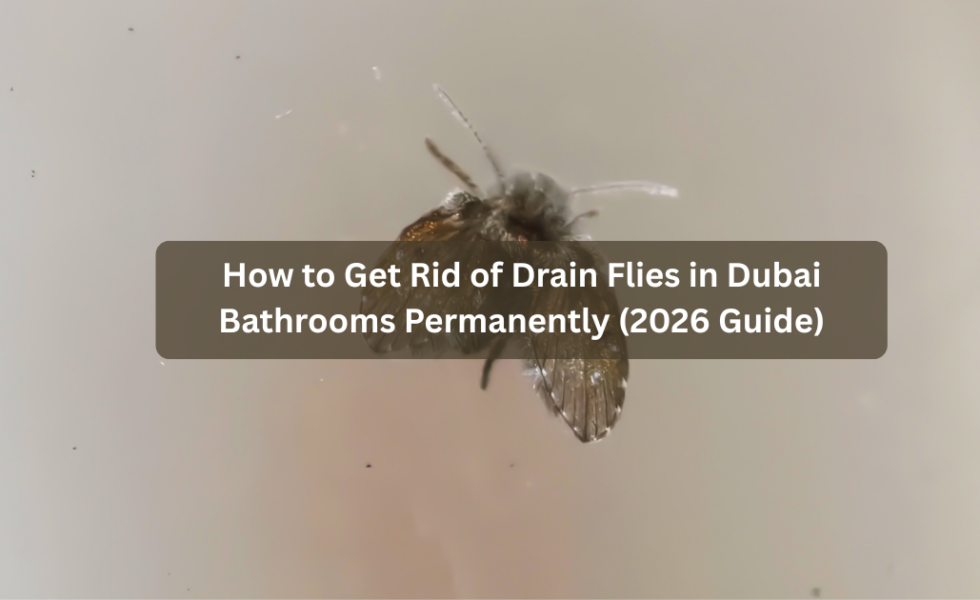
How to Get Rid of Drain Flies in Dubai Bathrooms Permanently (2026 Guide)
Have you noticed tiny black flies hovering around your bathroom sink, shower drain, or kitchen sink? These aren’t fruit flies—they’re most likely drain flies, one of the most common household pests in Dubai.
Although drain flies don’t bite or sting, they can quickly become a nuisance if left untreated. Their presence often indicates organic buildup inside drains, making them a sign that your plumbing system needs attention.
The good news is that with the right approach, drain flies can be eliminated permanently.
In this guide, we’ll explain why Drain Flies Dubai infestations occur, how to identify them, what treatments work best, and how professional pest control can help keep your home fly-free.
What Are Drain Flies?
Drain flies, also known as moth flies, sewer flies, or filter flies, are tiny insects that breed in moist environments rich in organic matter.
Adult drain flies typically measure only 2–5 mm in length and have fuzzy wings that resemble tiny moths.
Unlike mosquitoes, they are poor flyers and usually stay close to their breeding sites.
You may commonly spot them around:
- Bathroom drains
- Kitchen sinks
- Floor drains
- Utility rooms
- Laundry areas
- Air conditioning drainage points
- Basement drains
Why Are Drain Flies Common in Dubai?
Dubai’s warm climate combined with constant indoor plumbing creates ideal breeding conditions for drain flies.
Several factors contribute to infestations:
Moisture
Drain flies require damp environments to reproduce.
Organic Buildup
Soap residue, hair, grease, food particles, and bacteria accumulate inside drain pipes, providing food for larvae.
Warm Temperatures
Dubai’s climate allows insects to breed throughout much of the year.
Infrequently Used Drains
Guest bathrooms and unused floor drains often become breeding grounds because stagnant water and debris collect over time.
Signs You Have Drain Flies
Early detection makes treatment much easier.
Common signs include:
- Tiny flies hovering near bathroom sinks
- Small insects around shower drains
- Flies appearing after turning on bathroom lights
- Increased activity around floor drains
- Clusters of insects resting on walls near drains
- Recurring flies despite using air fresheners or insect sprays
If these signs continue for several days, the infestation is likely originating inside your drainage system.
Drain Flies vs Fruit Flies: How to Tell the Difference
Many homeowners mistake drain flies for fruit flies.
Here’s how to identify them:
| Drain Flies | Fruit Flies |
|---|---|
| Fuzzy wings | Smooth wings |
| Moth-like appearance | Small tan or brown flies |
| Stay near drains | Stay near fruits and food |
| Weak flyers | Fast flyers |
| Breed in drains | Breed on decaying fruits |
Correct identification is essential because each pest requires a different treatment method.
Where Do Drain Flies Breed?
The real problem isn’t the adult flies—it’s the larvae hidden inside the drain.
Common breeding locations include:
- Bathroom sink drains
- Shower drains
- Kitchen sinks
- Floor drains
- Sewer pipe connections
- Condensate drain lines
- Utility sinks
- Septic systems
Larvae feed on the slimy organic film lining the inside of pipes.
Unless this breeding material is removed, new flies will continue emerging.
DIY Methods to Get Rid of Drain Flies
Small infestations can often be managed by improving drain hygiene.
Clean the Drain Thoroughly
Remove hair, soap scum, and organic buildup using a drain brush.
Cleaning the inner walls of the pipe is more effective than simply pouring chemicals down the drain.
Flush with Hot Water
Regularly flushing drains with hot water can help reduce grease and residue.
Use Enzyme-Based Drain Cleaners
Enzyme cleaners help break down organic matter that serves as food for drain fly larvae.
Always follow the manufacturer’s instructions.
Fix Plumbing Leaks
Leaking pipes create moisture that encourages breeding.
Repairing leaks helps reduce suitable breeding conditions.
Keep Drains Dry When Possible
Unused bathrooms should be flushed periodically to prevent stagnant water.
Common Mistakes That Make the Problem Worse
Many homeowners unintentionally allow infestations to continue by relying on temporary solutions.
Avoid these common mistakes:
Spraying Adult Flies Only
Killing adult flies doesn’t eliminate the larvae developing inside the drain.
Ignoring Hidden Drains
Utility rooms, floor drains, and AC drainage systems are often overlooked.
Using Excessive Chemicals
Strong chemicals may damage plumbing while failing to remove the organic buildup where larvae develop.
Delaying Treatment
A small infestation can quickly grow if breeding sites remain untreated.
When Should You Call Professional Pest Control?
You should consider professional assistance if:
- Drain flies return after cleaning.
- Multiple drains are affected.
- Infestations continue for several weeks.
- Commercial kitchens or restaurants are affected.
- The source cannot be located.
Professional technicians inspect the drainage system to identify breeding sites and recommend the most effective treatment plan.
How Alpha Arabian Controls Drain Flies in Dubai
At Alpha Arabian Pest Management, we understand that simply killing visible flies isn’t enough.
Our drain fly control service focuses on identifying and addressing the source of the infestation.
Our process includes:
- Detailed inspection
- Identification of breeding areas
- Professional treatment recommendations
- Drain sanitation guidance
- Preventive advice
- Follow-up inspections when required
Whether you’re dealing with drain flies in a villa, apartment, office, restaurant, or commercial property, our experienced team provides effective and reliable pest management solutions.
Tips to Prevent Drain Flies
Preventing drain flies is much easier than eliminating a large infestation.
Follow these simple habits:
- Clean drains regularly.
- Remove hair from shower drains.
- Avoid pouring grease into kitchen sinks.
- Repair leaking pipes promptly.
- Flush unused drains periodically.
- Keep bathrooms well ventilated.
- Schedule routine pest inspections.
Consistent maintenance significantly reduces the risk of future infestations.
Why Choose Alpha Arabian Pest Management?
Homeowners and businesses across Dubai trust Alpha Arabian because we provide:
✔ Dubai Municipality Approved Services
✔ Experienced Pest Control Technicians
✔ Safe & Effective Pest Management
✔ Residential & Commercial Solutions
✔ Fast Response Across Dubai
✔ Preventive Pest Control Programs
Our goal is not only to eliminate current pest problems but also to help prevent them from returning.
Final Thoughts
Drain flies may be small, but they often indicate a larger hygiene or drainage issue.
While DIY cleaning can help with minor infestations, persistent drain flies usually require a more thorough inspection to identify hidden breeding sites.
By combining proper drain maintenance, moisture control, and professional pest management when necessary, homeowners can keep their bathrooms and kitchens free from drain flies throughout the year.
If drain flies continue returning despite your efforts, a professional inspection can help identify the root cause and provide a long-term solution.
Frequently Asked Questions
Are drain flies harmful?
Drain flies are not known to bite humans, but they can become a nuisance and may indicate organic buildup inside drains that should be addressed.
Why do drain flies keep coming back?
Recurring infestations usually occur because larvae continue developing inside drains where organic matter has not been completely removed.
Can drain flies live in clean bathrooms?
Yes. Even clean bathrooms can develop drain flies if organic buildup exists inside plumbing pipes or unused drains.
How long does it take to eliminate drain flies?
Small infestations may improve within a few days after cleaning, while larger infestations can take longer depending on the extent of breeding inside the drainage system.
Should I call professional pest control for drain flies?
If drain flies continue returning despite cleaning and maintenance, a professional inspection can identify hidden breeding areas and recommend appropriate treatment.
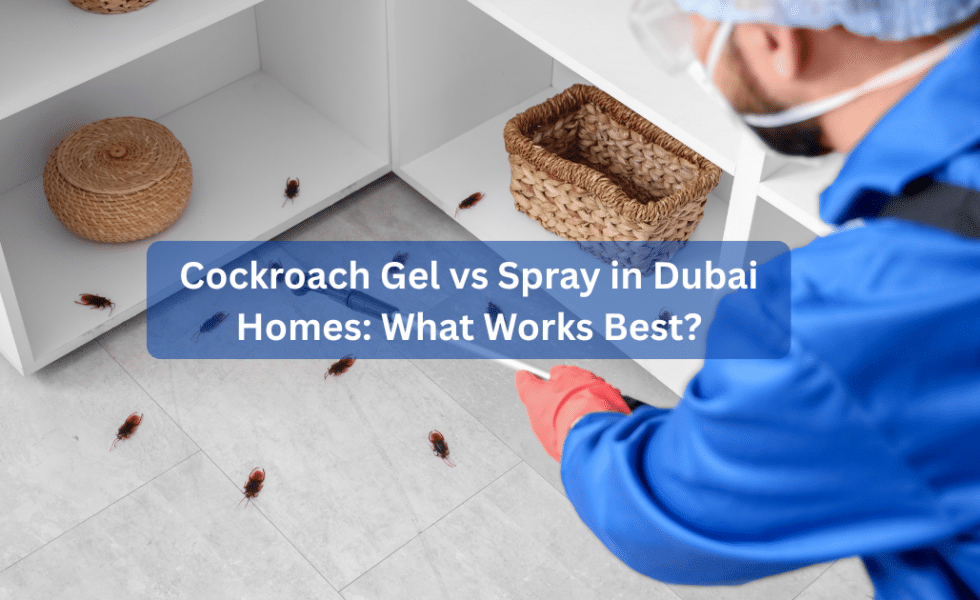
Cockroach Gel vs Spray in Dubai Homes: What Works Best?
Cockroaches are one of the most persistent household pests in Dubai. Whether you live in an apartment, villa, or townhouse, spotting cockroaches in your kitchen or bathroom can quickly become a serious concern.
When homeowners notice cockroach activity, the first question is often:
Should I use cockroach gel or cockroach spray?
While both methods can reduce cockroach activity, they work very differently. Choosing the wrong solution can leave the infestation untreated, allowing cockroaches to continue breeding behind walls and inside cabinets.
In this guide, we’ll compare cockroach gel and spray, explain when each method works best, and help you understand when professional cockroach control becomes the better option.
Why Cockroach Infestations Are Common in Dubai
Dubai’s warm climate allows cockroaches to remain active throughout the year.
Cockroaches thrive in environments with:
Food residue
Moisture
Warm temperatures
Dark hiding places
Easy access to water
German cockroaches are especially common in kitchens, while American cockroaches are often found in drains, basements, and outdoor areas.
What Is Cockroach Gel?
Cockroach gel is a specially formulated bait placed in areas where cockroaches travel.
Rather than killing insects immediately, the gel attracts cockroaches, which consume it and carry traces back to their hiding places. This allows the treatment to affect more of the colony over time.
Advantages of Cockroach Gel
Targets hidden cockroaches
Helps reduce entire colonies
No strong odor
Applied discreetly in cracks and corners
Suitable for kitchens and cabinets when used correctly
Limitations
Requires correct placement
Results are not immediate
Less effective if competing food sources are present
Large infestations may require professional application
What Is Cockroach Spray?
Cockroach spray is designed to kill insects that come into direct contact with the product.
Many homeowners prefer sprays because they provide immediate visible results.
Advantages of Cockroach Spray
Quick knockdown of visible cockroaches
Easy to purchase and apply
Useful for occasional sightings
Limitations
Usually affects only visible insects
Does not eliminate hidden nests
Limited effect on egg capsules
Frequent reapplication may be required
Sprays often provide temporary relief rather than long-term control.
Cockroach Gel vs Spray: A Comparison
| Feature | Cockroach Gel | Cockroach Spray |
|---|---|---|
| Targets hidden cockroaches | ✔ Yes | ✘ Limited |
| Immediate results | ✘ No | ✔ Yes |
| Colony reduction | ✔ Yes | ✘ No |
| Long-term effectiveness | ✔ Higher | ✘ Lower |
| Easy DIY application | Moderate | Easy |
| Suitable for severe infestations | Better | Limited |
Which Option Works Better?
For isolated cockroach sightings, a spray may provide temporary relief.
However, if cockroaches continue appearing over several days or weeks, the problem is usually larger than the insects you can see.
In these situations, bait-based treatments and professional pest management generally provide more comprehensive control because they focus on the source of the infestation rather than only the visible insects.
Why Cockroaches Keep Coming Back
Many homeowners believe the infestation has been eliminated because they stop seeing cockroaches for a few days.
Unfortunately, hidden colonies often remain active.
Common reasons infestations return include:
Egg capsules surviving treatment
Hidden nests inside walls
Food residue
Plumbing leaks
Nearby infestations in neighboring units
Cracks and entry points
Without addressing these issues, cockroach activity often returns.
How to Prevent Cockroach Infestations
Along with treatment, prevention plays a key role.
Simple steps include:
Clean kitchen surfaces daily.
Store food in airtight containers.
Repair leaking pipes and taps.
Empty garbage bins regularly.
Seal gaps around plumbing and utility lines.
Avoid leaving pet food out overnight.
These practices help reduce the conditions that attract cockroaches.
When Should You Call a Professional?
You should consider professional cockroach control if:
Cockroaches appear every day.
You see cockroaches during daylight hours.
DIY products have failed.
Cockroaches are spreading to multiple rooms.
The infestation keeps returning after treatment.
Professional pest control technicians inspect the property, identify the species involved, locate nesting areas, and recommend the most appropriate treatment plan.
Why Choose Alpha Arabian for Cockroach Control in Dubai?
Alpha Arabian Pest Management provides professional cockroach control services for homes and businesses across Dubai.
Our services include:
Comprehensive property inspections
Identification of cockroach species
Targeted treatment plans
Safe application methods
Follow-up inspections
Preventive recommendations
Our goal is not only to reduce visible cockroaches but also to address the source of the infestation and help prevent future problems.
Final Thoughts
Choosing between cockroach gel and spray depends on the extent of the infestation.
Sprays can provide quick results for isolated sightings, while gel treatments are generally more effective at reducing hidden cockroach populations over time.
For persistent infestations, professional cockroach control remains the most reliable solution, helping to identify hidden nesting areas and implement a long-term management strategy.
If cockroaches continue to appear despite repeated DIY treatments, it may be time to schedule a professional inspection before the infestation becomes more difficult to control.
Frequently Asked Questions
Is cockroach gel better than spray?
Cockroach gel is generally more effective for controlling hidden cockroach populations, while sprays are primarily used for immediate knockdown of visible insects.
How long does cockroach gel take to work?
Results vary depending on the infestation level, but noticeable reductions often occur over several days as the bait is carried back to the colony.
Can cockroach spray kill eggs?
Most sprays have limited impact on cockroach eggs, which is why repeat infestations are common.
Is cockroach gel safe to use around children and pets?
Cockroach gels should always be used according to the manufacturer’s instructions and placed in areas that are inaccessible to children and pets.
When should I hire professional cockroach control?
If cockroaches continue returning after DIY treatments or you notice widespread activity, professional inspection and treatment are recommended.
Why Cockroaches Keep Coming Back After Pest Control in Dubai (2026 Guide)
Why Cockroaches Keep Coming Back After Pest Control in Dubai
You’ve invested in pest control, cleaned your home thoroughly, and enjoyed a few weeks without seeing a single cockroach. Then suddenly, they reappear in your kitchen, bathroom, or storage areas.
If this sounds familiar, you’re not alone.
One of the most common complaints among homeowners and businesses in Dubai is that cockroaches return after treatment. While seeing a few cockroaches after a service doesn’t always mean the treatment failed, recurring infestations usually indicate that the root cause has not been fully addressed.
In this guide, we’ll explain why cockroaches keep coming back after pest control and what can be done to eliminate them permanently.
Why Cockroaches Are a Persistent Problem in Dubai
Dubai’s climate creates ideal conditions for cockroach populations.
Cockroaches thrive because of:
- Warm temperatures year-round
- High humidity in certain areas
- Abundant food sources
- Residential and commercial density
- Extensive drainage systems
These conditions make professional pest management essential for long-term control.
Common Cockroach Species Found in Dubai
German Cockroach
German cockroaches are the most common indoor species.
They:
- Reproduce rapidly
- Prefer kitchens and bathrooms
- Hide in small cracks
- Are difficult to eliminate completely
American Cockroach
American cockroaches are larger and often enter buildings through:
- Drains
- Sewer systems
- Utility openings
- Basements and storage areas
Understanding the species involved is critical for successful treatment.
1. The Nest Was Never Eliminated
One of the biggest reasons cockroaches return is that only visible insects were treated.
Cockroaches spend most of their time hiding in:
- Wall voids
- Kitchen cabinets
- Electrical conduits
- Ceiling spaces
- Drainage systems
If the nesting areas remain active, new cockroaches will continue to emerge.
2. Cockroach Eggs Survived the Treatment
Many pest control products target adult cockroaches but have limited effect on egg capsules.
A single egg case can contain dozens of developing cockroaches.
After treatment, eggs may hatch and create the impression that the infestation has returned when, in reality, a new generation has emerged.
This is why follow-up inspections and treatments are often necessary.
3. Food Sources Remain Available
Cockroaches require only tiny amounts of food to survive.
Common attractants include:
- Food crumbs
- Cooking grease
- Pet food
- Garbage bins
- Unsealed food containers
Even small amounts of food residue can sustain a cockroach population.
4. Water Sources Are Still Accessible
Cockroaches can survive for weeks with little food but require regular access to water.
Common water sources include:
- Leaking pipes
- Dripping faucets
- AC condensation
- Sink areas
- Bathroom moisture
Properties with ongoing moisture issues often experience recurring infestations.
5. Nearby Units Have Active Infestations
This is particularly common in:
- Apartment buildings
- Staff accommodations
- Hotels
- Commercial complexes
Even if one unit receives treatment, cockroaches may migrate from neighboring units through:
- Shared walls
- Plumbing systems
- Electrical conduits
- Ventilation openings
In these situations, building-wide management may be required.
6. DIY Treatments Interfere with Professional Solutions
Many residents continue using aerosol sprays after professional treatment.
Unfortunately, this can reduce effectiveness because:
- Cockroaches scatter into new hiding places
- Baits become less attractive
- Colonies relocate
- Treatment patterns are disrupted
Professional pest control plans should be allowed to work as intended.
7. Poor Sanitation Practices
Even the most effective treatment can be undermined if favorable conditions remain.
Key sanitation issues include:
Dirty Kitchen Areas
Grease and food residue provide a continuous food source.
Overflowing Garbage
Waste attracts cockroaches and supports colony growth.
Cluttered Storage Areas
Boxes and clutter create ideal hiding locations.
Unsealed Food Products
Open packaging encourages recurring infestations.
Signs That Your Cockroach Problem Is Getting Worse
Watch for these warning signs:
Frequent Daytime Sightings
Cockroaches are normally nocturnal.
Seeing them during the day often indicates a large infestation.
Droppings
Small black specks resembling ground pepper.
Unpleasant Odor
Heavy infestations can produce a musty smell.
Egg Capsules
Finding egg cases indicates active reproduction.
Shed Skins
Cockroaches molt several times during development.
How Professional Cockroach Control in Dubai Solves the Problem
Effective cockroach control focuses on eliminating the source rather than just killing visible insects.
Professional services typically include:
Detailed Inspection
Identifying:
- Species involved
- Nesting locations
- Entry points
- Contributing conditions
Targeted Treatment
Professional-grade solutions are applied strategically to high-risk areas.
Colony Elimination
The objective is to eliminate entire populations, including hidden cockroaches.
Follow-Up Monitoring
Regular inspections help ensure long-term success.
How to Prevent Cockroaches from Returning
After treatment, homeowners should:
- Fix plumbing leaks
- Store food in sealed containers
- Empty garbage regularly
- Clean kitchen surfaces daily
- Reduce clutter
- Seal cracks and gaps
- Maintain proper sanitation
Combining professional treatment with prevention provides the best results.
Why Choose Alpha Arabian for Cockroach Control Dubai?
At Alpha Arabian Pest Management, we provide comprehensive cockroach control services across Dubai for homes, apartments, villas, restaurants, offices, warehouses, and commercial facilities.
Our approach includes:
- Thorough inspections
- Species identification
- Targeted treatments
- Safe application methods
- Follow-up support
- Long-term prevention guidance
Our goal is not just to reduce cockroach activity but to help eliminate the infestation at its source.
Final Thoughts
If cockroaches keep returning after pest control, there is usually an underlying reason. Hidden nests, surviving eggs, food sources, moisture problems, and neighboring infestations can all contribute to recurring problems.
The key to long-term success is identifying the root cause and implementing a comprehensive treatment strategy.
If you’re still seeing cockroaches after treatment, professional inspection and targeted control measures can help restore a pest-free environment.
Frequently Asked Questions
Is it normal to see cockroaches after pest control?
Yes. Some cockroaches may remain visible for a short period after treatment as they come into contact with treated areas.
How long does it take to eliminate a cockroach infestation?
The timeline depends on the severity of the infestation, species involved, and property conditions.
Why do cockroaches keep coming back to my kitchen?
Food residue, moisture, and hidden nesting locations are the most common reasons.
Can cockroaches move between apartments?
Yes. Cockroaches frequently travel through shared plumbing, walls, and utility openings.
Is professional cockroach control better than DIY products?
Professional treatments target hidden populations and nesting areas, making them significantly more effective for long-term control.
Is Pest Control Safe for Kids & Pets in Dubai? (Complete 2026 Guide)
When planning a pest control service, one question comes up almost every time:
Is pest control safe for kids and pets in Dubai?
It’s a valid concern. With children crawling on floors and pets constantly exploring their surroundings, safety becomes a top priority.
The good news is — pest control in Dubai is generally safe when done by licensed professionals using approved methods. But understanding how it works, what chemicals are used, and what precautions to take is essential.
Are Pest Control Services Regulated in Dubai?
Yes — pest control in Dubai is strictly regulated.
Authorities such as Dubai Municipality ensure that:
- Only approved chemicals are used
- Technicians are licensed and trained
- Treatments follow strict safety standards
This regulation is the main reason why professional pest control services in Dubai are considered safe for residential use.
What Chemicals Are Used in Pest Control?
Modern pest control has evolved significantly. Today, most companies use low-toxicity, targeted treatments designed to minimize risk.
Common types include:
- Pyrethroid-based insecticides – Effective but safe once dried
- Gel baits – Used for cockroaches and ants, applied in small amounts
- Odorless sprays – Suitable for indoor environments
- Larvicides – Used for mosquito control in outdoor areas
These are designed to target pests specifically without harming humans or pets when used correctly.
Is Pest Control Safe for Children?
Yes, pest control is safe for children — but precautions are necessary.
Safety tips for homes with kids:
- Keep children away during treatment
- Allow surfaces to dry before use
- Avoid direct contact with treated areas for a few hours
- Clean frequently touched surfaces if required
Most treatments become safe within 2–4 hours after application.
Is Pest Control Safe for Pets?
Pets are more sensitive than humans, so extra care is needed.
Pet safety guidelines:
- Remove pets during treatment
- Cover or remove food and water bowls
- Keep pets away until the area is ventilated and dry
- Inform your pest control provider about your pets
Once the treatment settles, your home becomes safe for pets again.
How Long After Pest Control Is It Safe?
This is one of the most important concerns for homeowners.
Typical safety timeline:
- 2–4 hours: Safe to re-enter
- 6–8 hours: Ideal for children and pets
- 24 hours: Completely settled
Some treatments like gel bait require minimal restriction.
When Can Pest Control Be Unsafe?
While pest control is generally safe, issues can arise in certain situations.
Risks occur when:
- Unlicensed companies are used
- Excess chemicals are applied
- Safety instructions are ignored
- Poor-quality products are used
Choosing the right service provider makes all the difference.
Are Eco-Friendly Pest Control Options Available?
Yes — many companies in Dubai now offer safer alternatives.
Eco-friendly options include:
- Low-toxicity chemicals
- Herbal-based repellents
- Odorless and non-invasive treatments
These are ideal for homes with babies, elderly individuals, and pets.
Pre & Post Pest Control Safety Checklist
Before Treatment:
- Cover food and kitchen items
- Remove pets and children
- Inform the technician about sensitive areas
- Close windows if advised
After Treatment:
- Allow proper ventilation
- Avoid mopping immediately
- Keep children away from treated surfaces
- Follow technician instructions
This ensures maximum safety and effectiveness.
DIY vs Professional Pest Control in Dubai
| Factor | DIY Methods | Professional Services |
|---|---|---|
| Safety | Risk of misuse | Controlled & regulated |
| Effectiveness | Temporary | Long-lasting |
| Chemicals | Unknown quality | Approved & tested |
| Cost | Low initially | Better long-term value |
DIY solutions may seem cheaper, but they often fail to eliminate the root problem.
Related Guides
If you’re dealing with specific pest issues, these guides can help:
- How to Get Rid of Mosquitoes in Your Garden in Dubai
- Why Mosquitoes Are Increasing in Dubai
- Outdoor Mosquito Control for Villas in Dubai
These will help you understand pest problems more deeply.
Final Thoughts
So, is pest control safe for kids and pets in Dubai?
Yes — when done correctly by licensed professionals.
The key is:
- Choosing a trusted pest control company
- Following safety guidelines
- Using approved treatments
With the right approach, you can keep your home both pest-free and safe for your family.
Looking for Safe Pest Control in Dubai?
Alpha Arabian Pest Control offers:
- Municipality-approved treatments
- Safe solutions for kids & pets
- Expert technicians across Dubai
Book your FREE inspection today and enjoy a safe, pest-free home
Top 10 Germiest Spots in Your Dubai Home You Are Probably Ignoring
Most Dubai residents consider themselves clean and organised. Surfaces are wiped, bathrooms are scrubbed, and floors are mopped on a regular schedule. Yet despite these efforts, the average home in Dubai harbours millions of bacteria, virus particles, and mold spores on surfaces that are almost never disinfected — not because residents are careless, but because these spots are not the obvious ones.
Understanding where contamination actually accumulates — and why Dubai’s climate accelerates that accumulation — is the first step toward genuinely protecting your household. This guide identifies the ten most contaminated surfaces in a typical Dubai home, explains why each one poses a real health risk, and tells you what to do about it.
Why Dubai Homes Harbour More Bacteria Than You Think
Before looking at specific spots, it is worth understanding why Dubai homes are at higher risk than homes in cooler climates. Temperatures consistently above 35°C in summer, humidity levels that regularly spike above 70%, and near-continuous air conditioning use create a uniquely demanding hygiene environment.
Heat accelerates bacterial multiplication — some strains can double their population every 20 minutes at temperatures above 30°C. Humidity provides the moisture that mold and fungi need to establish and spread. And air conditioning, as essential as it is, circulates air — and everything suspended in it, including bacteria, allergens, and mold spores — continuously through every room. These conditions make regular professional disinfection not just desirable but genuinely necessary for households that want to maintain a safe living environment.
1. Kitchen Sponges and Dishcloths
Kitchen sponges are consistently identified in hygiene research as the most bacteria-laden object in the average home — more contaminated than a toilet seat by a significant margin. Their warm, moist, food-residue-soaked environment is ideal for bacterial growth, and in Dubai’s heat, contamination levels increase faster than in cooler climates.
Dishcloths present the same problem. A cloth used to wipe a raw chicken cutting board and then used to wipe a countertop has cross-contaminated every surface it subsequently touches. Replace sponges weekly at minimum. Dishcloths should be laundered at 60°C or above after every use. Neither can be adequately disinfected with a quick rinse under the tap.
2. Mobile Phones and Remote Controls
The average person touches their mobile phone over 2,600 times per day and carries it into every environment they enter — including bathrooms. Research consistently shows mobile phones carry ten times more bacteria per square centimetre than a toilet seat. Remote controls accumulate the same contamination but are almost never cleaned.
Both surfaces are touched repeatedly by multiple household members throughout the day and are warm from body heat and electronics — ideal conditions for bacterial survival and multiplication. Wipe both with an alcohol-based disinfectant wipe at least twice per week. Remove your phone case and disinfect underneath it — the gap between case and phone is a particularly effective bacterial trap.
3. Light Switches and Door Handles
Light switches and door handles are touched dozens of times per day by every person in the household — frequently immediately after touching food, faces, or external surfaces. Despite this, they are almost never included in a regular cleaning routine. Studies of residential properties consistently find pathogenic bacteria including E. coli and Staphylococcus on light switch plates and door handles in otherwise well-maintained homes.
In Dubai, the front door handle is a particularly high-risk surface — touched after returning from outdoor environments in extreme heat, where hands have been in contact with lift buttons, car doors, and public surfaces throughout the day. Include all switches and handles in your weekly disinfection routine without exception.
4. Refrigerator Seals and Handles
The rubber seal around your refrigerator door is one of the most neglected surfaces in the kitchen. Its folds and ridges trap food particles and moisture in a dark, consistently cool environment — ideal conditions for mold and bacteria including Listeria and Salmonella, both of which can survive and multiply at refrigerator temperatures.
The refrigerator handle is touched immediately before and after handling food, often without handwashing in between, making it a direct contamination pathway from external surfaces to food preparation. Clean the door handle weekly with a disinfectant wipe and clean the door seal monthly with a brush and antibacterial solution, paying close attention to the inner folds of the rubber.
5. Bathroom Taps and Flush Handles
The area immediately around bathroom taps and flush handles is one of the highest contamination zones in any home. People touch flush handles immediately before washing their hands, and tap handles immediately before hands are clean — meaning these surfaces receive contaminated contact continuously throughout the day.
In Dubai’s humid bathroom environment, contamination levels build faster than in drier climates, and the constant moisture around tap bases creates an ideal environment for mold growth in the grout and sealant lines that surround them. Disinfect taps, flush handles, and the surrounding surfaces two to three times per week as a minimum. Monthly professional sanitisation of bathroom surfaces addresses the deep contamination in grout lines and behind fixtures that surface cleaning cannot reach.
6. AC Vents and Filters
Air conditioning is used almost continuously in Dubai — typically eight to twelve months of the year in most households. The AC system circulates the entire air volume of your home repeatedly throughout the day, meaning that anything suspended in that air — dust, mold spores, bacteria, and allergens — is continuously redistributed to every room.
When AC filters are not cleaned regularly, they accumulate dust, mold, and bacteria and become a source of active airborne contamination rather than a filter against it. Dirty AC vents deposit settled contamination on the surrounding wall and ceiling surfaces that regular cleaning does not remove. Clean or replace filters monthly. Professional AC duct disinfection, carried out as part of a comprehensive home disinfection service in Dubai, treats the entire duct system and eliminates the mold and bacterial load that filter cleaning alone cannot address.
7. Children’s Toys and Play Mats
Children are significantly more vulnerable to pathogen exposure than adults — their immune systems are still developing and they touch their faces, mouths, and eyes far more frequently. Soft toys, plastic figures, and play mats accumulate saliva, food residue, and bacteria from floor contact and are rarely disinfected adequately.
Play mats in particular — especially foam tiles used on hard floors — develop mold on their undersides in Dubai’s humidity, often without visible surface signs. Lift and inspect the underside of foam play mats monthly. Hard toys can be disinfected with diluted child-safe disinfectant solution. Soft toys should be machine washed at the hottest temperature the label permits. A professional home disinfection service in Dubai that treats children’s rooms specifically, including soft furnishings and floor surfaces, provides a level of protection that routine cleaning cannot replicate.
8. Sofa Cushions and Soft Furnishings
Sofas and upholstered chairs are among the most used surfaces in any home and among the least disinfected. Cushion covers and upholstery absorb sweat, skin cells, food particles, and pet dander — all of which support bacterial and dust mite populations. In Dubai’s humidity, soft furnishings are also a common site for mold growth within the cushion filling, particularly in rooms with limited ventilation or near air conditioning units that produce condensation.
Vacuum sofa surfaces and cushions weekly. Wash removable covers at 60°C regularly. For deep-seated contamination within upholstery and cushion filling — which is inaccessible by surface cleaning — fogging and electrostatic spray disinfection as part of a professional home disinfection service in Dubai is the only effective treatment.
9. Reusable Shopping Bags
Reusable shopping bags are carried into supermarkets, placed on trolley surfaces, and used to transport raw food — then folded up and stored in a drawer or cupboard without being cleaned between uses. Research on reusable bags consistently finds high levels of bacterial contamination including E. coli and coliform bacteria, with contamination increasing significantly when bags are stored in warm environments between uses.
In Dubai’s heat, the inside of a car boot where shopping bags are typically stored reaches temperatures that accelerate bacterial multiplication rather than inhibit it. Wash fabric shopping bags in the washing machine weekly. Wipe hard-surface bags with a disinfectant solution after every use involving raw food or fresh produce.
10. Shoe Racks and Entrance Areas
Shoes carry an extraordinary level of bacterial contamination from outdoor surfaces — studies have found over 400,000 bacteria per square centimetre on the average shoe sole, including strains associated with serious illness. In Dubai, where outdoor surfaces in summer reach temperatures that kill some pathogens but not others, shoes also track in construction dust, sand, and chemical residues from treated outdoor areas.
The shoe rack itself and the floor area immediately inside the entrance door accumulate this contamination continuously. Establish a no-shoes-inside policy wherever possible. Disinfect the entrance floor area and shoe rack weekly. Monthly professional disinfection of entrance and hallway areas removes the settled bacterial load that regular mopping does not eliminate.
When Cleaning Is Not Enough: What Professional Disinfection Covers
The ten spots above have one thing in common — they are all areas where routine cleaning leaves behind significant pathogen levels that are not visible to the naked eye. Surface cleaning removes visible contamination and reduces bacterial load, but it does not eliminate viruses, antibiotic-resistant bacteria, mold spores, or airborne pathogens.
A professional home disinfection service in Dubai addresses all of these with hospital-grade biocidal agents applied using fogging and electrostatic spray technology. This approach treats every surface simultaneously — including vertical surfaces, undersides of furniture, air vents, soft furnishings, and the air itself — delivering a level of disinfection that manual cleaning cannot replicate regardless of how thorough it is.
For Dubai households, the recommended approach is a consistent DIY routine for daily and weekly surface maintenance, combined with monthly professional disinfection that addresses the contamination your routine cannot reach. This combination provides genuine, verifiable protection — not just a home that looks clean.
Book a Professional Home Disinfection Service in Dubai
Alpha Arabian is a Dubai Municipality-approved disinfection and sanitisation company serving homes, apartments, villas, and commercial properties across Dubai and the UAE. Our professional home disinfection services use hospital-grade biocidal agents, electrostatic spray and fogging technology, and fully certified technicians.
Call +971 4 227 3111, WhatsApp +971 588 219677, or visit alphaarabianuae.com/disinfection to book your home disinfection service or learn more about our full range of sanitisation treatments.
Moisture Matters: How Humidity Drives Pest Infestations and How to Stop It
The Hidden Power of Moisture in Pest Infestation is a critical element that significantly impacts pest growth. Damp conditions provide perfect habitats for insects and rodents to breed. For instance, termites thrive in humid conditions, relying on moisture for survival and the integrity of wood. Similarly, stagnant water attracts mosquitoes, increasing disease risk.
In this blog, we uncover the link between humidity and infestations and provide proven strategies to stop them, backed by science and experience.
What Is Humidity and Why Does It Attract Pests
Humidity is the measure of water vapor contained in the air. When relative humidity exceeds 60%, the air becomes a breeding ground for mould, fungi, and—most notably—pests. Warm, moist air causes condensation on walls, ceilings, and floors, creating perfect conditions for pests like silverfish, ants, and cockroaches to thrive.
In indoor spaces, humidity may be affected by inadequate ventilation, seasonal weather variations, or building design. Without proper moisture control, pests quickly exploit these conditions to breed, hide, and spread.
How Moisture Influences Pest Behaviour and Survival
Moisture plays a critical role in the survival and reproduction of numerous pests.Humidity and moisture affect pest activity in these ways:
- Survival Requirements: Certain pests, like cockroaches, cannot survive more than a week without water.
- Nesting Sites: Moist wood and organic materials create favourable breeding sites for termites and ants.
- Mould Development: Elevated humidity levels facilitate the growth of mould, which constitutes a food source for mould mites and silverfish.
- Structural Vulnerabilities: Moisture weakens materials, creating cracks that pests use for entry.
- Seasonal Increases: Periods of substantial rainfall or elevated humidity levels lead to heightened pest activity, particularly among mosquitoes and termites.
Top Causes of Indoor Moisture Accumulation
To effectively address a moisture problem, it is essential to comprehend its underlying sources. Common contributors to elevated indoor moisture levels include the following:
- Plumbing Leaks: This includes broken pipes, dripping faucets, and defective seals.
- Inadequate Ventilation: Inadequate airflow is especially concerning in areas such as bathrooms, kitchens, and basements.
- Condensation: This phenomenon happens when warm, moist air makes contact with cooler surfaces.
- Weather and Climate: Coastal regions or areas that experience frequent rainfall are particularly susceptible to moisture-related problems.
Identifying and mitigating these factors is fundamental to establishing effective moisture control measures.
High-Risk Pests That Thrive in Moisture-Rich Environments
Understanding how various pests exploit excessive moisture is essential for developing effective pest control strategies. Understanding these behaviours enables the development of targeted pest management strategies.
- Mosquitoes: These insects breed in stagnant water, which can occur even in small puddles.
- Termites: They consume and establish nests in damp or decaying wood, posing a significant risk to wooden structures.
- Cockroaches: These pests favour dark and humid environments, commonly found beneath sinks and around drains.
- Silverfish: They thrive in damp conditions, especially in cardboard and moldy wallpaper.
- Mould Mites: These organisms feed on the mould that develops in moist areas of residential settings.
Essential Moisture Control Strategies to Keep Pests Away
It is essential to clearly state the problem before exploring possible solutions. Using these moisture control strategies, you can effectively prevent pest infestations.
- Employ dehumidifiers in areas prone to moisture accumulation.
- Make sure to seal any gaps around windows, doors, and plumbing fixtures.
- Install ventilation fans in bathrooms and kitchens to improve air circulation.
- Address leaks promptly, regardless of their size.
- Regularly clearing gutters and downspouts helps stop water from accumulating.
- Incorporate vapour barriers in crawlspaces to mitigate moisture ingress.
- Utilize hygrometers to monitor humidity levels of 30–50%.
- Implement smart landscaping techniques by keeping plants at a distance from building walls.
- Remove any standing water from the interior and exterior of the property.
- Engage professional services if problems persist despite do-it-yourself interventions.
Advanced Tactics and Technology for Moisture Defense
For long-term control, consider upgrading your home with:
- HVAC Systems with Humidity Control: Maintain ideal humidity levels year-round.
- Smart Humidity Monitors: Get alerts when moisture levels rise.
- Desiccant Absorbers: Place silica gel or calcium chloride in closets and storage.
- Smart Drainage Solutions: French drains and sump pumps manage excess water effectively.
- Improved Insulation: Prevent external humidity from entering indoor spaces.
These improvements help keep pests away and enhance indoor air quality and strengthen the home’s structure.
Why Moisture Control Is a Non-Negotiable
Moisture management is crucial not only for surface drying but also for safeguarding health and property. The humidity control at its source will effectively reduce pest populations and prevent future infestations. Using the right tools and expert assistance, you can effectively eliminate moisture-dependent pests from your home.
At Alpha Arabian Pest Control, we prioritize addressing the underlying causes of pest issues rather than just treating the visible symptoms. Need expert help? Contact Alpha Arabian Pest Control for a customized moisture control and pest management solution.
Farm Pest Control in Dubai: Expert Solutions from Pest Control Professionals
Farm pest control is a crucial component of sustainable agriculture, especially in Dubai’s innovative agricultural sector, which operates within a challenging desert environment. The area’s scarce water supply, harsh temperatures, and sandy soil pose considerable obstacles to growing thriving crops. Effective pest management strategies are vital, as invasive pests can severely impact yields.
Alpha Arabian Pest Control provides customized pest control solutions specifically designed for farms in Dubai. This blog aims to explore how professional pest management not only protects crops but also fosters sustainable agricultural practices through the integration of local knowledge, cutting-edge technology, and environmentally responsible methodologies.
Understanding the Unique Farming Conditions in Dubai
Dubai presents a distinctive agricultural environment, contrasting with other regions characterized by temperate climates and fertile soil. The combination of elevated temperatures, limited water resources, and sandy soils complicates the efficacy of conventional pest control methods. These conditions create a conducive environment for certain pests, such as aphids, spider mites, and whiteflies, particularly in greenhouse settings or irrigated areas.
Pest control strategies in Dubai must be adapted to suit the area’s unique environmental characteristics. Solutions that work elsewhere may not be suitable for the desert climate. Therefore, customizing pest management strategies and utilizing local expertise are essential for successful agricultural pest control.
Customizing Pest Control to Dubai’s Climate and Soil
Customizing pest control strategies to align with local conditions substantially enhances outcomes for agricultural producers. The following are several methods employed by experts to adapt solutions for agriculture in Dubai:
- Heat-Resistant Formulations
Pesticides frequently degrade rapidly in extreme heat. It is advisable to use heat-stable formulations and to conduct treatments during the early morning or late evening hours when temperatures are cooler to maintain their effectiveness.
- Challenges of Sandy Soil
Sandy soil exhibits rapid drainage characteristics and is unable to effectively retain chemical treatments. We assist farmers in enhancing retention capabilities through soil amendments or by selecting pest control products specifically tailored for conditions characterized by quick drainage.
- Targeting Local Pest Populations
Understanding the specific pests present is an essential aspect of effective pest management. Our experts conduct thorough investigations into pest behaviour and life cycles to optimize the timing of treatments and effectively target affected areas. This level of detailed insight is critical for providing successful farm pest control services in Dubai.
The Power of Technology in Modern Farm Pest Control
Contemporary pest control extends beyond traditional sprays and traps. Recent technological advancements have transformed the methods employed in monitoring and addressing agricultural pest issues.
- Drones for Field Surveillance
Drones equipped with high-resolution cameras and various sensors scan entire agricultural fields to identify early signs of pest outbreaks. This innovation enhances efficiency and precision in pest detection.
- Mobile Pest Identification Applications
Numerous agricultural practitioners now utilize mobile applications that identify pest problems through photo recognition technology. Additionally, our team offers expert consultations and field assessments, integrating technological advancements with professional insights.
- Precision Sprayers
With automated sprayer systems, pesticides can be applied more precisely, reducing pesticide usage and mitigating environmental impact. This approach is particularly advantageous for areas adhering to organic farming regulations.
Integrated Pest Management: A Holistic Approach
At Alpha Arabian, we use Integrated Pest Management (IPM), a sustainable approach that combines different pest control methods. Our goal is to reduce the use of chemicals while keeping crops healthy.
- Biological Controls
We use beneficial insects, like ladybugs and predatory beetles, to control pest populations naturally. One example is Bacillus thuringiensis (Bt). This microbial agent targets specific pests without harming other organisms.
- Cultural and Mechanical Techniques
Practices such as crop rotation, intercropping, and controlled irrigation mitigate the risk of pest infestations. Additionally, we recommend using UV-resistant nets and sticky traps to deter insects in both open fields and greenhouses.
- Selective Chemical Use
We utilize chemical pesticides only as required and in a responsible manner. We prioritize eco-friendly options, ensuring that their application is informed by expert analysis to avoid resistance development.
By integrating these multifaceted approaches, we offer a comprehensive pest control service that enhances agricultural productivity and promotes sustainability within the Dubai region.
Partnering with Professional Pest Control Experts
Effective pest management on agricultural farms goes beyond simple observation; it demands a blend of scientific knowledge, hands-on experience, and specialized tools. Farmers cannot effectively handle pest-related challenges on their own.
- Expert Knowledge
Our team possesses a deep understanding of the unique challenges presented by the agricultural environment in Dubai. From managing temperature fluctuations to addressing regional pest species, we develop tailored strategies that are both effective and sustainable.
- Ongoing Maintenance Contracts
We provide flexible service agreements for continuous monitoring, treatment, and prevention throughout the year. Regular inspections of farms are crucial in identifying and resolving pest-related issues before they escalate into more significant problems.
- Ongoing Maintenance Contracts
We provide flexible service agreements for continuous monitoring, treatment, and prevention throughout the year. Regular inspections of farms are crucial in identifying and resolving pest-related issues before they escalate into more significant problems.
Conclusion
Dubai has achieved significant agricultural success through effective and sustainable pest management practices. Alpha Arabian Pest Control offers specialized solutions to tackle specific challenges in the region, such as extreme weather, sandy soils, and tough pests. They play an important role in addressing these issues.
The company uses modern technology and eco-friendly methods to protect farmers’ crops. For reliable pest control services tailored to farms in Dubai, Alpha Arabian Pest Control is the preferred choice, committed to promoting stronger and healthier agricultural practices.