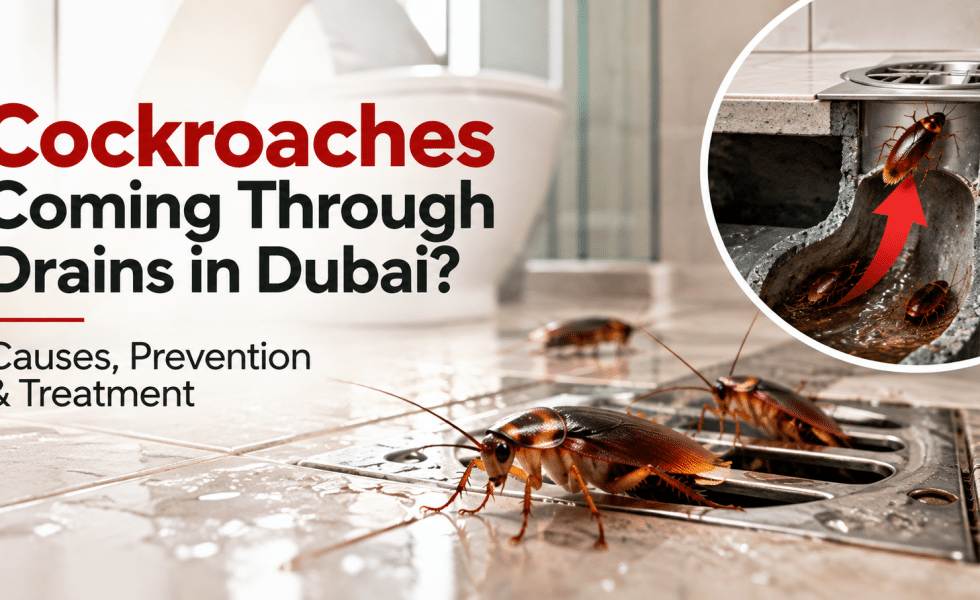
Cockroaches Coming Through Drains in Dubai? Causes, Prevention & Treatment.
Cockroaches Coming Through Drains in Dubai? Causes, Prevention & Treatment
You walk into the bathroom or kitchen at night and suddenly notice a large cockroach near the floor drain. You remove it, clean the area and assume the problem is solved—only to find another one a few days later.
If this keeps happening, you may naturally wonder: are cockroaches coming through the drains?
In some Dubai properties, drainage systems, manholes, pipe openings and other damp environments can be associated with cockroach activity. However, seeing a cockroach beside a drain does not automatically prove that it came directly through the drain opening.
The key is identifying where the cockroaches are actually coming from before deciding how to treat the problem.
Can Cockroaches Really Come Through Drains?
Yes, cockroaches can sometimes move through drainage-related environments and enter properties through accessible openings or gaps around plumbing systems.
Certain cockroaches are well adapted to dark, humid environments where water and organic material may be available. Drainage areas, sewer systems, manholes and utility spaces can therefore provide suitable conditions for cockroach activity.
But the drain itself is only one possibility.
A cockroach found near a bathroom drain may also have entered through a gap around a pipe, an opening beneath a door, a service shaft, a wall cavity or another structural route.
This is why repeated activity requires investigation rather than assuming every cockroach near a drain has travelled directly through the pipe.
Why Are Cockroaches Attracted to Drainage Areas?
Cockroaches generally look for three basic things: food, water and shelter.
Drainage environments can sometimes provide several of these conditions at once.
Potential attractions include:
- Moisture and standing water
- Organic residue
- Dark and protected spaces
- Cracks and gaps around plumbing
- Connections to external drainage environments
- Nearby waste or food residue
In Dubai’s warm climate, suitable protected environments can support pest activity throughout much of the year.
What Type of Cockroach Is Commonly Found Around Drains?
Large cockroaches found around drains, bathrooms, utility areas and manholes may sometimes be American cockroaches.
American cockroaches are much larger than German cockroaches and are generally reddish-brown in appearance.
They may be associated with:
- Drainage systems
- Manholes
- Sewer environments
- Utility rooms
- Basements
- Garbage and waste areas
- Damp external spaces
By comparison, the small cockroaches commonly found inside kitchen cabinets and around appliances are often German cockroaches.
Correct identification matters because a kitchen infestation involving German cockroaches may require a different treatment strategy from large cockroaches associated with drainage or external environments.
Why Do Cockroaches Come Through Bathroom Drains?
Bathrooms contain several features that can attract or provide access for cockroaches.
There is regular moisture, multiple plumbing connections and often several concealed structural openings.
If you repeatedly notice cockroaches around a bathroom, check areas such as:
- Floor drains
- Sink plumbing
- Pipe penetrations
- Gaps around sanitary fittings
- Utility openings
- Areas beneath cabinets
- Door gaps
Remember that finding a cockroach beside a floor drain doesn’t necessarily identify the drain as the exact entry point.
Why Are Cockroaches Appearing From Kitchen Drains?
Kitchens provide even more potential attractions because food and water are often available in the same area.
Food residue around sinks, moisture beneath cabinets, leaking plumbing, waste bins and grease or organic material can all contribute to pest activity.
If cockroaches repeatedly appear around the kitchen sink or drainage area, the problem may involve both an accessible entry route and favourable conditions inside the kitchen.
Cleaning the drain while ignoring food residue, plumbing gaps or nearby harbourage may therefore fail to solve the underlying problem.
Does Seeing One Cockroach Near a Drain Mean You Have an Infestation?
Not necessarily.
An occasional large cockroach may enter a property from an external environment without establishing an indoor infestation.
However, repeated sightings deserve attention.
Possible warning signs include:
- Large cockroaches appearing regularly at night
- Repeated sightings in the same bathroom or kitchen
- Cockroaches appearing around several drains
- Activity around manholes or external drainage areas
- Cockroaches emerging from plumbing or structural gaps
- Multiple cockroaches appearing over a short period
If the problem continues despite cleaning and basic prevention, professional inspection can help identify the source.
How Do You Stop Cockroaches Coming Through Drains?
There is no single solution that works for every drainage-related cockroach problem because the actual entry route can vary.
A more effective approach is to combine inspection, sanitation, entry-point management and appropriate pest-control treatment.
1. Keep Drain Areas Clean
Regular cleaning can reduce organic residue that may attract pests.
Kitchen sinks and surrounding surfaces should be kept free from food debris, grease and standing water wherever practical.
2. Check for Water Leaks
Inspect areas under sinks, around plumbing and inside cabinets for leaks or persistent moisture.
Even small water sources can create favourable conditions for cockroaches.
3. Inspect Gaps Around Pipes
Plumbing penetrations can leave small openings between pipes, cabinets, walls and floors.
These gaps may provide pest entry routes even when the actual drain opening is not responsible.
Once active pest issues have been assessed, suitable gaps can be sealed where appropriate.
4. Check External Drainage Areas
For villas and ground-floor properties, external drainage areas and manholes may also need attention.
If large numbers of cockroaches are active outside the property, repeatedly treating only the bathroom or kitchen may provide limited results.
5. Use Appropriate Drain Covers Where Suitable
Properly fitting drain covers can help reduce access through certain openings when appropriate for the drainage system.
However, covers alone will not solve activity originating from pipe gaps, structural openings or other parts of the property.
Should You Pour Insecticide Down the Drain?
Pouring household insecticide or other chemicals into a drain is not a good general solution.
The product may not reach the actual cockroach harbourage, and using chemicals in ways that are inconsistent with their instructions can create unnecessary risks.
Drainage-related infestations should instead be assessed so that treatment can be directed toward the actual areas of activity using products and methods appropriate for the situation.
Why Does Spraying the Bathroom Not Stop the Cockroaches?
If the cockroaches originate from a drainage system, external environment, manhole or concealed entry point, spraying visible bathroom surfaces may kill individual cockroaches without addressing the source.
This can create a cycle:
Cockroach appears → spray is applied → cockroach disappears → another cockroach appears later.
The problem continues because only the visible insect is being treated.
Professional cockroach control in Dubai should therefore investigate where the activity originates and which conditions are allowing cockroaches to enter the property.
Cockroaches Coming Through Drains in Dubai Apartments
Apartments can present additional challenges because plumbing, service ducts and other building systems may connect multiple areas of the property.
A cockroach problem may not always originate entirely within one apartment.
Potential pathways can include:
- Shared plumbing routes
- Service shafts
- Structural gaps
- Common drainage systems
- Utility areas
- Neighbouring units or shared spaces
If drainage-related cockroach activity repeatedly returns despite treatment inside the apartment, the broader building environment may need to be considered.
Cockroaches Coming Through Drains in Dubai Villas
Villas can have a different set of risk factors.
External drainage points, gardens, waste areas, utility spaces and manholes around the property can contribute to cockroach activity.
Large cockroaches found inside a villa may sometimes originate outdoors and enter through gaps, doors, drainage-related areas or other openings.
Inspection should therefore consider both the interior and relevant external areas rather than focusing exclusively on the room where the cockroach was found.
What About Restaurants and Commercial Kitchens?
Drainage-related cockroach activity can be particularly concerning in restaurants, cafés, food-preparation facilities and commercial kitchens.
These environments can provide food, moisture, warmth and multiple potential harbourage areas.
Effective control may require attention to:
- Floor drains
- Sink and plumbing areas
- Grease and food residue
- Waste-storage areas
- Equipment and appliances
- Structural gaps
- External drainage and service areas
Good sanitation and professional pest management should work together rather than being treated as separate issues.
How Does Professional Drain Cockroach Treatment Work?
The first step should be inspection.
A pest-control professional can assess where cockroaches are being seen, identify likely cockroach species and investigate potential harbourage and entry routes.
Depending on the findings, treatment may involve targeted pest-control measures around relevant areas, together with recommendations for sanitation, moisture management and entry-point reduction.
The exact treatment should depend on the property and infestation rather than applying the same method to every drain.
How Can You Reduce Drain-Related Cockroach Problems?
Prevention should focus on making the property less accessible and less attractive to cockroaches.
- Keep kitchens and bathrooms clean and dry where practical
- Remove food residue promptly
- Clean waste bins regularly
- Repair plumbing leaks
- Inspect gaps around pipes and fixtures
- Use suitable drain covers where appropriate
- Monitor external drainage and manhole areas
- Address recurring activity rather than repeatedly killing individual cockroaches
These measures can reduce risk, but established or recurring activity may still require professional treatment.
When Should You Call a Cockroach Control Professional?
Consider arranging professional inspection when:
- Cockroaches repeatedly appear from or around drains
- You see large cockroaches several times per week
- Several bathrooms or drainage areas are affected
- DIY sprays provide only temporary results
- Activity appears to originate from manholes or external drains
- Cockroaches are affecting a restaurant or commercial property
- You cannot identify where the cockroaches are entering
Finding the source can be more important than simply treating the location where the cockroach was last seen.
Professional Cockroach Control in Dubai
If cockroaches keep appearing around your drains, bathroom or kitchen, don’t assume that repeatedly spraying the visible insects will solve the problem.
The source may involve drainage areas, plumbing gaps, structural openings, external environments or other hidden harbourage.
Alpha Arabian Cleaning Services LLC provides professional cockroach control in Dubai for apartments, villas, restaurants and commercial properties.
Our approach focuses on inspecting the property, identifying likely cockroach activity and applying an appropriate treatment strategy based on the conditions found.
Contact Alpha Arabian today to arrange professional cockroach inspection and treatment in Dubai.
Frequently Asked Questions
Can cockroaches come up through bathroom drains?
Cockroaches can sometimes move through drainage-related environments and accessible openings. However, a cockroach found near a bathroom drain may also have entered through plumbing gaps, service areas or other structural openings.
Why do I see cockroaches in my bathroom at night?
Cockroaches are generally more active at night. Bathrooms can provide moisture, shelter and potential access through plumbing or structural openings, making them common areas for sightings.
What type of cockroach comes from drains?
Large cockroaches associated with drainage environments may sometimes be American cockroaches. Proper identification is recommended because different cockroach species can require different treatment approaches.
Will covering my drain stop cockroaches?
A suitable drain cover may reduce access through a particular opening, but it will not prevent cockroaches entering through gaps around pipes, doors, service shafts or other structural routes.
Does bleach kill cockroaches in drains?
Household drain-cleaning products should be used only for their intended purpose and according to their instructions. They should not be relied upon as a complete cockroach-control strategy because they may not address the actual harbourage or entry route.
Why do cockroaches keep returning after I spray them?
Spraying may kill the cockroaches you can see without treating insects or harbourage in drainage systems, structural gaps or other concealed locations. Identifying the source is important when activity repeatedly returns.
Do I need pest control if I only see one cockroach?
One occasional cockroach does not necessarily indicate an established indoor infestation. However, repeated sightings, multiple cockroaches or recurring activity around the same drain or room should be investigated.
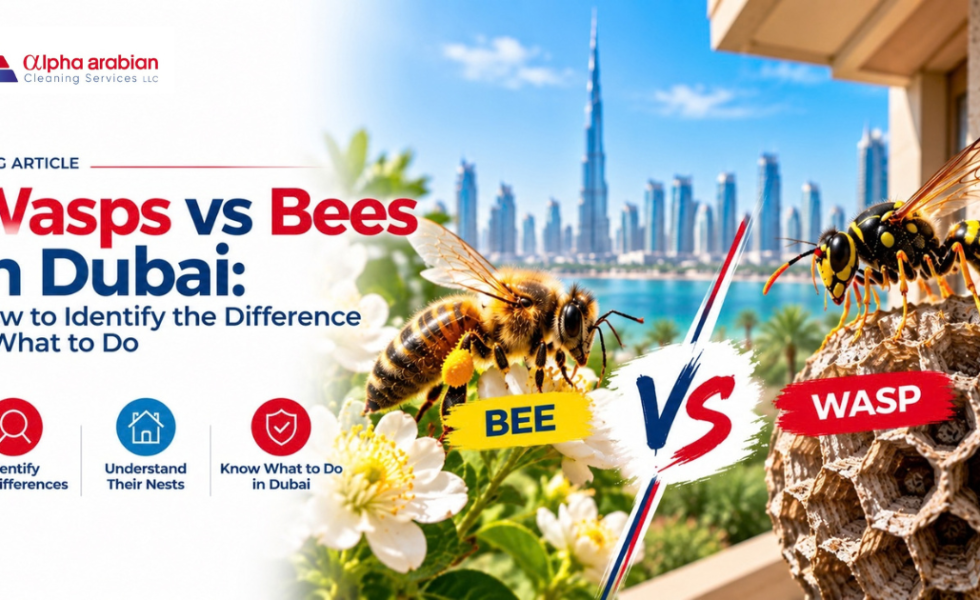
Wasps vs Bees in Dubai: How to Identify the Difference & What to Do
Wasps vs Bees in Dubai: How to Identify the Difference & What to Do
Wasps and bees are not the same, and identifying them correctly matters before attempting any type of removal. Bees generally have hairier, more robust bodies and play an important role as pollinators, while many wasps have smoother bodies, narrower waists and different nesting behaviour.
If you find a flying insect nest around your villa, balcony, garden or commercial property in Dubai, avoid disturbing it until you know whether you’re dealing with bees or wasps.
The appropriate response can be very different. A suspected wasp nest may require professional wasp control in Dubai, while a honey-bee colony may require assessment for bee hive removal in Dubai and, where appropriate and feasible, possible relocation.
This guide explains the differences between wasps and bees, how their nests differ, why they may appear around Dubai properties, what to do when you find them and when professional assistance may be appropriate.
What Is the Main Difference Between Wasps and Bees?
The easiest visible difference between many bees and wasps is their body structure.
Bees generally appear hairier and more robust, while many wasps have smoother bodies with a more noticeable narrow waist.
However, appearance varies between species, so colour alone should not be used for identification.
Some wasps and bees can look similar, particularly when they are flying. If there is an active nest, you should not move closer simply to identify the insect.
Wasps vs Bees: Quick Comparison
| Feature | Bees | Wasps |
|---|---|---|
| Body | Often hairier and more robust | Often smoother with a narrower waist |
| Role | Important pollinators | Many species are predators of other insects and may also visit food sources |
| Nest | Honey bees construct wax comb | Many social wasps construct paper-like nests |
| Food attraction | Often associated with flowers, nectar and pollen | Some species may be attracted to sweet foods, waste or other insects |
| Behaviour around nest | May defend an established colony if threatened | Some social wasps may strongly defend their nest when disturbed |
| Recommended response | Identify and assess before removal; relocation may sometimes be considered | Avoid disturbing an active nest and arrange appropriate assessment/control where necessary |
How Can You Identify a Bee?
Many bees have relatively rounded bodies covered with visible hairs. These hairs help collect pollen while bees move between flowers.
Depending on the species, bees may appear yellow, brown, black, golden or a combination of these colours.
You may notice bees:
- Visiting flowering plants
- Moving between garden areas
- Collecting pollen
- Gathering temporarily in a large cluster
- Repeatedly entering and leaving a particular structural opening
A few bees visiting flowers usually does not mean you have a bee hive on your property.
However, repeated activity concentrated around one opening, roof space, wall cavity or other sheltered location can indicate that a colony may be present.
How Can You Identify a Wasp?
Many wasps have a smoother and more slender appearance than bees.
A narrow waist between the thorax and abdomen is another common characteristic of many wasp species.
Depending on the species, wasps may be seen around:
- Building eaves
- Balconies
- Gardens
- Outdoor dining areas
- Waste areas
- Roof structures
- Wall openings
- Sheltered external structures
Some wasps also hunt other insects, while others may investigate sweet food, drinks or waste.
If wasps repeatedly travel to and from one particular location, there may be a nest nearby.
What Does a Bee Hive Look Like?
Honey bees construct wax comb made up of hexagonal cells.
An exposed colony may make this structure relatively easy to recognise, but colonies can also establish themselves inside protected cavities where the comb cannot be seen from outside.
In those situations, you may only notice bees repeatedly entering and leaving through a small opening.
Potential nesting locations around a property can include:
- Wall cavities
- Roof spaces
- Building gaps
- Balcony structures
- Trees
- Garden structures
- Other protected cavities
If you’ve discovered a suspected colony, see our guide to bee hive removal in Dubai for more information about identifying swarms and established hives.
What Does a Wasp Nest Look Like?
Many social wasps build nests using material created from chewed plant or wood fibres.
This can give the nest a grey, brown or paper-like appearance.
The exact structure varies considerably between species.
Wasps may establish nests in protected areas such as:
- Under roof edges
- Around eaves
- Balconies
- Sheds
- Garden structures
- Wall cavities
- External building gaps
If you’ve found a suspected nest, avoid touching, knocking or spraying it without first understanding what you’re dealing with.
Our guide to wasp control in Dubai explains how to recognise common warning signs and what to do when a nest is discovered.
Bee Hive vs Wasp Nest: How Can You Tell the Difference?
The material used to construct the nest is one of the clearest differences.
Honey bees produce wax comb with recognisable hexagonal cells. Many social wasps, by comparison, construct nests from a paper-like material.
However, you may not always be able to see the nest.
If insects are disappearing through a small opening in a wall, roof or other structure, identification may require observing their appearance and behaviour from a safe distance.
Do not put yourself at risk by approaching an active nest simply to determine which insect is present.
Why Are Bees Coming to My Dubai Property?
Seeing bees around your property does not necessarily indicate a pest problem.
Bees may simply be visiting flowering plants for nectar and pollen.
However, larger numbers may sometimes appear when bees are swarming or searching for a suitable nesting location.
A temporary swarm can form when a group of honey bees leaves an established colony and searches for a new home.
During this process, bees may temporarily gather on:
- Trees
- Walls
- Balcony structures
- Fences
- Other sheltered surfaces
A swarm should not automatically be treated as an established hive.
Why Are Wasps Coming to My Dubai Property?
Wasps may visit a property for several reasons.
Depending on the species, they may be searching for food, water, other insects or a protected nesting location.
Outdoor areas containing food and waste can sometimes attract wasps.
Suitable sheltered building features can also provide potential nesting locations.
Repeated wasp activity concentrated around one particular area is more significant than an occasional wasp flying through a garden.
Are Wasps More Dangerous Than Bees?
It isn’t useful to assume that every wasp is dangerous or every bee is harmless.
Both bees and wasps can sting when threatened, particularly when an established colony or nest is disturbed.
The level of risk depends on the species, circumstances, nest location and proximity to people.
A nest beside a frequently used doorway, balcony, children’s play area or outdoor seating area can create a greater chance of accidental disturbance.
People with known severe insect-sting allergies should be particularly cautious around active bee or wasp colonies.
If someone develops symptoms of a severe allergic reaction after a sting—such as difficulty breathing, swelling of the face or throat, dizziness or collapse—seek emergency medical assistance immediately.
Do Bees and Wasps Sting Differently?
Stinging behaviour varies by species.
A commonly discussed difference is that a worker honey bee may leave its barbed stinger behind after stinging a person, whereas many wasps can sting more than once.
However, you should not rely on this distinction when deciding whether it is safe to approach a nest.
The safest approach is to avoid disturbing either insect when significant nest activity is present.
What Should You Do If You Find a Bee or Wasp Nest?
If you discover an active nest, the first priority is simple:
Keep a safe distance and don’t disturb it.
You should also:
- Keep children away from the area
- Keep pets away from the nest
- Avoid hitting or shaking it
- Avoid blocking an active entrance
- Don’t attempt to knock the nest down
- Avoid uncontrolled DIY spraying
- Observe activity only from a safe distance
If possible, safely note where the insects are entering and leaving.
A photograph taken from an appropriate distance may also help with initial identification.
Should You Spray a Bee Hive or Wasp Nest?
Do not automatically spray a nest simply because flying insects are present.
There are two important reasons.
First, disturbing an active colony can provoke defensive behaviour and increase the risk of stings.
Second, you may not have correctly identified the insect.
Bees and wasps should not automatically receive identical treatment.
Correct identification should come before deciding on an appropriate removal or control method.
Can You Remove a Bee or Wasp Nest Yourself?
DIY removal can be risky, particularly when the nest is active, elevated, concealed or located close to frequently occupied areas.
Professional assessment becomes more appropriate when:
- The nest is above head height
- A ladder would be required
- The colony is inside a wall or roof
- Large numbers of insects are present
- The nest is beside an entrance
- Children or pets regularly use the area
- The insect cannot be confidently identified
- Someone nearby has a known severe sting allergy
The objective should not simply be to remove something that looks like a nest. The insect, colony location and surrounding conditions should first be understood.
What Is the Difference Between Bee Removal and Wasp Control?
The appropriate management approach can differ considerably.
Bees are important pollinators, and where circumstances, species, accessibility and practical conditions allow, removal or relocation may sometimes be considered.
Not every bee colony can necessarily be relocated, particularly when it is deeply established inside an inaccessible structural cavity.
Wasp management generally focuses on assessing the nest, the species involved, its location and the risk it presents before selecting an appropriate control approach.
This is why professional identification should happen before treatment rather than after it.
Wasps and Bees Around Dubai Villas
Villas can provide numerous locations where bees or wasps may temporarily gather or establish nests.
These can include:
- Gardens
- Trees
- Roof edges
- Balconies
- External storage areas
- Wall openings
- Garden structures
- Utility areas
Regularly checking less-used external areas can help identify developing activity before a nest becomes difficult to access.
If insects repeatedly travel to the same location, avoid sealing the opening until the activity has been properly assessed.
Wasps and Bees Around Apartments
Apartment residents may notice bee or wasp activity around balconies, windows, external AC areas or building openings.
An occasional flying insect does not necessarily indicate a nearby nest.
Repeated traffic to the same structural location is more important.
Because some nesting areas may be outside an individual apartment or within shared building structures, building management may also need to be involved depending on the location.
Wasps and Bees Around Restaurants and Commercial Properties
Restaurants, cafés, hotels and other commercial premises can experience flying-insect activity around outdoor areas, landscaping, waste zones and food-service locations.
The first step should still be correct identification.
A bee swarm resting temporarily outside a property should not automatically be treated as though it were an established wasp nest.
Where activity creates a potential risk for customers, employees or visitors, professional assessment can help determine the appropriate response.
How Can You Reduce the Risk of Wasps Nesting Around Your Property?
It isn’t possible to prevent every flying insect from entering an outdoor space, but maintaining the property can reduce some nesting opportunities.
Consider:
- Inspecting roof edges and external structures
- Maintaining balconies and storage areas
- Managing waste properly
- Cleaning food residue from outdoor dining areas
- Checking rarely used exterior spaces
- Repairing suitable structural gaps after confirming they are inactive
Never seal an opening that is actively being used by bees or wasps without first determining what is inside.
When Should You Call a Pest Control Professional?
Professional assistance should be considered when there is an established or suspected nest, large numbers of insects, recurring activity, a concealed colony or uncertainty about whether the insects are bees or wasps.
This is particularly important when the activity occurs close to people.
If you’re experiencing other pest problems around the property as well, professional pest control services in Dubai can help identify the pest and determine an appropriate management approach.
Professional Wasp and Bee Assessment in Dubai
The most important step when you discover a bee hive or wasp nest is correct identification.
A temporary bee swarm, established honey-bee colony and active wasp nest are different situations and should not automatically receive the same treatment.
Alpha Arabian Cleaning Services LLC provides professional pest-management services across Dubai for villas, apartments and commercial properties.
If you’ve discovered an active nest or recurring bee or wasp activity, professional assessment can help identify the insect, locate the nesting area and determine an appropriate course of action.
Not sure whether you have bees or wasps? Contact Alpha Arabian for professional identification and pest-management assistance in Dubai.
Frequently Asked Questions About Wasps vs Bees in Dubai
How can I quickly tell a bee from a wasp?
Many bees have hairier, more robust bodies, while many wasps appear smoother and have a narrower waist. However, appearance varies between species, so professional identification may be necessary when a nest is present.
How can I tell a bee hive from a wasp nest?
Honey bees construct wax comb with hexagonal cells. Many social wasps construct nests from a grey or brown paper-like material. Concealed nests may be difficult to identify without observing insect activity.
Why are bees suddenly gathering outside my house?
A large temporary cluster may be a bee swarm searching for a new nesting location. It does not necessarily mean an established hive is already present.
Why do wasps keep returning to the same area?
Repeated activity may indicate access to food, water, prey or a nearby nesting site. Wasps repeatedly entering the same structural opening can indicate a nest nearby.
Should I spray a bee or wasp nest?
Do not automatically spray an active nest. Disturbance can increase the risk of stings, and the insect should be correctly identified before deciding on an appropriate management approach.
Can bees and wasps build nests inside walls?
Depending on the species, both may use protected structural cavities. Repeated insects entering and leaving the same opening can be an important sign of nesting activity.
Should I block the hole they’re entering?
Not while the opening is actively being used. Blocking an entrance without addressing the colony can create additional problems and may cause insects to seek another route.
Are all bees and wasps aggressive?
No. Behaviour varies by species and situation. However, both bees and wasps may defend an established colony or nest when they perceive a threat.
Can a bee hive be relocated?
Relocation may be possible in some circumstances depending on the species, colony location, accessibility and practical conditions. It is not feasible for every colony.
Who should I call if I don’t know whether I have bees or wasps?
Contact an appropriately qualified pest-management or bee-removal professional who can identify the insect and assess the nesting location before recommending a response.

Ant Control in Dubai: Why Ants Keep Coming Back & How to Stop Them
Ant Control in Dubai: Why Ants Keep Coming Back & How to Stop Them
Seeing a few ants in your kitchen may not seem like a serious problem. But when the same ant trails return day after day—even after cleaning or spraying—the visible ants may only be a small part of a larger colony.
Effective ant control in Dubai is not simply about killing the ants you can see. Ants may be nesting in wall gaps, around kitchens, beneath flooring, outdoors, or in other protected areas and travelling between their nest and available food or water sources.
Ants are one of the common pest problems affecting residential and commercial properties in Dubai. If you’re dealing with multiple pest issues, professional pest control services in Dubai can help identify the source and determine an appropriate treatment.
This guide explains why ants keep coming back, what attracts them to Dubai properties, common methods for ant control, why some DIY treatments provide only temporary results, and practical ways to help prevent another infestation.
Why Do Ants Keep Coming Back?
One of the most common frustrations with an ant problem is that it appears to disappear after cleaning or spraying, only to return a few days later.
The reason can be relatively simple: you may have removed the visible ants without addressing the colony or the conditions attracting them.
Worker ants leave their nesting area to search for food and water. Once they locate a suitable source, they can establish trails that other workers follow.
Removing those workers may temporarily reduce visible activity, but if the colony remains active, more ants can appear.
Recurring ant activity can therefore be associated with:
- Accessible food
- Crumbs and food residue
- Moisture or water sources
- Unsealed food containers
- Waste bins
- Pet food
- Structural gaps
- Suitable nesting locations
- Established colonies nearby
This is why professional ant control in Dubai should focus on understanding where the ants are coming from rather than treating only the ants that happen to be visible.
Why Are Ants Common in Dubai Homes?
Ants are highly adaptable insects and can exploit very small opportunities to enter residential properties.
In Dubai, they may be found around villas, apartments, kitchens, balconies, gardens, bathrooms, utility areas and commercial premises.
Air-conditioned indoor environments don’t necessarily prevent ants from entering. If food, water and suitable access points are available, ants can establish trails into occupied spaces.
Properties with gardens and landscaped outdoor areas may also experience activity originating outside the building.
The important question isn’t simply “Where are the ants?” It’s “Where are they coming from, and what is attracting them?”
That distinction can make a significant difference to the effectiveness of an ant-control strategy.
What Attracts Ants Into Your Home?
Ants usually enter properties while searching for food, water or suitable nesting conditions. Several everyday conditions can make a property more attractive to foraging ants.
1. Food Residue
Even very small amounts of food can attract ants.
Common sources include:
- Crumbs
- Sugar and sweets
- Fruit
- Cooking residue
- Grease
- Open food packaging
- Pet food
Kitchen counters, cabinets, dining areas and spaces underneath appliances can therefore become frequent ant-activity zones.
2. Water and Moisture
Ants also require water. Activity may occur around sinks, bathrooms, leaking plumbing, damp areas, plant pots and other moisture sources.
3. Waste Bins
Food residue inside or around waste bins can provide a consistent food source. Regular cleaning and properly closed bins can help reduce this attraction.
4. Small Entry Points
Ants can enter through very small openings around:
- Doors
- Windows
- Wall cracks
- Pipes
- Utility penetrations
- Balcony areas
- Skirting
- Cabinet gaps
Finding these routes can be more useful than simply spraying the visible trail.
5. Outdoor Landscaping
Gardens, plants, soil and landscaped areas naturally support insect activity.
Ants nesting outdoors may eventually begin foraging around the building, particularly when food or water is easily available.
Why Are Ants Appearing in My Kitchen?
The kitchen is one of the most common places to notice ants because it provides several potential food and water sources in a relatively small area.
You might clean the visible countertop and still continue seeing ants because food residue can accumulate in less obvious places.
Check areas such as:
- Behind appliances
- Under cabinets
- Around waste bins
- Beneath dining furniture
- Inside cupboards
- Around sinks
- Along wall edges
If you notice ants travelling in a relatively consistent line, observe the trail and determine where they appear to be entering the room.
Don’t assume that the point where you see the largest number of ants is necessarily where the colony is located.
Kitchens can attract more than ants. Food residue, moisture and hidden spaces can also contribute to cockroach activity. If you’re experiencing recurring cockroach problems as well, read our guide on why cockroaches keep coming back after treatment.
Does Killing the Ants You See Solve the Problem?
Not necessarily.
The ants travelling across your countertop or floor are typically worker ants. The colony itself may contain many more ants in a protected nesting area.
This is one reason indiscriminately spraying visible ants can sometimes produce disappointing long-term results.
You may kill the workers you can see while leaving the underlying colony unaffected.
A more complete ant pest control strategy considers:
Species → Trail → Food/Water Source → Entry Point → Nesting Area → Appropriate Control Method
This approach addresses the cause of recurring activity rather than focusing exclusively on the symptom.
What Are the Most Effective Methods for Ant Control?
There isn’t one universal treatment for every ant problem.
The appropriate method depends on factors such as the type of ant, colony location, level of activity and property conditions.
Professional ant control may therefore involve a combination of approaches.
Inspection
An inspection helps determine where ants are active, their likely entry routes, potential food and water sources, and possible nesting locations.
This should come before simply applying products throughout the property.
Ant Baiting
Baiting may be appropriate for certain ant infestations.
Worker ants encounter the bait and can carry it back towards the colony. The type and placement of bait matter, which is why random application may not produce the expected result.
Targeted Treatment
Depending on the infestation and species involved, targeted treatment may be applied to specific ant-active locations.
The objective should be to address identified activity rather than unnecessarily treating every surface.
Entry-Point Management
Structural gaps and openings can allow ants to continue entering the property.
Once active nesting areas have been appropriately addressed, suitable entry points may be sealed as part of longer-term prevention.
Sanitation and Environmental Management
Pest treatment alone cannot compensate indefinitely for readily available food and water.
Cleaning food residue, controlling waste and addressing moisture can therefore form an important part of an integrated approach.
Why Doesn’t Ant Spray Always Work?
Household sprays can kill ants they directly contact.
The problem is that the ants you see may represent only a portion of the colony.
Repeated spraying without understanding the infestation can therefore become a cycle:
Ants appear → Spray → Visible ants disappear → New workers arrive → Spray again.
It can look like the treatment worked initially when the underlying source was never addressed.
Different ant species can also respond differently to control methods. That’s another reason identification and targeted ant control in Dubai can be more effective than relying entirely on general-purpose spraying.
Can Ants Nest Inside Walls?
Yes. Depending on the species and property conditions, ants can sometimes establish nests in protected areas within or around structures.
Possible locations can include:
- Wall voids
- Gaps around cabinets
- Flooring edges
- Utility areas
- Roof or ceiling spaces
- External cracks
- Garden areas
- Spaces around pipes
If ants repeatedly emerge from the same crack or opening, simply sealing it immediately may not address the colony.
The activity should first be assessed.
How Can You Prevent Ant Infestations in Your Dubai Home?
Preventing every ant from entering an outdoor or residential environment isn’t realistic. However, you can make your property considerably less attractive to them.
Keep Food Properly Stored
Store sugar, sweets, cereals, snacks and other foods in properly closed containers. Clean spills promptly, particularly sugary liquids.
Clean Kitchen Surfaces Regularly
Wipe counters and dining surfaces and pay attention to less-visible areas around appliances and cabinets.
Don’t Leave Pet Food Out Unnecessarily
Pet bowls can provide ants with a readily accessible food source. Clean the surrounding area regularly.
Manage Waste Properly
Use bins with suitable lids and clean food residue from the surrounding area.
Address Moisture
Check for dripping taps, plumbing leaks and persistent damp areas.
Inspect Entry Points
Look around doors, windows, pipe penetrations and structural gaps for possible ant access.
Maintain Outdoor Areas
For villas in particular, gardens and external areas should be maintained and monitored for recurring ant activity near the structure.
Prevention works best when combined with appropriate treatment of an existing colony rather than being used as a substitute for addressing an established infestation.
Ant Control for Villas in Dubai
Villas can present different ant-control challenges from apartments.
Gardens, external walls, patios, landscaping, service areas and multiple access points can create a larger interface between the building and outdoor insect activity.
If ants repeatedly enter a villa, inspection should therefore consider both the interior and exterior environment.
Treating only the kitchen may not solve an infestation originating from an outdoor colony.
Professional ant control in Dubai villas can include inspection of trails, likely nesting areas, external activity and entry points before determining the appropriate control strategy.
Ant Control for Apartments in Dubai
Ants can also become a recurring problem in apartments.
They may enter through small structural gaps, balconies, utility penetrations or other access points.
In multi-unit buildings, the source of activity may not always be limited to the exact location where ants are first noticed.
Recurring activity should therefore be assessed rather than repeatedly treated with household spray alone.
Ant Control for Restaurants and Commercial Properties
For restaurants, cafés, food businesses, offices, warehouses and other commercial properties, ant activity can become more than a simple nuisance.
Food-handling environments in particular require strong sanitation, monitoring and pest-management procedures.
Potential problem areas include:
- Kitchens
- Food preparation areas
- Storage rooms
- Waste areas
- Staff pantries
- Outdoor dining areas
- Loading and delivery zones
A professional pest-management programme can combine inspection, targeted treatment, monitoring and preventive recommendations appropriate to the premises.
DIY Ant Control vs Professional Ant Control
For occasional ants, basic sanitation and removing an obvious food source may be enough to stop the activity.
Recurring infestations are different.
If ants continue returning despite cleaning and basic preventive measures, there may be a colony or ongoing entry route that hasn’t been addressed.
Professional ant control becomes particularly useful when:
- Ants return repeatedly
- Several rooms are affected
- Large numbers appear
- The trail cannot be traced
- Ants emerge from walls or structural gaps
- Kitchen activity continues despite cleaning
- DIY treatments provide only temporary results
- A restaurant or commercial property is affected
The goal isn’t simply to use a stronger chemical. The goal is to understand why the infestation is occurring and select an appropriate method accordingly.
Different pests also require different approaches. For example, attempting DIY treatment around an active wasp nest can present different risks from dealing with an ant trail. Read our guide to wasp control in Dubai if you’ve discovered a suspected wasp nest around your property.
How Long Does Ant Control Take?
There is no single timeframe that applies to every infestation.
The result depends on factors such as:
- Ant species
- Colony size
- Nest location
- Property conditions
- Treatment method
- Access to food and water
- Whether multiple colonies are involved
Some treatments are intentionally designed to work through ant activity rather than producing an immediate disappearance of every visible worker.
For that reason, the appropriate treatment should be judged according to the method being used and the infestation being treated.
Avoid expecting every ant problem to disappear instantly after one application.
When Should You Call a Professional for Ant Control?
A few occasional ants don’t always indicate a major infestation.
However, professional assessment is worth considering if you notice persistent trails, repeated kitchen activity, ants emerging from structural gaps, activity in multiple rooms, or ants returning shortly after DIY treatment.
The sooner the source is identified, the easier it may be to prevent the activity from becoming an ongoing problem.
Not every insect problem around a property should be treated in the same way. If you’ve noticed bees gathering around your balcony, roof or garden, read our guide to bee hive removal in Dubai before attempting to disturb them.
Professional Ant Control in Dubai
Recurring ants are often a sign that simply killing the visible insects isn’t addressing the full problem.
Effective ant control in Dubai starts with identifying where the ants are active, what is attracting them, where they may be entering and which treatment approach is appropriate for the situation.
Alpha Arabian Cleaning Services LLC provides professional pest control services in Dubai for villas, apartments and commercial properties, including solutions for ants and other common pest problems.
Whether you’re dealing with ants in the kitchen, recurring trails around your villa or persistent activity at a commercial property, a professional inspection can help determine the source and appropriate treatment.
Need help with recurring ants? Contact Alpha Arabian for professional ant control services in Dubai.
Frequently Asked Questions About Ant Control in Dubai
Why do ants keep coming back after I spray them?
Spraying may kill visible worker ants without addressing the colony. If the nest, food source or entry route remains active, additional ants can continue appearing.
What is the best way to get rid of ants in a Dubai home?
The appropriate method depends on the ant species and source of the infestation. Cleaning food sources, managing moisture and identifying entry points can help, while recurring infestations may require targeted professional treatment.
Why are there suddenly ants in my kitchen?
Ants may have discovered food, water or another attractive resource. Once workers establish a route to that source, additional ants may follow the trail.
Can ants live inside walls?
Some ants can establish nests in protected structural areas or use wall gaps as travel routes. Repeated activity from the same opening should be investigated.
Should I seal a hole where ants are coming from?
If an active infestation is present, identify and address the source first. Simply sealing one visible opening may cause ants to use another route.
Are ant baits better than sprays?
They work differently. Contact sprays primarily affect ants they reach directly, while appropriately selected baits may be carried by foraging ants. The appropriate approach depends on the species and infestation.
How can I prevent ants from coming back?
Reduce accessible food and water, clean spills and crumbs, manage waste, address moisture and inspect suitable entry points. For recurring infestations, the colony itself may also need to be addressed.
Do I need professional pest control for a few ants?
Not necessarily. Occasional activity may be resolved by removing the food or water source. Repeated trails, large numbers or persistent activity are stronger reasons to arrange an inspection.

Bee Hive Removal in Dubai: What to Do If You Find Bees at Home
Finding a group of bees around your balcony, garden, roof, window, or villa entrance can be worrying—especially when their numbers suddenly increase. But seeing bees does not always mean there is an established hive inside your property.
Sometimes, you may be seeing a temporary bee swarm. In other situations, bees may have established a colony in a sheltered part of the building.
If you are looking for bee hive removal in Dubai, the first step is to identify what is happening and avoid disturbing the bees. Spraying, hitting, blocking, or attempting to remove an active hive without proper assessment can increase the risk of stings.
This guide explains how to identify a bee hive, the difference between a swarm and an established colony, where bees may settle around Dubai properties, what you should and shouldn’t do, and when professional assistance may be appropriate.
Why Are Bees Coming to Your Dubai Property?
Bees may visit a property simply because flowering plants, gardens, or other food sources are nearby. Individual bees collecting nectar or pollen outdoors do not necessarily indicate an infestation or hive.
The situation becomes more important when you notice large numbers of bees repeatedly gathering in one location.
Bees searching for a suitable nesting location may be attracted to sheltered areas that provide protection from weather and disturbance.
Around Dubai properties, potential locations can include:
- Balconies
- Roof spaces and roof edges
- Wall cavities
- Building gaps
- Garden structures
- Trees and shrubs
- Storage areas
- External utility spaces
- Areas around air-conditioning installations
- Other sheltered structural openings
Repeated bees entering and leaving the same opening can be an important indication that a colony may be established inside.
How Do You Know If You Have a Bee Hive?
One or two bees around flowering plants usually isn’t enough to indicate a hive.
Instead, look at the pattern of activity.
Signs that may indicate a bee colony include:
1. Bees Repeatedly Entering the Same Location
Watch from a safe distance.
If bees continuously enter and leave the same opening in a wall, roof, balcony, or other structure, there may be a colony inside.
2. A Visible Cluster of Bees
A large cluster hanging from a tree, building, railing, or another surface may be a swarm.
It can look alarming, but a swarm is not necessarily the same as an established hive.
3. Increasing Bee Activity
Occasional bees are normal around flowering vegetation.
Consistent activity concentrated around one particular area deserves closer attention.
4. Honeycomb or Wax Structures
Visible comb in a sheltered location can indicate that bees have begun establishing a colony.
Avoid touching or disturbing it.
5. Bees Appearing Inside the Property
Repeated bees indoors—particularly around the same room, ceiling, window, or wall—may indicate an entry point nearby.
Professional bee hive removal in Dubai should begin with determining whether the bees are temporarily resting or have established a colony.
Bee Swarm vs Bee Hive: What’s the Difference?
This distinction is important.
What Is a Bee Swarm?
Swarming is part of the natural reproductive process of honey bees.
A group of bees leaves an existing colony with a queen and searches for a new nesting location.
During this process, the bees may temporarily cluster together on a tree, wall, railing, or another surface.
The cluster can contain a large number of bees and may look like an established nest even when there is no comb.
A swarm may remain temporarily while scout bees search for a suitable location.
What Is an Established Bee Hive?
An established colony has settled in a location and begun building comb.
Bees may repeatedly travel between the nesting site and surrounding areas while maintaining the colony.
An established hive can therefore require a different approach from a temporary swarm.
This is why simply seeing a cluster of bees isn’t enough to determine the correct response.
What Should You Do If You Find a Bee Hive in Dubai?
If you discover a suspected bee hive or large cluster of bees, keep a safe distance and avoid disturbing them.
Keep children and pets away from the immediate area.
If possible, observe from a safe location and note:
- Where the bees are gathering
- Whether there is visible comb
- Whether bees are entering a structural opening
- How long the activity has been present
- Whether the number of bees is increasing
- Whether bees are entering occupied indoor areas
Photographs taken safely from a distance can also help with initial identification.
If the colony is close to an entrance, walkway, balcony, children’s area, or other frequently used space, professional assessment becomes particularly important.
What Should You NOT Do With a Bee Hive?
Several DIY approaches can make the situation more dangerous.
Don’t Hit or Shake the Hive
Physical disturbance can trigger defensive behaviour.
Don’t Spray Bees Indiscriminately
Household insecticide is not an appropriate first response to every bee situation.
Correct identification and assessment should come first.
Don’t Burn or Smoke the Hive Yourself
Using fire or uncontrolled smoke around a building introduces obvious safety risks and should not be attempted.
Don’t Block the Entrance
If bees are established inside a wall or structural cavity, simply sealing their visible entrance can create additional problems.
The bees may search for another route.
Don’t Attempt Removal From a Ladder
Trying to remove bees from a roof, balcony ceiling, or elevated structure creates both sting and fall hazards.
Professional bee removal in Dubai is a safer approach when a colony is active, inaccessible, or close to people.
Can You Remove a Bee Hive Yourself?
Small and apparently accessible hives can still contain a substantial number of bees.
Without suitable protective equipment, identification, experience, and an appropriate removal plan, DIY hive removal can result in multiple stings.
The risk increases when:
- The colony is large
- The hive is above head height
- Access requires a ladder
- Bees are inside a wall or roof
- The area is confined
- Children or pets are nearby
- The hive is close to a doorway
- Someone at the property has a known severe sting allergy
For these situations, professional bee hive removal in Dubai is generally the more appropriate option.
Should You Kill Bees or Relocate Them?
Bees are important pollinators, so bee management should not automatically be approached in the same way as controlling a typical household pest.
Where circumstances, species, accessibility, local requirements, and practical conditions allow, removal or relocation may be considered.
However, not every situation is suitable for relocation.
A colony deeply established inside a structural cavity, for example, can present very different challenges from an exposed swarm hanging from a tree.
The appropriate response should therefore be determined after assessing the specific situation.
Avoid claims from anyone promising that every bee colony can simply be relocated regardless of its location or condition.
How Does Professional Bee Hive Removal in Dubai Work?
The exact process depends on whether the bees are swarming or established, where they are located, and how accessible the area is.
A professional assessment will generally consider the following steps.
Step 1: Identify the Insect
Bees and wasps can be confused.
Correct identification should come before treatment or removal.
Step 2: Determine Whether It Is a Swarm or Colony
A temporary cluster without established comb may require a different response from a developed hive.
Step 3: Locate the Nesting Area
If bees are repeatedly entering a wall or other opening, the visible entrance may not reveal the exact location of the colony.
Step 4: Assess Accessibility and Risk
Technicians need to consider height, structural access, proximity to people, colony activity, and other site-specific conditions.
Step 5: Determine the Appropriate Removal Approach
The method should depend on the actual situation.
Where feasible and appropriate, removal or relocation can be considered.
Step 6: Address the Nesting Area
For established colonies, simply removing visible bees may not address comb or other material remaining at the nesting location.
The site should be assessed appropriately after removal.
Step 7: Recommend Prevention Measures
Once the colony has been properly addressed, suitable entry points or conditions that could encourage future nesting can be considered.
This assessment-based process is why professional bee hive removal in Dubai is preferable to simply spraying the insects you can see.
Bees vs Wasps: How Can You Tell the Difference?
Bees and wasps are frequently confused, but their management can differ considerably.
Many bees appear comparatively hairy or fuzzy and have more robust bodies.
Wasps often have smoother bodies, narrower waists, and a more slender appearance.
However, appearance varies by species, and trying to inspect an active nest closely is not advisable.
There are also differences in nest structure.
Honey bees create wax comb, while some wasps construct paper-like nests from chewed plant or wood fibres.
If you’re unsure whether you have a bee hive or wasp nest, arrange professional identification before attempting removal.
Are Bee Hives Dangerous?
A bee hive does not automatically mean people nearby will be attacked.
However, bees may defend their colony when they perceive a threat.
The risk becomes more significant when a hive is:
- Near an entrance
- Beside a walkway
- On a frequently used balcony
- Near children or pets
- Close to maintenance work
- Inside an occupied building
- In an area where accidental disturbance is likely
Stings can be particularly serious for individuals with severe insect-sting allergies.
If someone develops signs of a severe allergic reaction following a sting—such as difficulty breathing, swelling of the face or throat, dizziness, or collapse—seek emergency medical assistance immediately.
Why Are Bees Gathering on My Balcony?
A group of bees on a balcony does not automatically mean they are building a hive.
They may be temporarily resting during swarming, investigating a potential nesting location, or using nearby flowering plants as a food source.
However, repeated bees entering the same balcony gap or structural opening over several days can indicate that they are establishing or have established a colony.
Avoid sealing the opening until the activity has been professionally assessed.
Can Bees Build a Hive Inside a Wall?
Yes, bees can sometimes establish colonies within protected structural cavities where suitable access exists.
The challenge is that you may see only the entrance.
The actual comb may be located deeper inside the structure.
This makes DIY bee nest removal particularly difficult because blocking the external opening does not necessarily remove the colony or comb.
A professional assessment can determine the likely extent of the problem and the available options.
What Happens If a Bee Hive Is Left Inside a Property?
The answer depends on where the colony is located and whether it presents a practical risk.
A hive situated close to frequently occupied areas may increase the chance of accidental interaction with people.
Established colonies inside building cavities may also involve comb, wax, and stored material that should be considered as part of any removal plan.
For this reason, don’t focus only on getting rid of the visible bees.
The nesting site itself matters.
How Can You Help Prevent Bees From Nesting Around Your Property?
It isn’t possible—or desirable—to prevent bees from flying through outdoor spaces entirely.
Instead, prevention should focus on reducing suitable nesting opportunities around the building.
After confirming that no active colony is present:
- Repair appropriate structural gaps
- Maintain roof and external building areas
- Inspect infrequently used storage spaces
- Check balconies and external structures periodically
- Address openings around suitable utility penetrations
- Monitor locations where previous colonies occurred
Do not seal suspected entry points while bees are actively using them.
Bee Hive Removal for Dubai Villas
Villas can provide numerous potential nesting locations because of their gardens, roofs, balconies, external structures, landscaping, and storage areas.
If a swarm appears in a tree or a colony establishes itself near a villa entrance, avoid unnecessary disturbance.
Professional bee hive removal in Dubai can help establish whether the bees are temporarily swarming or have developed an established colony.
Bee Hive Removal for Commercial Properties
Bee activity can also become an issue around restaurants, hotels, offices, warehouses, schools, retail premises, and other commercial properties.
The priority should be protecting customers, employees, and visitors while determining an appropriate response to the colony.
Where bees are located close to customer entrances, outdoor dining areas, or high-traffic spaces, the situation should be assessed promptly.
When Should You Call for Professional Bee Hive Removal?
Consider professional assistance when:
- A large number of bees suddenly appear
- Bees repeatedly enter the same building opening
- You can see an established hive or comb
- Bees are appearing inside the property
- The colony is above ground level
- The hive is close to an entrance or walkway
- Children or pets use the affected area
- Someone nearby has a known severe sting allergy
- You’re unsure whether the insects are bees or wasps
Professional assessment is particularly useful when the colony is concealed or difficult to access.
Professional Bee Hive Removal in Dubai
The right response to bees depends on what you actually have.
A temporary swarm, an established honey-bee colony, and a wasp nest should not automatically receive the same treatment.
That’s why effective bee hive removal in Dubai begins with identification and inspection.
Alpha Arabian Cleaning Services LLC provides professional pest-management services across Dubai. If you have discovered a suspected bee hive, swarm, or recurring bee activity around your villa, apartment, or commercial property, the area can be assessed to determine an appropriate course of action.
Found a bee hive at your property? Contact Alpha Arabian for professional bee hive assessment and removal in Dubai.
Frequently Asked Questions About Bee Hive Removal in Dubai
Who should I call to remove a bee hive in Dubai?
If bees have established a colony on or within a property, contact an appropriately qualified pest-management or bee-removal professional who can first identify the insects, assess the location, and determine an appropriate removal approach.
What should I do if I suddenly see hundreds of bees?
Keep your distance and avoid disturbing them. A large temporary cluster may be a bee swarm rather than an established hive. Professional identification can help determine what is happening.
How long will a bee swarm stay?
A swarm may remain temporarily while scout bees search for a suitable nesting location. How long it remains can vary, so don’t rely on a specific timeframe or disturb the cluster in an attempt to make it leave.
Can I spray a bee hive?
Spraying an active bee colony yourself can provoke defensive behaviour and may expose people nearby to stings. Identification and assessment should come first.
Can a bee hive be relocated?
Relocation may be possible in some situations, depending on species, accessibility, colony condition, location, local requirements, and whether the hive can be safely accessed. It isn’t practical in every case.
Why do bees keep entering a hole in my wall?
Repeated entry and exit through the same opening can indicate a nesting site inside a structural cavity. Don’t seal the opening while it is actively being used.
What’s the difference between a bee hive and a wasp nest?
Honey bees construct wax comb, whereas many wasps build paper-like nests. Their physical appearance and behaviour also differ. Professional identification is recommended when you’re uncertain.
Is bee hive removal available for villas in Dubai?
Bee-related pest-management services can be provided for villas and other residential properties, but the appropriate approach depends on the location, accessibility, and type of activity found during inspection.
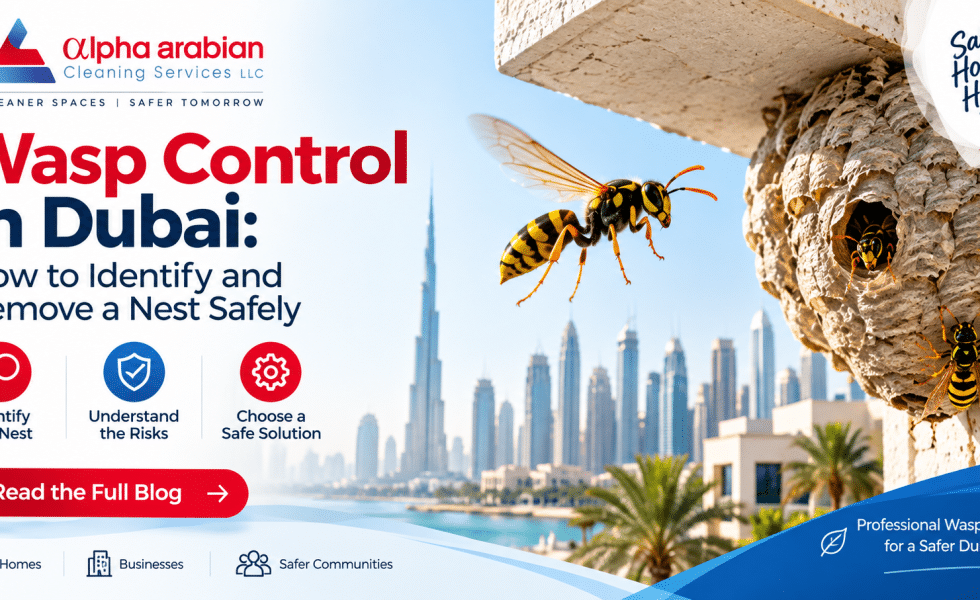
Wasp Control in Dubai: How to Identify and Remove a Nest Safely
Wasp Control in Dubai: How to Identify and Remove a Nest Safely
Wasps can quickly turn a quiet balcony, garden, villa entrance, or outdoor seating area into a place people prefer to avoid. While an occasional wasp outdoors may not indicate a serious problem, repeated activity around the same part of a property can suggest a nearby nest.
For homes and businesses, effective wasp control in Dubai starts with correctly identifying the insect, locating the nest, assessing the risk, and choosing a safe removal approach. Attempting to knock down, spray, burn, or disturb an active wasp nest can provoke defensive behaviour and increase the risk of multiple stings.
This guide explains how to identify wasps, where nests are commonly found, what signs to watch for, and when to arrange professional wasp control in Dubai.
What Are Wasps?
Wasps are flying insects that are often recognised by their narrow waist, smooth-looking body, long legs, and distinctive yellow, brown, black, or reddish markings depending on the species.
Unlike bees, many wasps can sting more than once. They may become defensive when they perceive a threat close to their nest.
Wasps can also play a beneficial ecological role by preying on other insects. The concern arises when an active nest is established close to people, pets, entrances, balconies, children’s play areas, or frequently used outdoor spaces.
How Can You Identify a Wasp Problem?
Seeing one wasp doesn’t necessarily mean there is a nest on your property.
Instead, watch for repeated and concentrated activity.
Signs that may indicate a nearby nest include:
- Several wasps repeatedly flying through the same area
- Wasps entering and leaving a particular opening
- Increased activity around a roof edge or balcony
- A visible paper-like nest
- Wasps regularly appearing around outdoor food or waste
- Activity around wall gaps, utility areas, sheds, or landscaping
One of the strongest clues is a consistent flight path. If wasps repeatedly travel to and from the same location, there may be a nesting site nearby.
Avoid standing directly in their flight path or approaching the suspected nest closely to investigate.
What Does a Wasp Nest Look Like?
The appearance of a wasp nest depends on the species and stage of development.
Some nests have a distinctive paper-like or layered appearance. Wasps can create this material by chewing plant or wood fibres and combining them with saliva.
Depending on the species, you may see exposed comb-like cells or a more enclosed structure.
Nests can begin relatively small and become larger as the colony develops.
If you discover a suspected nest, avoid touching it to determine whether it is active. Observe from a safe distance and look for insects entering or leaving the area.
Where Do Wasps Build Nests in Dubai Properties?
Wasps generally look for locations that offer shelter and suitable conditions.
Around Dubai villas and residential properties, potential nesting locations can include:
Roof Eaves and Overhangs
Protected roof edges can provide shelter while still allowing wasps easy access to the outdoors.
Balconies
Balcony ceilings, corners, decorative structures, storage areas, and other relatively undisturbed spaces can potentially provide nesting locations.
Gardens and Landscaping
Trees, shrubs, garden structures, and sheltered outdoor areas may support certain types of nests.
Sheds and Storage Areas
Areas that remain undisturbed for long periods can provide suitable nesting sites.
Wall Gaps and Structural Openings
Repeated wasp activity around a small opening should be treated carefully. The visible entrance may lead to a concealed nesting area.
Outdoor Equipment
Air-conditioning areas, external structures, and equipment that provide sheltered spaces can sometimes attract nesting insects.
Because nests aren’t always immediately visible, professional wasp control in Dubai may involve observing insect movement before deciding how the problem should be treated.
Are Wasps Dangerous?
Most wasps don’t actively seek out people to sting.
However, they can become defensive when their nest is threatened.
The risk can increase if someone:
- Touches or shakes the nest
- Attempts to knock it down
- Sprays it from close range
- Blocks the nest entrance
- Disturbs the surrounding structure
- Tries to remove it without suitable protection
A person may also accidentally disturb a concealed nest while gardening, cleaning, moving outdoor furniture, or performing building maintenance.
For most people, a wasp sting causes temporary pain, redness, or swelling. For someone with a severe insect-sting allergy, however, a sting can cause a potentially serious allergic reaction requiring urgent medical attention.
What Should You Do If You Find a Wasp Nest?
If you discover a suspected nest, the safest first action is usually to leave it undisturbed and keep people away from the immediate area.
Do not poke, shake, hit, or attempt to remove it.
Observe the location from a safe distance if this can be done without putting yourself in the insects’ flight path.
You can note:
- Where the nest appears to be
- Whether it is exposed or concealed
- Where wasps are entering and leaving
- How close it is to doors or walkways
- Whether children or pets use the area
- Whether wasps are entering the building
This information can help a pest-control professional assess the situation.
Can You Remove a Wasp Nest Yourself?
DIY removal can be risky, particularly when the nest is active, difficult to access, located at height, or concealed inside part of a building.
A common mistake is assuming that a small visible nest means only a few wasps are involved.
Disturbing an active colony can trigger defensive behaviour.
Attempting removal from a ladder introduces another risk: even a minor defensive reaction can lead to a fall.
For these reasons, professional wasp nest removal in Dubai is generally the safer option when the nest is active or located close to occupied areas.
Why You Shouldn’t Knock Down an Active Wasp Nest
Knocking down the nest before dealing with the insects can create an immediate problem.
Wasps returning to or occupying the nest may become agitated and defensive.
Similarly, sealing an entrance to a concealed nest without understanding its location can create complications. Insects may search for another exit route.
Professional assessment should therefore focus on the nest and wasp activity together, rather than simply removing the visible structure.
Should You Spray a Wasp Nest?
Spraying an active nest without appropriate knowledge, equipment, or protection can increase your exposure to defensive wasps.
It can be particularly hazardous when:
- The nest is above head height
- Access requires a ladder
- The nest is concealed
- The area is narrow or enclosed
- Multiple wasps are active
- The nest is near a doorway
- The person attempting treatment has a history of sting reactions
Professional wasp control in Dubai allows the situation to be assessed before an appropriate treatment or removal method is selected.
How Does Professional Wasp Control in Dubai Work?
The exact process depends on the nest location, species, accessibility, and level of activity.
A professional service will generally begin with an inspection.
1. Identify the Insect
Correct identification matters because bees and wasps shouldn’t automatically be handled in the same way.
2. Locate the Nest
Technicians may observe flight patterns and inspect likely nesting areas to identify the source of activity.
3. Assess the Risk
Nest height, access, proximity to people, activity level, and whether the nest is exposed or concealed can influence the approach.
4. Select an Appropriate Control Method
The treatment should be chosen according to the specific situation rather than using the same approach for every nest.
5. Address the Nest
Once the wasp activity has been appropriately controlled, the nest may be removed where practical and appropriate.
6. Recommend Preventive Measures
Potential nesting conditions or structural openings can then be assessed to help reduce the likelihood of future problems.
This targeted approach is one of the main advantages of choosing professional wasp control in Dubai instead of repeatedly spraying individual insects.
Wasps vs Bees: Why Correct Identification Matters
Wasps and bees are often confused, especially when insects are moving quickly.
Wasps commonly appear smoother and more slender, while many bees have a hairier or fuzzier appearance. Behaviour, nesting habits, and appearance vary considerably between species, however.
If you’re unsure whether you have wasps or bees, don’t disturb the nest simply to identify them.
Professional identification is preferable.
A suspected bee colony may require a different approach, including bee hive removal or relocation where appropriate and feasible, rather than being treated as a wasp nest.
Why Are Wasps Coming to Your Property?
A nest isn’t the only reason wasps may visit.
Wasps can also be attracted by accessible food and other resources.
Common attractants around residential and commercial properties can include:
- Open waste bins
- Food left outdoors
- Sweet drinks
- Fallen fruit
- Food residue around outdoor dining areas
- Other insects that certain wasps prey upon
- Suitable sheltered nesting locations
Reducing these attractants can help make outdoor areas less favourable.
How to Help Prevent Wasp Nests
No prevention method can guarantee that wasps will never appear, but good property maintenance can reduce potential nesting opportunities.
Keep Waste Properly Covered
Use bins with secure lids and clean areas where food residue accumulates.
Clean Outdoor Dining Areas
Remove spills and leftover food after eating outdoors.
Inspect Sheltered Areas
Periodically check roof edges, balconies, storage areas, sheds, and other quiet spaces for early nest development.
Maintain the Property
Where appropriate, repair suitable gaps and openings after confirming there is no active nest inside.
Keep Landscaping Maintained
Regular garden maintenance makes it easier to notice unusual insect activity before a nest becomes difficult to access.
Wasp Control for Dubai Villas
Villas can provide numerous sheltered outdoor locations for nesting insects.
Gardens, boundary structures, roof overhangs, balconies, storage areas, and outdoor equipment should be checked when repeated wasp activity occurs.
If family members, children, domestic staff, or pets regularly use the affected area, avoid disturbing the nest and arrange an assessment.
Professional wasp control in Dubai can help determine where the insects are nesting and how the situation should be handled.
Wasp Control for Restaurants and Commercial Properties
Wasps around restaurants, cafés, outdoor seating areas, warehouses, offices, or other businesses can affect customers and staff.
Open waste, outdoor food service, landscaping, and sheltered building features can all contribute to activity.
Commercial pest management should therefore address both the immediate nesting problem and environmental factors that may be attracting wasps.
Regular inspection can be especially useful for businesses with outdoor customer areas.
When Should You Call a Wasp Control Company?
Consider professional assistance when:
- You can see an active nest
- Wasps repeatedly enter the same structural opening
- The nest is located at height
- Wasps are entering indoor areas
- The nest is near an entrance or walkway
- Children or pets regularly use the affected area
- You’re unsure whether the insects are wasps or bees
- Activity continues despite removing food and waste attractants
Avoid waiting until someone is stung before addressing a nest located in a frequently occupied area.
Professional Wasp Control in Dubai
A wasp nest should be approached as more than just a visible structure that needs to be knocked down.
Correct identification, safe access, appropriate treatment, nest management, and prevention all matter.
Alpha Arabian Pest Management & Cleaning Company provides professional wasp control in Dubai for villas, apartments, commercial properties, restaurants, gardens, and other premises.
If you’ve noticed repeated wasp activity or discovered a suspected nest, professional inspection can help identify the source and determine an appropriate control and removal approach.
Need help with a wasp nest in Dubai? Contact Alpha Arabian for professional inspection and wasp control services.
Frequently Asked Questions About Wasp Control in Dubai
What should I do if I find a wasp nest in Dubai?
Avoid touching or disturbing it. Keep children and pets away from the immediate area and consider arranging professional inspection, particularly if the nest is active or close to frequently used spaces.
Is it safe to remove a wasp nest myself?
DIY removal can expose you to multiple stings, especially when the nest is active, elevated, concealed, or difficult to access. Professional removal is generally safer in these situations.
Why do wasps keep coming back?
Recurring activity can be related to food sources, waste, suitable nesting locations, nearby insect prey, or favourable sheltered areas. If wasps repeatedly return to one location, check for a nearby nest.
How do I know if I have a wasp nest?
Repeated wasps entering and leaving the same location are an important clue. You may also see a paper-like nest around roof edges, balconies, trees, sheds, or other protected areas.
Are wasps and bees treated the same way?
No. Correct identification is important. A bee colony may require a different management approach, including hive removal or relocation where appropriate.
Can wasps build nests inside walls?
Some species may use sheltered cavities or structural openings. Repeated insects entering a small gap can indicate concealed activity, which should not be sealed until the situation has been properly assessed.
How quickly can a wasp nest be removed?
This depends on its location, accessibility, size, insect activity, and whether the nest is exposed or concealed. An inspection is the best way to determine the appropriate approach.
Do you provide wasp control for villas in Dubai?
Alpha Arabian provides pest-control services for residential and commercial properties in Dubai. The specific treatment required depends on the location and nature of the wasp activity.
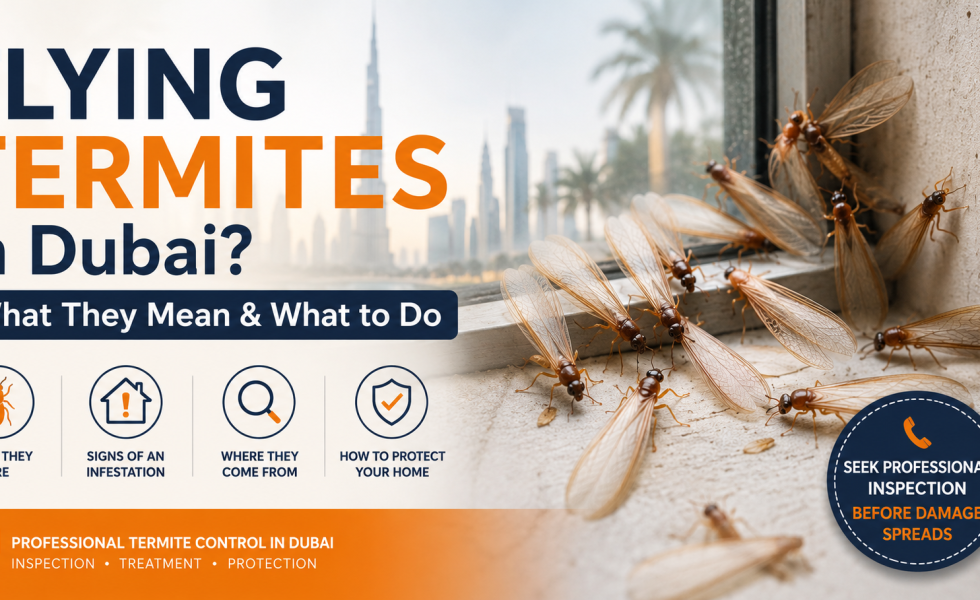
Flying Termites in Dubai? What They Mean & What to Do?
Flying Termites in Dubai? What They Mean & What to Do
Seeing flying termites in Dubai can be alarming, particularly when they suddenly appear around windows, lights, balconies, or inside your home.
But what does it actually mean?
Flying termites usually indicate that a mature termite colony exists somewhere nearby. If they are repeatedly appearing indoors or emerging from walls, wooden fixtures, floors, or other parts of the property, an active termite infestation may be present and should be professionally inspected.
Flying termites are the reproductive members of a termite colony. Their appearance is therefore different from seeing an occasional crawling insect that has simply entered your home.
This guide explains what flying termites are, why they appear, how to distinguish them from flying ants, whether they indicate an infestation, and when you should consider professional termite treatment in Dubai.
What Are Flying Termites?
Flying termites are reproductive termites known as alates or termite swarmers.
A termite colony contains different groups with specialised roles. Workers gather food, soldiers help defend the colony, while reproductive termites are responsible for establishing new colonies.
When an established colony reaches an appropriate stage and environmental conditions are favourable, winged reproductive termites leave the colony.
This event is known as swarming.
After leaving, the reproductive termites attempt to pair, shed their wings and find a suitable location where a new colony may potentially develop.
Therefore, finding flying termites around a property should not automatically be dismissed as ordinary seasonal insect activity.
Does Seeing Flying Termites Mean You Have Termites?
Not necessarily — but it is an important warning sign.
A few flying termites outdoors may have originated from a colony elsewhere in the surrounding environment.
However, the situation becomes more concerning when:
Flying termites repeatedly appear indoors
Large numbers suddenly emerge inside a room
They appear to come from walls or wooden fixtures
Discarded wings accumulate inside the property
Mud tubes are also present
Wooden fixtures show unexplained damage
Termites have previously been found on the property
In these situations, professional inspection is advisable.
The critical question is not simply whether flying termites are present.
It is where they are coming from.
Why Do Flying Termites Appear?
Termite swarming is part of the colony’s reproductive cycle.
When conditions are suitable, mature colonies release winged reproductive termites.
Factors such as temperature, humidity, rainfall, seasonality, and local environmental conditions can influence termite activity.
Swarming allows reproductive termites to leave an established colony and potentially create new colonies elsewhere.
This explains why they may suddenly appear in substantial numbers even when no termites were visible the previous day.
The colony itself may have existed unnoticed for considerably longer.
Why Are Flying Termites a Concern in Dubai?
Dubai contains numerous modern concrete buildings, but concrete construction does not make a property immune to termites.
Termites do not need to eat concrete.
Instead, they can exploit suitable cracks, construction joints, utility penetrations, soil interfaces, and other pathways to reach cellulose-containing materials.
Potentially vulnerable materials include:
Wooden doors
Door frames
Built-in wardrobes
Kitchen cabinets
Skirting
Decorative wood
Wooden flooring
Furniture
Outdoor timber
Wooden fencing
Villas can require particular attention because they generally have more direct interaction with soil, gardens, irrigation, and landscaping.
If flying termites appear around such a property, investigating their origin can help identify potential termite activity before more obvious damage develops.
Flying Termites vs Flying Ants: How to Tell the Difference
Flying termites are frequently confused with flying ants.
At a glance, the two can look similar. A closer examination reveals several differences.
Flying Termite Appearance
Flying termites generally have:
Relatively straight antennae
Broad, comparatively uniform waists
Two pairs of wings of approximately similar length
A relatively straight body profile
Flying Ant Appearance
Flying ants generally have:
Elbowed antennae
Clearly constricted waists
Front wings larger than the rear wings
A more segmented body profile
Correct identification matters.
Flying ants do not automatically indicate a termite problem, while termite swarmers can signal the presence of a mature termite colony nearby.
If you are uncertain, avoid making treatment decisions based solely on appearance. A pest control professional can identify the insect and determine whether further termite investigation is required.
Why Are Flying Termites Attracted to Lights?
Termite swarmers may gather around artificial light sources.
This is why homeowners often notice them around:
Windows
Balcony lights
Outdoor lighting
Glass doors
Entrance areas
Interior lights
A swarm can therefore become particularly noticeable during the evening.
Finding insects around a light does not reveal where the colony is located.
The termites may have travelled from elsewhere, or they may have emerged from somewhere within or close to the property.
The location and frequency of the activity provide important clues.
What Does It Mean If Flying Termites Are Inside Your House?
Flying termites outdoors and flying termites emerging inside a property should be considered differently.
If a substantial number suddenly appears inside a closed room, there may be a termite colony or concealed termite activity within or close to the structure.
Pay particular attention if swarmers appear around:
Wooden door frames
Skirting
Wall openings
Built-in cabinets
Windows
Utility penetrations
Floor edges
Look for additional evidence rather than focusing solely on the flying insects.
Mud tubes, discarded wings, hollow wood, damaged timber, or visible worker termites can strengthen the indication that active termite infestation is present.
What Do Discarded Termite Wings Mean?
After swarming, reproductive termites shed their wings.
You may therefore discover piles of small, translucent wings around:
Windowsills
Doors
Balconies
Floors
Light fixtures
Wooden structures
Discarded wings can be one of the most useful clues that termite swarming has occurred.
Finding them indoors repeatedly is particularly noteworthy.
Do not simply sweep them away.
Take note of where they were found and check the surrounding area for other evidence of termite activity.
7 Signs Flying Termites Could Indicate an Infestation
Flying termites become more concerning when they appear alongside other termite warning signs.
1. Repeated Indoor Swarms
A single outdoor swarm does not prove that your house contains a termite colony.
Repeated swarming inside the property requires more attention.
If flying termites continue appearing from the same room or structural area, arrange an inspection.
2. Mud Tubes
Subterranean termites construct protective mud tubes that can appear as narrow brown lines along walls and other surfaces.
Check:
Ground-level walls
Foundations
Skirting
Pipe penetrations
Garden walls
Utility areas
Active mud tubes combined with flying termites are a strong reason to seek professional termite control in Dubai.
3. Hollow-Sounding Wood
Termites can consume timber internally while leaving the external surface partially intact.
Affected wood may therefore sound unusually hollow when gently tapped.
Door frames, cabinets, skirting, and other wooden components deserve particular attention.
4. Discarded Wings
Finding numerous similarly sized wings near windows or wooden fixtures can indicate recent termite swarming.
Recurring wing accumulation indoors should not be ignored.
5. Visible White Ants
Termites are sometimes called white ants because workers can be pale or creamy in appearance.
If pale insects are discovered inside damaged timber or mud tubes, active termite activity may be present.
6. Damaged Wooden Fixtures
Unexplained deterioration in doors, cabinets, wardrobes, skirting, or decorative wood can indicate termite activity.
Look for blistering, hollow areas, weakened surfaces, or internal galleries.
7. Termites Emerging From a Structural Area
This is one of the clearest reasons for immediate investigation.
If winged termites appear to be emerging directly from a wall, floor edge, wooden frame, or structural opening, document the location and arrange a professional termite inspection.
Are Flying Termites Dangerous?
Flying termites are primarily a property concern, rather than insects that typically attack people.
Their significance comes from what their presence can indicate.
A swarm may signal that a mature termite colony exists nearby.
Termites feed on cellulose-containing material. If a colony gains access to susceptible materials within a property, continued activity can result in damage over time.
The flying insects themselves are therefore not usually the central problem.
The colony they may represent is.
Can Flying Termites Damage Furniture?
Flying termites themselves are reproductive members searching for suitable locations.
Worker termites are responsible for most feeding activity within an established colony.
If a termite colony gains access to wooden materials, potentially susceptible items can include:
Furniture
Wardrobes
Cabinets
Door frames
Wooden flooring
Skirting
Decorative timber
Shelving
Finding flying termites around furniture does not automatically prove the furniture is infested.
The surrounding area should be inspected for additional evidence.
Where Do Flying Termites Come From?
The answer depends on the termite species and property conditions.
For subterranean termites, colonies are typically associated with soil.
Workers can travel from underground colonies through protected pathways to reach suitable food sources.
Flying reproductive termites are then produced by mature colonies and released during swarming.
Potential termite access routes around a building can include:
Foundation gaps
Construction joints
Utility penetrations
Pipe openings
Soil-contact areas
Structural cracks
Landscaping adjacent to buildings
This is why killing flying termites alone does not solve an underlying infestation.
The colony may be located somewhere entirely different.
What Should You Do If You See Flying Termites?
Do not panic, but do not ignore them.
Take the following steps.
Step 1: Identify Where They Are Appearing
Determine whether the termites are:
Outside the property
Around windows
Inside one particular room
Emerging from wood
Emerging from walls or floor edges
This information can be valuable during a professional inspection.
Step 2: Take a Photo
Photograph the insects before removing them.
Close-up images can help distinguish flying termites from flying ants.
Step 3: Look for Discarded Wings
Check windowsills, floors, balconies, and nearby surfaces.
Large numbers of shed wings can provide additional evidence of swarming.
Step 4: Check for Other Termite Signs
Look for:
Mud tubes
Hollow wood
Damaged wooden fixtures
Visible worker termites
Unusual surface deterioration
Avoid unnecessarily breaking apart structural materials while inspecting.
Step 5: Arrange a Professional Inspection When Activity Is Suspicious
If termites repeatedly appear indoors, emerge from structural areas, or occur alongside other warning signs, professional inspection is recommended.
The objective should be to identify the source rather than simply remove the flying insects.
What Should You NOT Do When You Find Flying Termites?
One common mistake is immediately spraying every visible termite and assuming the problem is solved.
The swarmers may die.
The colony may remain completely unaffected.
Avoid:
Relying solely on aerosol sprays
Breaking open suspected termite pathways unnecessarily
Removing evidence before documenting it
Assuming termites disappeared because the swarm stopped
Ignoring repeated discarded wings
Treating only visibly damaged furniture
Termite management requires investigation beyond the insects visible at the surface.
Do Flying Termites Go Away on Their Own?
A termite swarm itself is usually temporary.
That does not mean the underlying termite problem has disappeared.
This distinction is extremely important.
You might see dozens of flying termites one evening and none the following morning.
The mature colony responsible for producing them may still exist.
Therefore:
The disappearance of flying termites does not necessarily mean the disappearance of termites.
If the swarm occurred indoors or other termite signs are present, the property should still be investigated.
Can Flying Termites Start a New Colony in Your House?
That is the biological purpose of termite swarming.
Reproductive termites leave mature colonies, pair and search for conditions suitable for establishing new colonies.
However, not every pair successfully creates a colony.
Survival depends on the termite species and environmental conditions.
Rather than attempting to determine whether individual swarmers have successfully established themselves, property owners should focus on the more immediate question:
Why are flying termites appearing around the property in the first place?
How Does Professional Termite Inspection Help?
Professional inspection aims to determine whether the swarm is associated with active termite infestation and identify potential areas of concern.
A technician may examine:
Areas where swarmers appeared
Discarded wings
Mud tubes
Damaged timber
Door frames
Cabinets
Skirting
Soil-contact areas
Gardens
Utility penetrations
Plumbing areas
Previous termite damage
The inspection can then inform whether termite treatment in Dubai is necessary and what type of treatment may be appropriate.
How Are Termites Treated?
The appropriate method depends on the property, termite species, infestation, construction, and whether treatment is preventive or corrective.
Professional termite management can include different approaches.
Soil Treatment
For suitable situations, approved termiticide may be applied to soil areas to create a treated zone intended to reduce termite access to the structure.
Targeted Treatment
Areas showing active infestation may require targeted treatment as part of a broader termite management strategy.
Termite Baiting
Certain termite management programmes can incorporate strategically positioned bait systems.
Pre-Construction Anti Termite Treatment
For new buildings, preventive treatment can be incorporated during construction while soil and foundation areas remain accessible.
The appropriate anti termite treatment in Dubai should be selected according to the specific property rather than assuming one method is suitable for every infestation.
Flying Termites in Dubai Villas
Villa owners should pay particular attention to termite swarms.
Villas generally have greater interaction with soil and landscaping than upper-floor apartments.
Potential risk areas can include:
Gardens
Irrigation areas
Ground-floor walls
Garages
Wooden fencing
Pergolas
Door frames
External storage areas
Utility entry points
If flying termites repeatedly appear around a villa, both the internal and external environments should be assessed.
What About Flying Termites in Dubai Apartments?
Flying termites can also appear in apartments.
Their presence does not automatically mean the colony is directly beneath the individual unit.
Termite activity can involve concealed building pathways, structural areas, wooden interiors, or other parts of a property.
Ground-floor units may warrant particular attention where soil-associated termites are involved.
If multiple units experience termite activity, building management may also need to investigate common areas.
How Can You Reduce the Risk of Termite Infestation?
No practical home-maintenance strategy can guarantee that termites will never appear, but several measures can reduce favourable conditions and make early detection easier.
Control Moisture
Repair leaking pipes, drainage problems, and persistent dampness.
Reduce Wood-to-Soil Contact
Avoid unnecessary direct contact between untreated timber and soil where practical.
Remove Timber Debris
Do not allow unused wood, cardboard, and other cellulose-rich debris to accumulate around the building perimeter.
Inspect Wooden Fixtures
Periodically check door frames, cabinets, skirting, and other timber for unexplained deterioration.
Monitor External Areas
Villa owners should inspect ground-level walls and landscaping areas for mud tubes and other suspicious activity.
Investigate Swarms
Do not automatically dismiss flying termites as harmless seasonal insects.
Knowing where they originated can be important.
When Do Flying Termites Require Professional Termite Treatment?
A swarm does not automatically determine the treatment required.
Professional assessment becomes particularly important when:
Flying termites repeatedly appear indoors
Termites emerge from walls or wooden fixtures
Mud tubes are present
Live worker termites are discovered
Wooden fixtures show damage
Large quantities of discarded wings appear indoors
The property has a previous termite history
Inspection should come before treatment.
Once the type and extent of activity are understood, an appropriate termite pest control strategy can be recommended.
Professional Termite Control in Dubai
Finding flying termites can be unsettling, but the most important action is determining where they came from.
Alpha Arabian Pest Management & Cleaning Company provides professional termite control in Dubai, including termite inspection and treatment solutions for residential and commercial properties.
Services can be provided for:
Villas
Apartments
Offices
Warehouses
Shops
Restaurants
Commercial properties
Existing buildings
New construction projects
If flying termites are repeatedly appearing around your property, professional inspection can help determine whether an active infestation exists and whether termite treatment in Dubai is required.
Frequently Asked Questions About Flying Termites in Dubai
What does it mean when you see flying termites?
Flying termites are reproductive members of a mature termite colony. Their presence means a colony exists somewhere in the surrounding environment, although it does not automatically prove that the colony is inside your property.
Do flying termites mean my house is infested?
Not always. Flying termites outdoors may originate elsewhere. However, repeated indoor swarms, termites emerging from structural areas, mud tubes, discarded wings, or damaged wood can indicate an infestation that requires professional investigation.
Why are flying termites suddenly appearing in my house?
A mature termite colony can release reproductive termites when environmental conditions are suitable. If large numbers suddenly appear indoors, the source may be within or close to the building.
Are flying termites the same as flying ants?
No. Termites generally have straighter antennae, broader waists, and approximately equal-sized wings. Flying ants typically have elbowed antennae, narrow waists, and unequal wing pairs.
Why do flying termites lose their wings?
After swarming, reproductive termites shed their wings as part of the process associated with pairing and attempting to establish new colonies.
Should I worry about discarded termite wings?
Repeated piles of similar-sized wings indoors can indicate recent termite swarming and should be investigated, especially if other termite signs are present.
Should I spray flying termites?
Killing visible flying termites does not necessarily affect the colony that produced them. If the activity is occurring indoors, identifying the source is more important than simply spraying the swarmers.
Will flying termites disappear on their own?
The swarm itself usually ends, but the underlying colony may remain. The absence of flying termites the following day does not prove that termite activity has stopped.
Are flying termites dangerous to humans?
Flying termites are primarily a property concern. Their significance is that they can indicate a mature termite colony and potential risk to susceptible wooden or cellulose-containing materials.
Can flying termites damage furniture?
The reproductive swarmers themselves are not responsible for most termite feeding damage. Worker termites within established colonies can damage susceptible wooden furniture and fixtures.
What should I do if flying termites are coming from a wall?
Document the location, avoid unnecessarily disturbing the area, and arrange a professional termite inspection. Termites emerging directly from a structural area can indicate concealed activity.
How do I get rid of flying termites in Dubai?
The appropriate solution depends on where the termites originate. Removing visible swarmers does not control an underlying colony. A professional inspection can determine whether termite treatment is necessary.
How much does termite treatment cost in Dubai?
Cost varies according to property size, construction, infestation extent, affected areas, and treatment method. An inspection is generally required before an accurate quotation can be provided.
Flying Termites in Dubai? Don’t Ignore the Warning
A termite swarm may last only a short time.
The colony behind it can be a very different story.
If flying termites in Dubai repeatedly appear inside your home, if you find discarded wings, or if the swarm occurs alongside mud tubes or damaged wood, investigate the source rather than simply removing the insects.
Early identification can help determine whether there is an active termite infestation and whether professional treatment is required.
For professional termite control and termite treatment in Dubai, contact Alpha Arabian Pest Management & Cleaning Company to arrange a property inspection.

10 Signs of Termites in Your House: Termite Treatment Dubai
Termites in House? 10 Signs You Need Termite Treatment in Dubai
Termites are among the most discreet pests that can enter a property. Unlike cockroaches or ants, they can remain hidden for long periods while feeding on wood and other cellulose-containing materials.
That is what makes a termite infestation particularly concerning.
You may not see termites crawling around your home every day. Instead, the first warning could be a thin mud tube on a wall, a wooden door frame that suddenly feels hollow, or a collection of discarded wings near a window.
For homeowners who discover possible termites in house, recognising these warning signs early can help determine when professional termite treatment in Dubai is needed.
Here are 10 important signs of termite activity and what you should do if you notice them.
Why Are Termites a Concern for Dubai Properties?
Many buildings in Dubai are constructed primarily from concrete, which can create the impression that termites are unlikely to be a problem.
But termites do not need to consume concrete.
They can exploit tiny gaps, construction joints, pipe penetrations and other openings to reach materials containing cellulose.
Inside a property, susceptible materials can include:
Wooden doors and frames
Kitchen cabinets
Built-in wardrobes
Skirting
Wooden flooring
Decorative timber
Furniture
False-ceiling components
Wooden fencing and outdoor structures
Villas can have additional exposure because of gardens, landscaping and greater contact between the building and surrounding soil.
Once termites establish concealed access to a food source, their activity may remain unnoticed until visible signs or damage begin to appear.
Professional termite control in Dubai therefore focuses not only on visible termites but also on identifying how and where they are accessing the property.
What Are Termites?
Termites are social insects that live in organised colonies.
A colony can contain workers, soldiers and reproductive members, each performing different functions.
Worker termites are responsible for gathering food. Their diet primarily consists of cellulose, an organic compound present in wood, paper and many plant-derived materials.
Depending on the species, termite colonies may be established underground or within suitable wooden material.
This is an important point.
The few termites you might discover inside damaged timber are not necessarily the entire problem. They may simply be workers connected to a much larger concealed colony.
Are White Ants Actually Termites?
The phrase white ants is commonly used to describe termites.
However, termites are not ants.
Worker termites are usually pale or creamy white, which explains the informal name. Their appearance can cause homeowners to mistake them for unusual ants.
There are several differences.
Termites generally have relatively straight antennae and broad waists. Ants typically have elbowed antennae and distinctly narrow waists.
Winged termites and flying ants can also be confused with one another.
Correct identification is important because ordinary ant treatment is not an appropriate substitute for professional termite management.
If you notice pale insects emerging from wooden fixtures, soil or mud-like structures, arrange an inspection rather than assuming they are harmless ants.
10 Signs You May Need Termite Treatment in Dubai
1. Mud Tubes on Walls
Mud tubes are among the most recognisable signs associated with subterranean termites.
They may appear as narrow brown or soil-like lines running along:
Walls
Foundations
Skirting
Concrete surfaces
Pipe openings
Garden walls
Utility penetrations
Subterranean termites construct these protective passages from soil and other materials.
The tubes help maintain a suitable microenvironment while allowing termites to travel between their colony and a food source.
If you find a suspicious mud tube, simply removing it does not address the underlying problem.
There may still be active termites elsewhere.
This is a strong reason to consider a professional termite inspection in Dubai.
2. Wood Sounds Hollow When Tapped
Termites can consume wood internally while leaving part of the external surface relatively intact.
As a result, timber can appear normal at first glance even though its internal structure has been compromised.
One potential warning is a hollow or papery sound when the wood is gently tapped.
Check areas such as:
Door frames
Wooden skirting
Built-in cabinets
Wardrobes
Decorative panels
Staircase components
In more advanced cases, affected timber may become fragile, blistered or unusually easy to damage.
Hollow wood alone does not prove termite activity, but unexplained deterioration should not be ignored.
3. Flying Termites Inside or Around Your House
Flying termites, known as alates or swarmers, are reproductive members of a termite colony.
When environmental conditions are suitable, they leave established colonies to mate and potentially form new colonies.
They may gather around:
Windows
Doors
Balconies
Outdoor lights
Garden areas
Other illuminated locations
Seeing one winged insect does not automatically mean your property has an active infestation.
However, repeated sightings or a significant swarm can indicate a mature termite colony somewhere nearby.
If flying termites are emerging from inside the property itself, professional investigation becomes particularly important.
4. Discarded Wings Near Windows or Doors
After swarming, reproductive termites shed their wings.
You may therefore discover small piles of translucent wings around:
Windowsills
Door frames
Balconies
Light sources
Floor edges
These wings can easily be mistaken for ordinary insect debris and swept away.
Take a closer look first.
A recurring accumulation of similar-sized wings can be evidence of termite reproductive activity.
If you cannot identify the insects responsible, a professional termite pest control inspection can help determine whether termites are present.
5. Wooden Doors or Windows Suddenly Start Sticking
A door becoming difficult to close is not automatically a termite problem.
Dubai’s temperature, humidity, normal wear, alignment problems and moisture can all affect wooden doors and frames.
However, termite damage can sometimes contribute to structural changes in timber.
Pay attention when a previously functional door or window suddenly begins sticking and there is no obvious explanation.
Inspect the surrounding wood for additional warning signs such as:
Hollow sections
Cracks
Blistering
Mud tubes
Surface deterioration
Multiple symptoms occurring together provide a stronger reason for professional assessment.
6. Bubbling or Cracked Paint
Termites can sometimes create irregularities underneath finished wooden or wall surfaces.
This may result in paint that appears:
Bubbling
Cracked
Raised
Uneven
Distorted
Unfortunately, water damage can produce very similar symptoms.
Do not immediately assume that every patch of bubbling paint indicates a termite infestation.
Instead, check for accompanying evidence.
Mud tubes, hollow wood, visible insects or unusual deterioration around the same area can make termite activity more plausible.
A professional inspection can help differentiate pest damage from moisture or maintenance problems.
7. Small Droppings or Frass Near Wood
Some termite species produce small faecal pellets known as frass.
They can resemble tiny grains, coarse dust or sawdust and may accumulate beneath affected timber.
If you repeatedly clean a small pile of material and it reappears in the same location, inspect the wooden structure above it.
Look for tiny openings or unusual surface changes.
Do not automatically assume that sawdust-like material is caused by termites, however. Other wood-damaging insects and ordinary deterioration can produce similar evidence.
Correct pest identification should come before treatment.
8. Wooden Furniture or Fixtures Show Unexplained Damage
A termite infestation does not necessarily remain confined to one door frame.
Depending on the species and circumstances, susceptible wooden fixtures and furniture may also be affected.
Look carefully at:
Wardrobes
Kitchen cabinets
Wooden shelving
Bed frames
Wooden flooring
Skirting
Decorative wood
Door frames
Signs may include weakened surfaces, internal galleries, blistering or unexplained deterioration.
Replacing one damaged piece of furniture may not solve the underlying problem if active termites are still accessing the property.
The source needs to be identified.
9. Clicking or Faint Noises From Wood
Termites are not completely silent.
Soldier termites can produce vibrations or tapping sounds when their colony is disturbed. In certain circumstances, activity inside heavily affected wood may also be faintly perceptible.
These sounds are usually subtle.
You should not rely on sound alone to diagnose a termite problem.
However, faint noises coming from wood that also appears hollow, damaged or otherwise suspicious provide another reason to investigate.
10. You Can Actually See Termites or White Ants
The most obvious sign is finding the insects themselves.
Worker termites are generally pale, soft-bodied and vulnerable to exposure. They normally remain inside protected environments.
You might see them when:
Damaged wood breaks open
A mud tube is disturbed
Soil around an active area is moved
An affected wooden fixture is removed
If you discover insects resembling white ants inside timber, do not simply spray the exposed insects and assume the problem has been solved.
The visible termites may represent only a tiny part of a much larger colony.
This is when professional termite treatment in Dubai becomes particularly important.
Where Should You Check for Termites in Your House?
Knowing where to look can help with early detection.
In Dubai properties, pay particular attention to:
Door Frames
Ground-floor wooden door frames can be vulnerable, especially where termite access exists from surrounding soil or structural openings.
Kitchen Cabinets
Built-in cabinetry provides substantial cellulose material and may conceal activity behind finished surfaces.
Wardrobes
Check the lower portions of fitted wardrobes, particularly where they meet walls and floors.
Wooden Skirting
Inspect for unusual deterioration, hollow areas or mud tubes.
Under Staircases
Dark, relatively undisturbed spaces can conceal pest activity.
Gardens and External Walls
Villa owners should inspect areas where landscaping meets the building.
Garages and Storage Areas
Stored cardboard, timber and other cellulose materials can create additional food sources.
Utility and Plumbing Areas
Small gaps around pipes and building services can provide concealed access routes.
What Are Subterranean Termites?
Subterranean termites live primarily underground and travel from their colonies to suitable food sources.
This makes them particularly difficult for homeowners to detect.
The colony may not be inside the damaged wooden door you discover.
Workers could be travelling from the soil through concealed pathways before reaching that particular fixture.
This distinction matters when choosing anti termite treatment in Dubai.
Treating only the visibly damaged piece of wood may fail to address the underlying route or colony responsible for the activity.
A professional assessment should therefore consider both the visible damage and the wider property environment.
How Do Termites Get Into Dubai Houses?
Termites can exploit remarkably small structural vulnerabilities.
Potential entry routes include:
Foundation cracks
Construction joints
Gaps around pipes
Utility penetrations
Areas where timber contacts soil
Landscaping close to the building
Structural gaps
Existing termite pathways
Properties do not need to be old to experience termite problems.
New buildings can also become vulnerable when preventive termite protection is inadequate or access routes develop.
Are Termites Dangerous to People?
Termites are primarily a property pest rather than a pest known for attacking occupants.
The principal concern is the material they consume.
Over time, persistent activity can damage susceptible wooden components and other cellulose-containing materials.
This is why termite management should focus on protecting the property and controlling the infestation rather than simply eliminating insects that become visible.
Why DIY Termite Treatment Often Doesn’t Solve the Problem
Imagine finding termites inside a wooden door frame.
You spray the area.
The exposed insects die.
The next question is more important:
Where did they come from?
If the termites are connected to a concealed underground colony, spraying the visible area may do very little to control the wider infestation.
DIY treatment can therefore create a false sense of resolution.
Professional termite pest control in Dubai is designed to investigate the infestation, identify likely access routes and determine an appropriate treatment method for the property.
What Happens During a Professional Termite Inspection?
The first step should be assessment.
A termite technician may examine:
Visible termite activity
Mud tubes
Damaged timber
Ground-contact areas
Plumbing penetrations
External walls
Gardens
Wooden fixtures
Potential moisture issues
Previous treatment areas
The objective is to understand the extent and characteristics of the problem before recommending treatment.
Not every suspicious mark requires the same response.
Accurate diagnosis prevents unnecessary or poorly targeted treatment.
Types of Termite Treatment in Dubai
The appropriate treatment depends on whether termites are already active, the construction of the property and the areas involved.
Soil Treatment
Professional termiticides may be applied to appropriate soil areas to create a treated zone intended to reduce termite access.
The exact procedure depends on the building and treatment programme.
Targeted Termite Treatment
Where specific areas show activity, targeted treatment may be incorporated into the overall control strategy.
This should not be confused with simply spraying visible termites.
The treatment needs to consider how the insects are reaching the affected area.
Termite Baiting Systems
Some professional termite management programmes use baiting systems positioned strategically around or within appropriate areas of a property.
Termites encounter the bait during their normal foraging activity.
Whether baiting is suitable depends on the circumstances.
Anti Termite Treatment During Construction
Preventive anti termite treatment in Dubai can also be carried out during certain stages of construction.
Pre-construction treatment provides access to soil and foundation areas that can become difficult to reach after the building is completed.
This can form part of a broader termite prevention strategy for new properties.
Pre-Construction vs Post-Construction Termite Treatment
Pre-construction treatment takes place while the building is being constructed and focuses primarily on prevention.
Post-construction termite treatment is performed after construction has been completed.
It may be required when:
Active termites are discovered
A property has an established infestation
Preventive protection is being considered for an existing building
The treatment procedure can differ substantially between these situations.
A professional termite control provider should recommend an approach based on the individual property rather than applying a generic treatment plan.
How to Reduce the Risk of Termites in Your House
Professional treatment is important when an active infestation is present, but property maintenance can also help reduce termite risk.
Reduce Wood-to-Soil Contact
Where practical, avoid leaving untreated timber directly against soil.
This includes timber stored around gardens and building perimeters.
Fix Moisture Problems
Repair leaking pipes, drainage issues and persistent dampness.
Moisture does not automatically cause termites, but damp environments can create more favourable conditions for certain termite activity.
Remove Wood and Cardboard Debris
Avoid accumulating timber, cardboard and other cellulose-rich material immediately around the building.
Inspect Wooden Fixtures Periodically
Pay attention to door frames, skirting, cabinets and other vulnerable areas.
Early detection is considerably easier when you know what normal timber should look and feel like.
Monitor the Property Perimeter
Villa owners should periodically inspect external walls, landscaping areas and ground-level entry points for mud tubes or unusual activity.
Do Not Ignore Flying Termites
A termite swarm can be an early warning.
Rather than simply removing the insects, investigate why they are appearing and whether they are emerging from within the property.
Termite Control in Dubai Villas
Villas can present particular termite-control challenges because of their extensive contact with soil and landscaping.
Potential risk areas include:
Gardens
Boundary walls
Ground-floor door frames
Pergolas
Wooden fencing
Garages
External storage
Irrigation areas
Utility penetrations
Professional termite control in Dubai for villas should therefore consider both internal and external conditions.
Finding damaged wood inside the villa does not necessarily mean the source is located in the same room.
What About Termites in Apartments?
Apartment buildings can also experience termite problems.
Ground-floor units may have greater exposure to soil-associated activity, but termite pathways can sometimes extend beyond immediately obvious locations.
Wooden interiors, fitted cabinets and decorative materials can all be vulnerable.
Where termite activity appears to involve common structural areas, coordination with building management may be necessary.
When Should You Arrange Termite Treatment in Dubai?
Do not wait for extensive damage before taking action.
Consider arranging an inspection if you notice:
Live termites
Mud tubes
Flying termites indoors
Repeated piles of discarded wings
Hollow wooden fixtures
Unexplained timber damage
Suspected termite galleries
White ants emerging from wood
Recurring activity after previous treatment
One ambiguous symptom does not always prove an infestation.
Several warning signs together substantially increase the need for professional assessment.
Why Early Termite Detection Matters
Termites are effective precisely because they remain concealed.
By the time extensive surface damage becomes obvious, activity may have been occurring for considerably longer.
Early detection provides an opportunity to investigate before additional wooden components are affected.
This can be particularly important in Dubai properties containing expensive fitted wardrobes, kitchen cabinetry, decorative timber and custom interiors.
Waiting rarely improves a termite problem.
Investigation does.
Professional Termite Treatment in Dubai with Alpha Arabian
If you suspect termites in your house, the priority should be determining whether an active infestation is present and where the termites are coming from.
Alpha Arabian Pest Management & Cleaning Company provides professional termite treatment in Dubai for residential and commercial properties.
Termite management solutions are available for:
Villas
Apartments
Offices
Shops
Warehouses
Restaurants
Commercial properties
Existing buildings
New construction projects
The treatment approach is selected according to the property, evidence of termite activity and areas requiring attention.
Rather than repeatedly treating the termites you can see, the objective is to identify the infestation and implement an appropriate termite control strategy.
Conclusion
Termites can be difficult to detect, but they usually leave clues.
Mud tubes, hollow timber, flying termites, discarded wings, unusual wooden damage and visible white ants can all indicate that closer inspection is necessary.
Do not panic when you find one suspicious sign.
But do not ignore it either.
If you believe there are termites in your house, early professional assessment can help determine whether an active termite infestation is present.
The sooner the source is identified, the sooner an appropriate termite treatment in Dubai can be planned to protect the property from further damage.
Contact Alpha Arabian Pest Management & Cleaning Company for professional termite inspection, termite control and anti termite treatment in Dubai.
Frequently Asked Questions
What are the most common signs of termites in a house?
Common signs include mud tubes, hollow or damaged wood, flying termites, discarded wings, visible termites, frass and unexplained deterioration of wooden fixtures.
Are white ants and termites the same?
White ants is an informal name commonly used for termites. Termites are not true ants, although pale worker termites can look similar at first glance.
What should I do if I find termites in my house?
Avoid disturbing the suspected infestation unnecessarily and arrange a professional inspection. The visible termites may represent only part of a larger concealed colony.
How do termites enter houses in Dubai?
Depending on the species, termites may access buildings through soil, foundation gaps, construction joints, utility penetrations, cracks and other concealed pathways.
Do flying termites mean there is an infestation?
Flying termites indicate reproductive termite activity nearby. Repeated swarms indoors or termites emerging from the structure should be professionally investigated.
Can termites damage a concrete building?
Termites do not normally eat concrete. However, they can use small gaps and penetrations in and around construction materials to reach wooden and cellulose-containing components.
What is anti termite treatment?
Anti termite treatment refers broadly to professional measures intended to prevent or control termite activity. The exact method can vary according to whether the building is under construction or already completed.
Is termite treatment necessary if I only see a few termites?
A few visible termites can be connected to a much larger concealed colony. An inspection can determine whether treatment is required and how extensive the activity is.
Can I treat termites myself?
DIY products may kill exposed termites without reaching the wider infestation. Where active termites are suspected, professional assessment is recommended before deciding on a control strategy.
How much does termite treatment cost in Dubai?
The cost of termite treatment in Dubai depends on factors such as property size, construction, infestation extent, treatment method and areas requiring treatment. An inspection is generally needed before an accurate quotation can be provided.
How can I prevent termites from coming back?
Reduce unnecessary wood-to-soil contact, address moisture and drainage issues, remove timber debris, inspect vulnerable wooden fixtures and follow the preventive recommendations provided after professional treatment.
When should I contact a termite control company in Dubai?
Arrange an inspection when you discover mud tubes, live termites, repeated flying termites, discarded wings or unexplained damage to wooden fixtures. Early investigation can help determine whether active treatment is required.
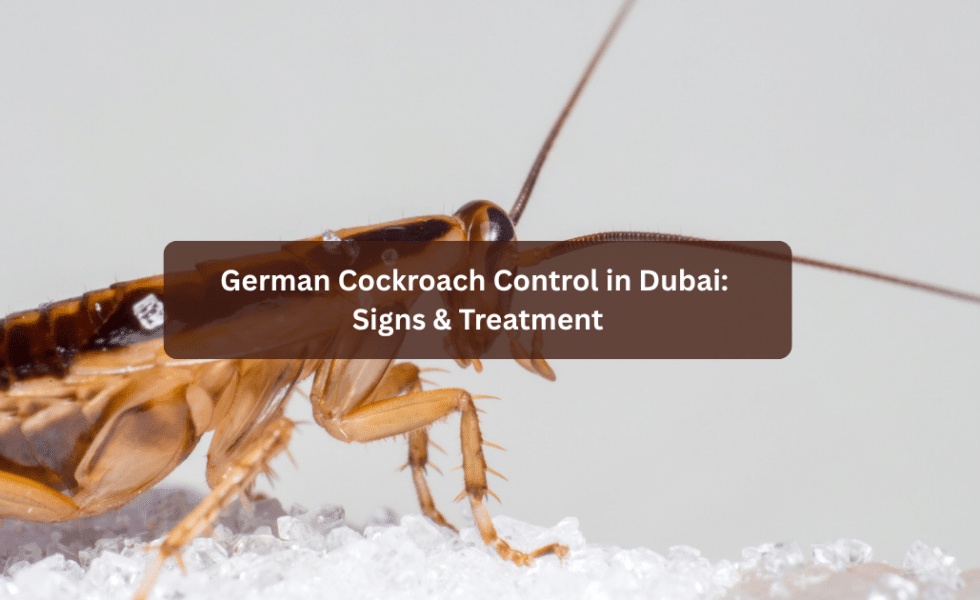
German Cockroach Infestation in Dubai Kitchens: Signs, Causes & Best Treatment
German Cockroach Infestation in Dubai Kitchens: Signs, Causes & Best Treatment
German cockroaches are small, fast, and exceptionally good at hiding. That combination makes them one of the most troublesome pests to deal with inside kitchens.
A few tiny cockroaches appearing near the sink at night can quickly turn into repeated sightings around cabinets, refrigerators, drawers, and kitchen appliances. More importantly, the cockroaches you see may represent only a fraction of the population concealed nearby.
In Dubai, kitchens provide many of the conditions German cockroaches need: warmth, food residue, moisture, narrow hiding spaces, and easy access to adjoining areas.
Effective German cockroach control in Dubai therefore requires more than spraying the insects you can see. The infestation needs to be located, its contributing conditions understood, and the appropriate treatment applied to areas where the cockroaches are actually living.
This guide explains how to identify a German cockroach infestation, why these pests are attracted to Dubai kitchens, where they hide, and what can be done to control them.
What Is a German Cockroach?
The German cockroach, scientifically known as Blattella germanica, is a relatively small cockroach species commonly associated with indoor environments.
Adults are usually light brown or tan and have two dark, approximately parallel stripes behind the head.
Unlike some larger cockroach species that are frequently associated with outdoor areas and drainage systems, German cockroaches are particularly well adapted to living close to people.
They favour areas that provide three essentials:
Food
Water
Warmth
A kitchen provides all three.
Once German cockroaches establish themselves inside a property, their rapid reproduction and cryptic behaviour can make the infestation challenging to eliminate without a systematic approach.
Why Are German Cockroaches a Problem in Dubai Kitchens?
Dubai’s external climate is warm, but the problem is not simply the outdoor temperature.
Kitchens create stable microenvironments throughout the year.
Areas behind refrigerators, ovens, dishwashers, coffee machines, and other appliances can remain warm while also providing access to crumbs, grease, and moisture.
German cockroaches can therefore find favourable conditions even in clean, air-conditioned properties.
Apartments introduce another complication.
Connected walls, utility lines, service areas, and neighbouring units can potentially allow pest activity to spread beyond a single kitchen.
For this reason, German cockroach infestation in Dubai kitchens should be addressed early rather than waiting until the population becomes obvious.
How to Identify a German Cockroach
Correct identification matters because not every cockroach problem should be approached in exactly the same way.
Adult German cockroaches are typically around 1.1 to 1.6 cm long. Their most recognisable characteristic is the pair of dark stripes running lengthwise on the area immediately behind the head.
Young German cockroaches, called nymphs, are smaller and darker.
Homeowners sometimes mistake them for other insects because of their tiny size.
If you repeatedly notice small cockroaches in kitchen cabinets or around appliances, particularly at night, German cockroaches may be responsible.
A professional pest inspection can confirm the species and determine how extensive the infestation is.
Common Signs of a German Cockroach Infestation
Finding a live cockroach is an obvious warning sign, but several other indicators can reveal an infestation.
1. Small Cockroaches in the Kitchen
Repeated sightings of small cockroaches are one of the clearest signs.
Pay particular attention at night.
Switch on the kitchen light suddenly and observe areas around the sink, countertop, refrigerator, and cabinets. German cockroaches are predominantly nocturnal and may quickly retreat into nearby cracks.
2. Cockroach Droppings
German cockroach droppings are small and dark and may resemble pepper-like specks.
They can accumulate around harbourage areas such as:
Cabinet corners
Drawers
Hinges
Appliances
Wall edges
Under sinks
Concentrated droppings can help indicate where cockroaches are spending significant amounts of time.
3. Egg Cases
German cockroaches produce egg cases known as oothecae.
Finding these around kitchen cabinets, appliances, or concealed areas indicates reproductive activity.
This should not be ignored.
An infestation involving reproducing females can increase considerably if the underlying population is not controlled.
4. Cockroach Nymphs
Seeing numerous tiny cockroaches can indicate that eggs have hatched nearby.
Nymph sightings are particularly important because they suggest the kitchen is not simply receiving occasional cockroaches from elsewhere. There may be an active breeding population within or close to the property.
5. Unusual Odour
Heavy cockroach infestations can sometimes produce a distinctive musty or unpleasant smell.
An odour alone is not enough to identify a cockroach problem, but when combined with droppings and live sightings, it can indicate substantial activity.
Why German Cockroaches Prefer Kitchens
German cockroaches are not attracted to kitchens because kitchens are necessarily dirty.
They are attracted because kitchens concentrate resources into a relatively small area.
A kitchen can provide food, water, heat, and shelter within just a few metres.
Even meticulous cleaning cannot remove every possible hiding location.
A tiny gap behind a cabinet combined with occasional food residue and moisture may be enough to support cockroach activity.
Where Do German Cockroaches Hide in a Kitchen?
Finding the harbourage is a critical part of successful German cockroach control in Dubai.
Common hiding locations include:
Behind Refrigerators
Refrigerators can provide warmth, darkness, and access to food particles underneath or behind the appliance.
The compressor area can be particularly attractive.
Kitchen Cabinets
Cockroaches can hide inside cabinet joints, corners, hinges, and narrow gaps between cabinets and walls.
The small dimensions of German cockroaches allow them to exploit spaces that homeowners rarely notice.
Under the Kitchen Sink
This area can provide moisture from plumbing, condensation, cleaning materials, or minor leaks.
It also contains numerous pipe penetrations and structural gaps.
Around Dishwashers
Heat, moisture, and food residue make the surrounding environment potentially attractive to cockroaches.
Cooking Appliances
Grease and food particles can accumulate behind or underneath ovens and cookers.
Regular surface cleaning does not necessarily reach these concealed areas.
Small Electrical Appliances
Severe infestations may extend into or around appliances such as coffee machines, microwaves, toasters, and other equipment.
Treatment around electrical equipment should be carried out carefully and appropriately.
What Causes German Cockroach Infestations in Dubai?
There is rarely a single cause.
Several factors can contribute simultaneously.
Food Residue and Grease
German cockroaches are opportunistic feeders.
They can survive on very small quantities of food.
Crumbs underneath a refrigerator, grease behind a cooker, food residue inside a cabinet, or unsealed ingredients may provide sufficient nourishment.
Regular cleaning should therefore extend beyond visible countertops.
Water and Hidden Moisture
Water availability can strongly influence cockroach survival.
Potential sources include:
Leaking pipes
Dripping taps
Wet sponges
Moisture underneath sinks
Condensation
Water around dishwashers
Damp cleaning cloths
Repairing leaks and reducing persistent moisture can make the environment less favourable.
Unsealed Cracks and Gaps
German cockroaches prefer narrow spaces.
Small openings around cabinets, countertops, skirting, plumbing, and utility lines can become harbourages.
They can spend much of the day hidden in these spaces before emerging at night to feed.
Cardboard Boxes and Deliveries
Cockroaches can occasionally be introduced into properties through boxes, packaging, used appliances, groceries, and other transported materials.
Restaurants and commercial kitchens receiving frequent deliveries can face an increased risk.
Inspecting incoming materials and avoiding unnecessary cardboard accumulation can therefore be useful preventive measures.
Neighbouring Apartments
In multi-unit residential buildings, the source may not be confined to your kitchen.
Cockroaches can potentially move between units through structural and utility connections.
If neighbouring apartments have established infestations, treating only one property may not fully address the wider problem.
Persistent building-wide activity should be reported to property management where appropriate.
Why German Cockroaches Multiply So Quickly
Rapid reproduction is one reason German cockroach infestations can become difficult to manage.
Females carry egg cases containing multiple developing offspring. Under favourable indoor conditions, successive generations can develop relatively quickly.
The practical implication is simple:
Do not wait for a small problem to become a large one.
A couple of cockroaches observed repeatedly around the same area may indicate more extensive concealed activity.
Early intervention can make control considerably easier.
Why Do German Cockroaches Appear Mostly at Night?
German cockroaches are predominantly nocturnal.
During the day, they typically remain concealed inside cracks, cabinets, appliance areas, and other protected spaces.
At night, they emerge to search for food and water.
This explains why someone may use a kitchen all day without seeing anything and then discover several cockroaches after entering the room late at night.
Frequent daytime sightings can be more concerning.
While daytime activity does not automatically indicate a severe infestation, it can occur when harbourages are disturbed or populations become crowded.
Why DIY Cockroach Sprays Often Fail
Aerosol spray can kill the cockroach directly in front of you.
But that cockroach may not be the real problem.
If dozens of insects are hiding behind cabinets or appliances, repeatedly spraying visible individuals will have limited impact on the underlying population.
Excessive spraying can also cause insects to disperse into alternative hiding places and may interfere with some bait-based treatment strategies.
Random application is therefore not the same as systematic cockroach control.
Why Spraying the Entire Kitchen Is Not Necessarily Better
More pesticide does not automatically mean better pest control.
Effective treatment should be targeted according to the infestation, product instructions, property conditions, and safety requirements.
Food preparation environments require particular care.
Professional pest management focuses on treating relevant harbourages and activity zones while selecting methods appropriate for the environment.
The objective is precision rather than indiscriminate chemical application.
Is Gel Treatment Effective for German Cockroaches?
Gel bait is commonly used as part of professional German cockroach management.
Small amounts are strategically placed in areas where cockroaches are likely to forage or harbour.
Cockroaches consume the bait and are exposed to its active ingredient.
However, gel treatment is not simply a matter of placing bait randomly around a kitchen.
Effectiveness can depend on:
Correct placement
Suitable bait selection
Competing food sources
Infestation severity
Previous insecticide use
Sanitation
Availability of moisture
For established infestations, gel bait may form one component of a broader treatment programme.
Gel vs Spray for German Cockroach Control
Homeowners often ask whether gel or spray is better.
The answer depends on the situation.
Gel bait can be particularly useful for concealed indoor infestations because it can be placed near harbourage and foraging areas without treating broad surfaces.
Targeted insecticide applications may also be appropriate in selected situations.
Rather than automatically choosing one method, a pest control technician should evaluate the infestation and determine the most suitable combination.
Why Professional Inspection Is Important
Successful German cockroach pest control in Dubai begins with finding where the population is concentrated.
A technician may inspect:
Cabinet hinges
Drawer runners
Sink areas
Refrigerators
Cooking appliances
Dishwashers
Plumbing openings
Countertop gaps
Food storage areas
Waste areas
Evidence such as droppings, egg cases, nymphs, and concentrated activity helps reveal harbourage zones.
Treatment can then be directed towards the actual infestation rather than simply the areas where homeowners happen to notice cockroaches.
What Happens During Professional German Cockroach Treatment?
The exact procedure depends on the property and infestation.
A professional approach may involve several stages.
Inspection
The affected kitchen and adjoining areas are assessed for activity, harbourages, food sources, moisture, and potential entry points.
Identification
Confirming the cockroach species helps determine an appropriate management strategy.
Targeted Treatment
Suitable baiting or other approved treatment methods may be applied to relevant locations based on the assessment.
Sanitation Recommendations
The technician may identify conditions that could reduce treatment effectiveness, such as grease accumulation, exposed food, waste, or moisture.
Monitoring
For significant infestations, monitoring can help determine whether activity is declining and identify remaining hotspots.
Follow-Up
Some infestations may require additional inspection or treatment, particularly where breeding populations are well established.
What Should You Do Before Cockroach Treatment?
Follow the specific preparation instructions provided by your pest control company.
Depending on the treatment, this may include:
Removing exposed food
Cleaning excessive grease
Emptying waste bins
Clearing unnecessary clutter
Providing access underneath sinks
Identifying areas where cockroaches are frequently seen
Do not carry out excessive DIY spraying immediately before professional treatment unless specifically advised.
Knowing what products were previously used can also help the technician plan the treatment.
What Should You Do After Treatment?
Aftercare is just as important.
Follow all instructions provided by the pest control technician.
In general:
Avoid disturbing bait placements.
Keep kitchen surfaces clean.
Store food properly.
Remove waste regularly.
Repair water leaks.
Monitor previously affected areas.
Avoid unnecessary insecticide spraying.
If activity persists, contact the pest control provider rather than repeatedly applying different household products.
How to Prevent German Cockroaches in Dubai Kitchens
Prevention is an ongoing process.
Keep Food Sealed
Store rice, flour, cereals, sugar, snacks, and other foods in suitable sealed containers.
Do not rely solely on loosely folded packaging.
Clean Under Appliances
Move accessible appliances periodically and clean food debris and grease underneath them.
These hidden spaces are frequently overlooked.
Empty Bins Regularly
Kitchen waste provides a concentrated food source.
Use suitable bins and avoid allowing food waste to accumulate unnecessarily.
Repair Plumbing Leaks
Inspect the area underneath the sink and around appliances for persistent moisture.
Even a small leak deserves attention.
Reduce Clutter
Unnecessary cardboard, packaging, and stored items create additional hiding places.
Keep storage areas organised.
Seal Suitable Gaps
Once active infestations are under control, appropriate gaps around cabinets, plumbing, and structural penetrations can be sealed to reduce future harbourage opportunities.
German Cockroach Control in Dubai Apartments
Apartment infestations require special attention because of the possibility of migration between units.
If cockroaches repeatedly return despite proper treatment and sanitation, possible building-level sources should be considered.
These can include:
Adjacent apartments
Shared utility spaces
Service shafts
Waste areas
Plumbing connections
Residents experiencing repeated infestations may need to coordinate with building management, particularly when multiple units are affected.
German Cockroaches in Restaurants and Commercial Kitchens
German cockroaches are a serious concern for food businesses.
Restaurants, cafés, hotels, catering facilities, bakeries, and commercial kitchens contain numerous warm appliances and receive frequent food deliveries.
The environment can therefore support infestations if monitoring and sanitation are inadequate.
Commercial kitchens should pay particular attention to:
Cooking equipment
Refrigerators
Food storage
Dishwashing stations
Drains
Waste areas
Delivery zones
Cardboard storage
Waiting until customers or staff regularly see cockroaches is not a suitable pest management strategy.
Regular inspection and monitoring can help detect activity earlier.
Why Cockroaches May Return After Treatment
Seeing some cockroach activity after treatment does not necessarily mean the entire programme has failed.
Possible reasons include:
Previously hidden cockroaches emerging
Egg cases hatching
Untreated harbourages
Continued access to food
Persistent moisture
Migration from another area
A substantial original population
What matters is the trend.
Activity should be monitored, and persistent infestations should be reassessed so that the treatment strategy can be adjusted where necessary.
When Is Follow-Up Treatment Necessary?
Follow-up may be appropriate when there is an established breeding population or when activity remains after the initial treatment period.
It allows the technician to evaluate:
Whether cockroach numbers have decreased
Where activity remains concentrated
Whether nymphs are emerging
Whether sanitation issues persist
Whether additional harbourages have been identified
Whether cockroaches may be entering from elsewhere
This is particularly valuable for substantial German cockroach infestations.
When Should You Call a Cockroach Control Company?
Consider professional German cockroach control in Dubai if you notice:
Small cockroaches almost every night
Cockroaches inside kitchen cabinets
Numerous nymphs
Egg cases
Droppings around appliances
Daytime cockroach activity
Cockroaches returning after DIY treatment
Activity spreading to additional rooms
Early action is preferable to waiting.
German cockroaches can reproduce quickly when conditions are favourable, allowing a localised kitchen infestation to become more difficult to control.
Professional German Cockroach Control in Dubai
A persistent German cockroach infestation is rarely solved by killing one insect at a time.
The harbourage needs to be found. Food and water sources need to be reduced. Appropriate treatment needs to reach the locations where cockroaches are actually active.
Alpha Arabian Pest Management & Cleaning Company provides professional cockroach control services for residential and commercial properties across Dubai.
Services can be provided for:
Apartments
Villas
Restaurants
Cafés
Offices
Shops
Commercial kitchens
Warehouses
Other residential and commercial properties
If tiny cockroaches continue appearing around your kitchen despite cleaning and DIY products, an inspection can help determine whether an established German cockroach infestation is present.
Conclusion
German cockroaches are successful indoor pests because they need very little space to survive.
A warm appliance, a narrow cabinet gap, a few crumbs, and a small amount of moisture may be enough to support them.
Their rapid reproduction makes early detection especially important.
Effective German cockroach control in Dubai therefore requires a combination of inspection, appropriate treatment, sanitation, moisture reduction, monitoring, and prevention.
Do not focus only on the cockroaches running across the countertop.
The real infestation is usually hiding somewhere else.
Contact Alpha Arabian Pest Management & Cleaning Company for professional German cockroach control in Dubai and arrange an inspection of your property.
Frequently Asked Questions
What causes German cockroaches in Dubai kitchens?
German cockroaches are attracted to environments providing food, moisture, warmth, and shelter. They may also be introduced through packaging or migrate from other areas of a building.
How do I know if I have German cockroaches?
Look for small tan or brown cockroaches with two dark stripes behind the head. Other signs include tiny droppings, egg cases, nymphs, and repeated nighttime activity around kitchen appliances.
Why are there tiny cockroaches in my kitchen?
Tiny cockroaches may be German cockroach nymphs. Seeing several can indicate that an active breeding population exists nearby.
Where do German cockroaches hide?
They commonly hide around refrigerators, cabinets, sinks, dishwashers, cooking appliances, cracks, plumbing penetrations, and other warm, narrow spaces.
Is cockroach gel effective against German cockroaches?
Gel bait can be an effective component of German cockroach management when correctly selected and placed. Results also depend on sanitation, competing food sources, infestation severity, and other conditions.
Can German cockroaches come from neighbouring apartments?
Yes. In multi-unit buildings, cockroaches may potentially move through utility openings, service shafts, wall cavities, and other structural connections.
Why do German cockroaches come back after treatment?
Possible causes include surviving insects, egg cases hatching, untreated harbourages, food and moisture availability, or migration from another part of the building.
Can cleaning alone remove a German cockroach infestation?
Cleaning is an important part of control but may not eliminate an established infestation because cockroaches and egg cases can remain concealed in inaccessible areas.
Are German cockroaches only found in dirty kitchens?
No. Even well-maintained kitchens can experience infestations. Hygiene affects food availability, but cockroaches can also be introduced through packaging or migrate from neighbouring areas.
When should I arrange professional cockroach treatment?
Professional inspection should be considered when cockroaches are repeatedly seen, nymphs or egg cases are present, activity occurs during the day, or DIY treatment provides only temporary results.
Cockroach Control in Dubai: Why They Return After Treatment
Cockroach Control in Dubai: Why Cockroaches Keep Coming Back After Treatment
You arrange pest control, the cockroaches disappear, and everything seems fine.
Then, several days or weeks later, you walk into the kitchen at night and spot another cockroach disappearing underneath a cabinet.
For many Dubai residents, this is an all-too-familiar situation.
Recurring cockroach activity does not necessarily mean that nothing was achieved during the previous treatment. Cockroaches are exceptionally resilient pests. Their reproductive behaviour, cryptic hiding places, access to moisture, and ability to move through buildings can make an established infestation difficult to eliminate with a single intervention.
Effective cockroach control in Dubai therefore involves much more than killing visible insects. The source of the infestation needs to be identified, harbourage areas treated, entry points addressed, and conditions supporting the population reduced.
Understanding why cockroaches return is the first step towards achieving better long-term control.
Why Cockroach Control in Dubai Can Be Challenging
Dubai provides cockroaches with several environmental advantages.
Warm temperatures allow them to remain active for much of the year, while modern buildings provide abundant shelter, food, water, and interconnected utility systems.
Inside a property, cockroaches can establish themselves in surprisingly inconspicuous locations.
They may hide:
Behind kitchen cabinets
Under refrigerators
Around dishwashers
Inside wall voids
Near drainage systems
Under sinks
Around plumbing lines
Behind electrical appliances
Inside cupboards
Around garbage areas
This behaviour makes cockroach control in Dubai a process of locating and treating the infestation rather than simply dealing with the insects that happen to be visible.
Dubai’s Climate Creates Favourable Conditions for Cockroaches
Cockroaches generally thrive in warm environments.
Dubai’s climate, combined with temperature-controlled indoor spaces, creates conditions where cockroach populations can remain active throughout the year.
Air-conditioned buildings do not necessarily prevent infestations. Kitchens, bathrooms, utility rooms, drainage areas, and spaces behind appliances can still provide warm microenvironments.
Humidity and water availability are equally important.
A small leak underneath a kitchen sink may seem insignificant to a homeowner, but to a cockroach colony it can provide a dependable source of hydration.
This combination of warmth, shelter, food, and moisture helps explain why cockroach infestations can become persistent.
Common Cockroach Species Found in Dubai Properties
Different cockroach species exhibit different behaviours, so identifying the pest can influence the treatment strategy.
German Cockroaches
German cockroaches are small and commonly associated with kitchens, restaurants, food preparation areas, and appliances.
They reproduce rapidly and prefer warm environments close to food and moisture.
They may establish harbourages around:
Refrigerators
Kitchen cabinets
Coffee machines
Dishwashers
Cooking equipment
Sinks
Food storage areas
Because they spend much of their time concealed, a substantial infestation may exist before the problem becomes obvious.
American Cockroaches
American cockroaches are considerably larger.
They are often associated with drains, sewage systems, basements, service areas, utility spaces, and other humid environments.
When large cockroaches repeatedly appear in bathrooms or around floor drains, investigating drainage and plumbing access points can be particularly important.
Why Cockroaches Come Back After Treatment
There is rarely one universal reason.
Recurring cockroach problems usually involve a combination of factors.
The initial treatment may have reduced the population without reaching every harbourage. Eggs may subsequently hatch. Food or moisture may remain available. Alternatively, cockroaches may simply re-enter from another part of the building.
Identifying which scenario applies is critical.
Otherwise, homeowners can become trapped in a repetitive cycle:
See cockroach → spray cockroach → activity disappears → cockroaches return → spray again.
Breaking that cycle requires addressing the infestation systematically.
The Original Infestation Was Not Completely Eliminated
Cockroaches are remarkably adept at concealment.
A kitchen that appears relatively cockroach-free during the daytime may contain numerous insects hidden behind cabinetry, appliances, wall gaps, or plumbing installations.
This is why treating only visible surfaces can be inadequate.
Professional cockroach pest control in Dubai should focus on the locations where cockroaches are actually harbouring and travelling.
If those areas remain untreated, surviving insects can continue reproducing.
The population then gradually becomes noticeable again.
Cockroach Eggs Can Survive the Initial Treatment
Cockroach reproduction is another major factor.
Female cockroaches produce protective egg cases known as oothecae. These structures contain developing offspring and can provide a degree of protection from environmental conditions.
Depending on the species and treatment approach, some egg cases may remain unaffected during the initial intervention.
Later, nymphs emerge.
Suddenly, tiny cockroaches begin appearing around cabinets and appliances.
Homeowners may assume that cockroaches have returned from outside when the young insects actually originated from egg cases already present inside the property.
For established infestations, monitoring after treatment can therefore be important.
Hidden Cockroach Harbourages Are Easy to Miss
Cockroaches exhibit thigmotactic behaviour, meaning they prefer tight spaces where their bodies remain in contact with surrounding surfaces.
Consequently, narrow cracks are highly attractive.
Common harbourages include:
Cabinet hinges
Gaps behind countertops
Cracks around skirting
Appliance motors
Pipe penetrations
Wall cavities
Loose tiles
Cupboard corners
Electrical equipment
These locations are easy to overlook during casual cleaning.
An experienced pest control inspection concentrates heavily on these cryptic harbourages.
Food Sources Continue to Support the Infestation
Cockroaches are opportunistic feeders.
They do not require large quantities of food.
Tiny accumulations of grease, crumbs, food residue, organic waste, and even pet food can sustain them.
Particular attention should be given to spaces underneath:
Refrigerators
Cookers
Microwaves
Cabinets
Dining furniture
Food preparation equipment
Dry foods should also be stored in properly sealed containers.
Treatment becomes considerably more effective when cockroaches have fewer alternative food sources available.
Water and Moisture Can Keep Cockroaches Alive
Food receives most of the attention, but moisture can be equally important.
Potential water sources include:
Leaking taps
Condensation
Wet sinks
Pipe leaks
Damp cleaning materials
Water underneath appliances
Bathroom moisture
Floor drains
A persistent infestation underneath a sink should therefore prompt more than pest treatment.
The plumbing should also be inspected.
Eliminating unnecessary moisture makes the environment substantially less hospitable to cockroaches.
Cockroaches May Enter Through Drains
Drain-associated cockroach activity is particularly relevant in densely developed urban environments.
Floor drains can provide pathways between internal spaces and broader drainage infrastructure.
Bathrooms, kitchens, balconies, laundry areas, and utility rooms should therefore be monitored carefully.
Regular drain maintenance can help.
However, repeatedly pouring household chemicals into drains is not a substitute for determining where cockroach activity is originating.
When large cockroaches frequently emerge around drainage areas, a professional assessment can help identify the likely access route.
Plumbing and Utility Openings Create Hidden Entry Points
Pipes rarely pass through walls with perfectly sealed edges.
Small openings can remain around:
Water pipes
Drainage pipes
Electrical conduits
Air-conditioning lines
Utility connections
These openings effectively create miniature corridors between rooms or neighbouring areas.
Sealing appropriate gaps after an infestation has been controlled can reduce the likelihood of future intrusion.
Cockroaches Can Migrate Between Dubai Apartments
Apartment infestations can be particularly challenging because an individual unit is not an isolated ecosystem.
Neighbouring apartments may share:
Plumbing systems
Service shafts
Drainage infrastructure
Wall cavities
Utility routes
Common corridors
Cockroaches can exploit these connections.
Consequently, a meticulously clean apartment can still experience cockroach activity if a substantial infestation exists nearby.
Where multiple units report similar problems, broader building pest management may be required.
Garbage Rooms and Common Areas Can Contribute to Infestations
Waste management areas provide an obvious combination of food, moisture, and shelter.
If garbage rooms are poorly maintained, cockroach populations can establish themselves and subsequently spread to nearby parts of the building.
Good building-level pest management should therefore consider:
Garbage rooms
Waste chutes
Service corridors
Drainage areas
Utility rooms
Common kitchens
Storage areas
Treating individual apartments without addressing heavily infested common areas may result in repeated reinvasion.
Why DIY Cockroach Sprays Often Provide Only Temporary Relief
Aerosol insecticides provide immediate gratification.
You see a cockroach, spray it, and the insect dies.
Unfortunately, the visible cockroach may represent only a tiny fraction of the infestation.
Spraying exposed insects does little if dozens more are concealed behind a kitchen installation.
Indiscriminate spraying can also interfere with certain baiting strategies and cause cockroaches to disperse into alternative hiding locations.
DIY products can have a role when used according to their labels, but recurring or extensive infestations generally require a more structured approach.
How Incorrect Use of Insecticides Can Complicate Control
Using more insecticide does not automatically produce better results.
Excessive or poorly targeted applications can create unnecessary chemical exposure without addressing the infestation’s core harbourages.
Cockroach populations may also display varying degrees of resistance to particular active ingredients.
Professional pest management therefore considers factors such as:
Species
Infestation level
Harbourage location
Previous treatments
Property type
Sanitation
Moisture
Appropriate application methods
Precision is often more useful than saturation.
Why Professional Cockroach Inspection Matters
A thorough inspection is one of the most important components of successful cockroach control in Dubai.
The objective is to determine why cockroaches are present.
A technician may inspect areas around:
Kitchen appliances
Cabinets
Sinks
Bathrooms
Drains
Plumbing
Waste storage
Utility spaces
Food preparation areas
Evidence such as droppings, egg cases, live insects, harbourage patterns, and activity hotspots can help determine the severity of the problem.
Treatment can then be directed towards the areas where it is most likely to be effective.
Cockroach Gel Treatment and Targeted Pest Management
Gel bait is commonly incorporated into cockroach management programmes, particularly for indoor infestations.
Small placements can be made in strategic locations where cockroaches are likely to travel or harbour.
The goal is not to cover the property with gel.
Placement matters.
Depending on the infestation, professional treatment may combine several approaches, including targeted baiting, monitoring, sanitation recommendations, exclusion measures, and appropriate insecticide applications.
An integrated approach generally provides better long-term results than relying on a single technique.
Signs That a Cockroach Infestation Is Still Active
Seeing live cockroaches is the most obvious indication, but there are other warning signs.
Look for:
Cockroach droppings
Egg cases
Small nymphs
Repeated nighttime sightings
Cockroaches around kitchen appliances
Activity around sinks
Cockroaches emerging from drains
Unusual musty odours
Frequent daytime sightings deserve particular attention.
Cockroaches are predominantly nocturnal. Seeing several during daylight hours can sometimes indicate substantial population pressure or disturbed harbourages.
How to Prevent Cockroaches From Returning After Treatment
Professional treatment should be supported by preventive measures.
Cockroach management works best when the property becomes less attractive and less accessible to the pests.
Improve Kitchen Hygiene
Clean food preparation surfaces regularly.
Pay particular attention to grease and food particles underneath appliances and inside difficult-to-access spaces.
Avoid leaving dirty dishes overnight where practical.
Food should be stored in sealed containers.
Remove Water Sources
Repair dripping taps and leaking pipes.
Dry excessive moisture around sinks and bathroom areas.
Check underneath kitchen cabinets periodically for hidden leaks.
Even minor water sources can sustain cockroaches.
Seal Cracks and Entry Points
Inspect openings around:
Pipes
Cabinets
Skirting
Doors
Utility connections
Appropriate sealing can reduce both harbourage opportunities and possible migration routes.
Maintain Drains
Keep drainage areas clean and properly maintained.
If cockroaches repeatedly appear around a particular drain, investigate rather than continuously treating the visible insects.
The source may lie elsewhere in the drainage system.
Monitor High-Risk Areas
Pay attention to kitchens and bathrooms after treatment.
Sticky monitoring traps may sometimes be used by pest management professionals to determine whether activity continues and where cockroaches are concentrated.
Early detection makes an emerging infestation easier to manage.
Cockroach Control for Dubai Apartments
Apartment cockroach control requires consideration of the wider building environment.
An infestation may originate within the apartment, but it can also be associated with neighbouring units, drainage infrastructure, garbage areas, or service shafts.
Professional treatment should therefore consider both internal harbourages and potential migration routes.
Residents should also report recurring building-wide activity to property management where appropriate.
Cockroach Control for Villas
Villas present a different set of challenges.
Potential entry points may include:
External drains
Garden areas
Utility rooms
Garages
Doors
Pipe penetrations
Outdoor waste areas
Cockroach management in villas may therefore involve both indoor treatment and inspection of external conditions contributing to pest activity.
Cockroach Control for Restaurants and Commercial Properties
Cockroaches are particularly problematic in food-related businesses.
Even limited activity can affect hygiene, reputation, customer confidence, and operational standards.
Restaurants, cafés, commercial kitchens, supermarkets, warehouses, and food preparation facilities should maintain structured pest management programmes rather than waiting for an infestation to become visible.
Regular monitoring is particularly valuable.
Potential risk areas include:
Cooking equipment
Food storage
Drainage
Waste areas
Dishwashing stations
Refrigeration equipment
Delivery zones
Commercial pest management should be adapted to the operational environment.
When Follow-Up Cockroach Treatment May Be Necessary
One treatment is not always sufficient for an established infestation.
Follow-up may be recommended when:
The infestation was severe
German cockroaches are present
Egg cases remain
New nymphs appear
Multiple harbourages exist
Nearby properties remain infested
Commercial food operations are involved
Follow-up inspections also allow technicians to evaluate whether the original activity has decreased.
Treatment can then be adjusted based on what is observed rather than repeated indiscriminately.
When to Call a Professional Cockroach Control Company in Dubai
Professional assistance should be considered when cockroach sightings become frequent or DIY measures repeatedly fail.
Warning signs include:
Cockroaches appearing every day
Numerous small cockroaches in the kitchen
Daytime sightings
Egg cases
Droppings inside cabinets
Cockroaches inside appliances
Persistent activity around drains
Repeated infestations following DIY spraying
Early intervention is preferable.
Once a cockroach population becomes established across multiple harbourages, control can become more complicated.
Professional Cockroach Control in Dubai with Alpha Arabian
Recurring cockroach activity often indicates that something is being missed.
It may be an inaccessible harbourage. It could be an unnoticed plumbing leak, surviving egg cases, a drainage pathway, or infestation elsewhere in the building.
Alpha Arabian Pest Management & Cleaning Company provides professional cockroach control in Dubai for residential and commercial properties.
The approach focuses on identifying infestation hotspots, assessing potential contributing factors, and selecting suitable pest management methods for the property.
Services are available for:
Apartments
Villas
Offices
Restaurants
Cafés
Shops
Warehouses
Commercial kitchens
Other residential and commercial properties
Conclusion
Cockroaches do not keep returning because they are impossible to control.
They return when the conditions that support them remain available or when parts of the infestation survive.
Successful cockroach control in Dubai therefore requires more than killing visible cockroaches. Harbourages, eggs, food sources, moisture, drains, plumbing gaps, and possible migration routes all need consideration.
Cleaning helps. Treatment helps. Exclusion helps.
The strongest results usually come from combining them.
If cockroaches continue appearing despite repeated DIY treatments, arranging a professional inspection can help identify the source of the problem and determine an appropriate treatment strategy.
Contact Alpha Arabian Pest Management & Cleaning Company to arrange professional cockroach control services in Dubai.
Frequently Asked Questions
Why do cockroaches keep coming back after pest control?
Cockroaches can reappear when some insects or egg cases survive treatment, hidden harbourages remain untreated, or new cockroaches enter through drains, plumbing gaps, service shafts, or neighbouring properties.
Why am I seeing small cockroaches after treatment?
Small cockroaches may be newly emerged nymphs from egg cases that were already present before treatment. Continued activity should be monitored and reported to the pest control provider if it persists.
Can cockroaches come from neighbouring apartments?
Yes. Cockroaches can potentially move between apartments through plumbing routes, wall cavities, service shafts, utility openings, and other connected building infrastructure.
Can cockroaches enter through drains in Dubai?
Drainage systems can provide potential pathways, particularly for species associated with humid environments. Frequent sightings around floor drains should be investigated.
Is gel treatment effective for cockroaches?
Gel bait can be an effective component of cockroach management when the correct product is placed appropriately. Its effectiveness depends on infestation conditions, placement, sanitation, competing food sources, and other factors.
Does a clean house still get cockroaches?
Yes. Good hygiene reduces food sources but cannot prevent every infestation. Cockroaches can enter clean properties through drains, plumbing, deliveries, neighbouring units, or structural openings.
How often should cockroach pest control be done in Dubai?
There is no universal schedule for every property. Treatment frequency depends on the property type, infestation history, environmental conditions, and pest pressure. Commercial food establishments may require more frequent monitoring than low-risk residential properties.
What should I do after cockroach treatment?
Follow the pest control provider’s specific instructions. In general, maintain good sanitation, remove unnecessary moisture, avoid disturbing bait placements, manage waste properly, and monitor areas where cockroaches were previously active.
Why do I see cockroaches mostly at night?
Cockroaches are primarily nocturnal and usually leave their harbourages when the environment is quiet and dark to search for food and water.
When should I contact Alpha Arabian for cockroach control?
If cockroaches are appearing repeatedly, DIY methods provide only temporary relief, or you notice nymphs, egg cases, droppings, or frequent activity around kitchens and drains, a professional inspection can help determine the source and appropriate treatment.
How to Get Rid of Drain Flies in Dubai Bathrooms Permanently (2026 Guide)
How to Get Rid of Drain Flies in Dubai Bathrooms Permanently (2026 Guide)
Have you noticed tiny black flies hovering around your bathroom sink, shower drain, or kitchen sink? These aren’t fruit flies—they’re most likely drain flies, one of the most common household pests in Dubai.
Although drain flies don’t bite or sting, they can quickly become a nuisance if left untreated. Their presence often indicates organic buildup inside drains, making them a sign that your plumbing system needs attention.
The good news is that with the right approach, drain flies can be eliminated permanently.
In this guide, we’ll explain why Drain Flies Dubai infestations occur, how to identify them, what treatments work best, and how professional pest control can help keep your home fly-free.
What Are Drain Flies?
Drain flies, also known as moth flies, sewer flies, or filter flies, are tiny insects that breed in moist environments rich in organic matter.
Adult drain flies typically measure only 2–5 mm in length and have fuzzy wings that resemble tiny moths.
Unlike mosquitoes, they are poor flyers and usually stay close to their breeding sites.
You may commonly spot them around:
- Bathroom drains
- Kitchen sinks
- Floor drains
- Utility rooms
- Laundry areas
- Air conditioning drainage points
- Basement drains
Why Are Drain Flies Common in Dubai?
Dubai’s warm climate combined with constant indoor plumbing creates ideal breeding conditions for drain flies.
Several factors contribute to infestations:
Moisture
Drain flies require damp environments to reproduce.
Organic Buildup
Soap residue, hair, grease, food particles, and bacteria accumulate inside drain pipes, providing food for larvae.
Warm Temperatures
Dubai’s climate allows insects to breed throughout much of the year.
Infrequently Used Drains
Guest bathrooms and unused floor drains often become breeding grounds because stagnant water and debris collect over time.
Signs You Have Drain Flies
Early detection makes treatment much easier.
Common signs include:
- Tiny flies hovering near bathroom sinks
- Small insects around shower drains
- Flies appearing after turning on bathroom lights
- Increased activity around floor drains
- Clusters of insects resting on walls near drains
- Recurring flies despite using air fresheners or insect sprays
If these signs continue for several days, the infestation is likely originating inside your drainage system.
Drain Flies vs Fruit Flies: How to Tell the Difference
Many homeowners mistake drain flies for fruit flies.
Here’s how to identify them:
| Drain Flies | Fruit Flies |
|---|---|
| Fuzzy wings | Smooth wings |
| Moth-like appearance | Small tan or brown flies |
| Stay near drains | Stay near fruits and food |
| Weak flyers | Fast flyers |
| Breed in drains | Breed on decaying fruits |
Correct identification is essential because each pest requires a different treatment method.
Where Do Drain Flies Breed?
The real problem isn’t the adult flies—it’s the larvae hidden inside the drain.
Common breeding locations include:
- Bathroom sink drains
- Shower drains
- Kitchen sinks
- Floor drains
- Sewer pipe connections
- Condensate drain lines
- Utility sinks
- Septic systems
Larvae feed on the slimy organic film lining the inside of pipes.
Unless this breeding material is removed, new flies will continue emerging.
DIY Methods to Get Rid of Drain Flies
Small infestations can often be managed by improving drain hygiene.
Clean the Drain Thoroughly
Remove hair, soap scum, and organic buildup using a drain brush.
Cleaning the inner walls of the pipe is more effective than simply pouring chemicals down the drain.
Flush with Hot Water
Regularly flushing drains with hot water can help reduce grease and residue.
Use Enzyme-Based Drain Cleaners
Enzyme cleaners help break down organic matter that serves as food for drain fly larvae.
Always follow the manufacturer’s instructions.
Fix Plumbing Leaks
Leaking pipes create moisture that encourages breeding.
Repairing leaks helps reduce suitable breeding conditions.
Keep Drains Dry When Possible
Unused bathrooms should be flushed periodically to prevent stagnant water.
Common Mistakes That Make the Problem Worse
Many homeowners unintentionally allow infestations to continue by relying on temporary solutions.
Avoid these common mistakes:
Spraying Adult Flies Only
Killing adult flies doesn’t eliminate the larvae developing inside the drain.
Ignoring Hidden Drains
Utility rooms, floor drains, and AC drainage systems are often overlooked.
Using Excessive Chemicals
Strong chemicals may damage plumbing while failing to remove the organic buildup where larvae develop.
Delaying Treatment
A small infestation can quickly grow if breeding sites remain untreated.
When Should You Call Professional Pest Control?
You should consider professional assistance if:
- Drain flies return after cleaning.
- Multiple drains are affected.
- Infestations continue for several weeks.
- Commercial kitchens or restaurants are affected.
- The source cannot be located.
Professional technicians inspect the drainage system to identify breeding sites and recommend the most effective treatment plan.
How Alpha Arabian Controls Drain Flies in Dubai
At Alpha Arabian Pest Management, we understand that simply killing visible flies isn’t enough.
Our drain fly control service focuses on identifying and addressing the source of the infestation.
Our process includes:
- Detailed inspection
- Identification of breeding areas
- Professional treatment recommendations
- Drain sanitation guidance
- Preventive advice
- Follow-up inspections when required
Whether you’re dealing with drain flies in a villa, apartment, office, restaurant, or commercial property, our experienced team provides effective and reliable pest management solutions.
Tips to Prevent Drain Flies
Preventing drain flies is much easier than eliminating a large infestation.
Follow these simple habits:
- Clean drains regularly.
- Remove hair from shower drains.
- Avoid pouring grease into kitchen sinks.
- Repair leaking pipes promptly.
- Flush unused drains periodically.
- Keep bathrooms well ventilated.
- Schedule routine pest inspections.
Consistent maintenance significantly reduces the risk of future infestations.
Why Choose Alpha Arabian Pest Management?
Homeowners and businesses across Dubai trust Alpha Arabian because we provide:
✔ Dubai Municipality Approved Services
✔ Experienced Pest Control Technicians
✔ Safe & Effective Pest Management
✔ Residential & Commercial Solutions
✔ Fast Response Across Dubai
✔ Preventive Pest Control Programs
Our goal is not only to eliminate current pest problems but also to help prevent them from returning.
Final Thoughts
Drain flies may be small, but they often indicate a larger hygiene or drainage issue.
While DIY cleaning can help with minor infestations, persistent drain flies usually require a more thorough inspection to identify hidden breeding sites.
By combining proper drain maintenance, moisture control, and professional pest management when necessary, homeowners can keep their bathrooms and kitchens free from drain flies throughout the year.
If drain flies continue returning despite your efforts, a professional inspection can help identify the root cause and provide a long-term solution.
Frequently Asked Questions
Are drain flies harmful?
Drain flies are not known to bite humans, but they can become a nuisance and may indicate organic buildup inside drains that should be addressed.
Why do drain flies keep coming back?
Recurring infestations usually occur because larvae continue developing inside drains where organic matter has not been completely removed.
Can drain flies live in clean bathrooms?
Yes. Even clean bathrooms can develop drain flies if organic buildup exists inside plumbing pipes or unused drains.
How long does it take to eliminate drain flies?
Small infestations may improve within a few days after cleaning, while larger infestations can take longer depending on the extent of breeding inside the drainage system.
Should I call professional pest control for drain flies?
If drain flies continue returning despite cleaning and maintenance, a professional inspection can identify hidden breeding areas and recommend appropriate treatment.